Exams / CLF-C02 / D4 Security and Compliance
Security and Compliance #1: Shared responsibility, The shared responsibility pattern bank
- Exam domain: Content Domain 2: Security and Compliance
This first pass of the Security domain is dominated by one idea tested from a dozen angles: the AWS shared responsibility model. It also covers the small set of named security services this exam expects you to tell apart (Secrets Manager, Shield, WAF, Inspector, Security Hub, Trusted Advisor, CloudTrail), IAM basics (users vs. roles, the root user, least privilege), and where AWS CAF's Security perspective fits.
Shared responsibility: the line moves with how managed the service is
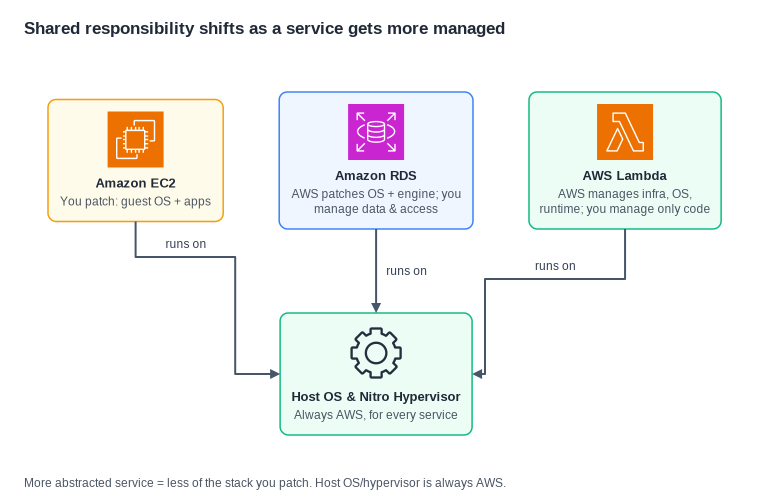
The exam's baseline split is: AWS secures "of the cloud" (the physical infrastructure — hardware, software, networking, and facilities that run every AWS service), and the customer secures "in the cloud" (their own data, applications, and access configuration). "AWS is responsible for protecting the infrastructure that runs all of the services offered in the AWS Cloud", and that infrastructure "is composed of the hardware, software, networking, and facilities that run AWS Cloud services."
What this pass adds is the detail of where exactly the line sits per service:
| Service | AWS manages | Customer manages |
|---|---|---|
| Amazon EC2 | Host OS, the hypervisor (e.g. the Nitro Hypervisor), physical hardware | Guest OS (patches/updates), installed software, security-group config, data/encryption |
| Amazon RDS | Underlying infrastructure + database engine patching | Data, access control, maintenance-window scheduling |
| AWS Lambda / Amazon S3 / DynamoDB | Infrastructure, OS, and (for Lambda) the runtime | Only their code (Lambda) or their data/access policies (S3, DynamoDB) |
Quotes that pin this down: "Customers that deploy an Amazon EC2 instance are responsible for management of the guest operating system (including updates and security patches), any application software or utilities installed by the customer on the instances, and the configuration of the AWS-provided firewall (called a security group) on each instance." For Lambda: "When using Lambda, you are responsible only for your code" — AWS runs it "on a high-availability compute infrastructure and manages all the computing resources." For RDS: "Amazon RDS manages backups, software patching, automatic failure detection, and" other DB-administration tasks, which is why RDS does not appear as a customer-patching answer the way EC2 does.
Configuration management is the one shared control the exam calls out by name: "AWS maintains the configuration of its infrastructure devices, but a customer is responsible for configuring their own guest operating systems, databases, and applications." Physical/environmental security, by contrast, is 100% AWS; IAM and data-integrity authentication are 100% customer.
Named security services: one job each
| Service | What it actually does | Exam-trap keyword |
|---|---|---|
| AWS Secrets Manager | Stores credentials (DB passwords, API keys, OAuth tokens) and can automatically rotate them on a schedule, including a native RDS/Aurora/Redshift/DocumentDB integration | "rotate", "automate credential management" |
| AWS Shield | DDoS protection with always-on detection and automatic inline mitigation | "DDoS", "always-on" |
| AWS WAF | Inspects HTTP(S) requests and blocks SQL injection and cross-site scripting (and other app-layer attacks); attaches to CloudFront, ALB, API Gateway | "malicious web requests", "SQL injection", "XSS" |
| Amazon Inspector | Continuously scans EC2, ECR images, and Lambda for software vulnerabilities and unintended network exposure | "vulnerability", "network exposure" |
| AWS Security Hub | Aggregates and normalizes findings from AWS services and partner products into the AWS Security Finding Format (ASFF) — this is its CSPM feature | "aggregate", "standardized format", "CSPM" |
| AWS Trusted Advisor | Runs best-practice checks, including dedicated security-group checks like "Specific Ports Unrestricted" | "unrestricted port/access" |
| AWS CloudTrail | Records every API call and console action in an account; browsable via Event history (90 days) or a trail | "audit API calls", "who did this" |
| AWS Customer Carbon Footprint Tool | Tracks/visualizes/forecasts the carbon emissions generated by your AWS usage | "carbon", "sustainability" |
Secrets Manager, Shield, WAF, and Inspector are the four services most often confused with each other: Secrets Manager is about credentials, Shield is about DDoS at the network/transport layer, WAF is about malicious HTTP(S) content (SQLi, XSS) at the application layer, and Inspector is about finding vulnerabilities (it doesn't block anything, unlike Shield/WAF).
IAM: users, roles, and the root user
- IAM user = long-term credentials for one person (or a single application) — "An IAM user is an identity with specific permissions for a single person or application." Create a user specifically when issuing AWS access credentials to an individual.
- IAM role = temporary credentials, assumed by — "IAM roles are useful for federated user access, temporary IAM user permissions, cross-account access, cross-service access, and applications running on Amazon EC2" — i.e. EC2 workloads, mobile apps, and anyone federating in from a corporate directory should get a role, not a user.
- Least privilege = granting "the minimum permissions required for their specific job functions" — nothing more than a task needs.
- The root user's access keys can only be managed by the root user itself — "Some tasks can only be performed when you sign in as the root user of an account." No IAM user or role, however permissioned, can create, view, or delete root access keys; best practice is in fact "Don't create access keys for the root user" at all.
AWS CAF: zooming into the Security perspective
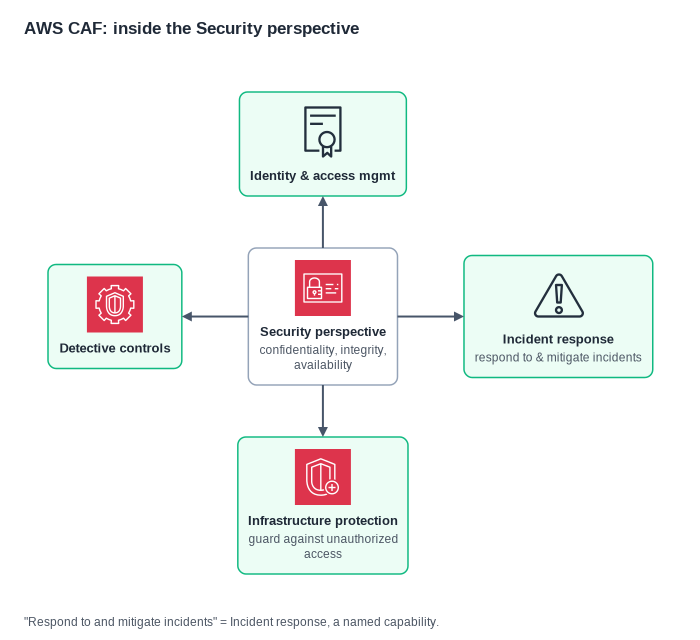
AWS CAF's six perspectives split into business-oriented (Business, People, Governance) and technology-oriented (Platform, Security, Operations) groups. The Security perspective itself helps an organization "achieve the confidentiality, integrity, and availability of your data and cloud workloads", and breaks down into named capabilities — the two tested here are:
- Incident response — establishing mechanisms to respond to and mitigate security incidents.
- Infrastructure protection — protecting systems and services from unintended or unauthorized access and from vulnerabilities.
Watch for distractor capability names that sound plausible but aren't the official CAF term: "Observability" and "Availability and continuity" are not named Security-perspective capabilities, and "Incident and problem management" is ITIL language, not AWS CAF's "Incident response."
Exam traps
- The abstraction gradient: EC2 (you patch the guest OS): RDS (AWS patches the OS/engine, you manage data) → Lambda/S3/DynamoDB (AWS manages almost everything, you manage code/data). The host OS and hypervisor (Nitro) are always AWS's job, on every service.
- "Security of the cloud" = AWS's infrastructure. "Security in the cloud" = the customer's data and configuration. A question asking what "security of the cloud" means is testing this definition, not asking about service availability.
- Configuration management is the textbook example of a shared control — don't file it under "AWS-only" or "customer-only."
- Secrets Manager vs. KMS vs. CloudHSM: Secrets Manager stores/rotates credentials; KMS manages encryption keys; CloudHSM gives dedicated cryptographic hardware. "Automate credential rotation" always points to Secrets Manager.
- Shield = DDoS, WAF = malicious HTTP content (SQLi/XSS), Inspector = vulnerability scanning (no blocking), Security Hub = aggregates everyone else's findings into one standardized format.
- IAM user → an individual's long-term credentials. IAM role → temporary credentials for EC2 apps, mobile apps, or federated users. "Create credentials for a person" is the one scenario that wants a user, not a role.
- Only the root user can manage the root user's own access keys — no amount of IAM permission on a user/role reaches that boundary.
- AWS CAF Security perspective capabilities: Incident response and Infrastructure protection are the real terms; "Incident and problem management," "Observability," and "Availability and continuity" are not.
Docs
- AWS Shared Responsibility Model
- Shared responsibility — AWS Well-Architected Security Pillar
- AWS Nitro System
- Amazon RDS — Welcome
- Security in AWS Lambda
- Security in Amazon S3
- What Is AWS Secrets Manager?
- Rotation schedules - AWS Secrets Manager
- AWS WAF or AWS Shield?
- AWS Shield detection logic for infrastructure layer threats
- What is AWS WAF?
- SQL injection attack rule statement - AWS WAF
- Using AWS WAF with Amazon CloudFront
- What is Amazon Inspector?
- AWS Security Finding Format (ASFF)
- Security checks in AWS Trusted Advisor
- Log Amazon EC2 API calls using AWS CloudTrail
- Working with CloudTrail event history
- Understanding the Customer Carbon Footprint Tool
- IAM users
- When do I use IAM?
- Grant least privilege access - AWS Well-Architected
- AWS account root user
- Root user best practices for your AWS account
- AWS Cloud Adoption Framework (overview)
- AWS Well-Architected Framework – Security Pillar
- Connect to your Linux instance