Exams / CLF-C02 / D1 Cloud Technology and Services
Cloud Technology and Services #11: DDoS protection and traffic filtering, High availability and failover across Regions
- Exam domain: Content Domain 3: Cloud Technology and Services
This final pass covers DDoS/traffic-filtering layering, cross-Region high availability, hybrid network hubs, EC2 purchasing/instance-family choices, data analytics and BI, core database engines, and a grab bag of identity, storage, and management services the exam likes to mix up.
DDoS protection and traffic filtering: three different layers
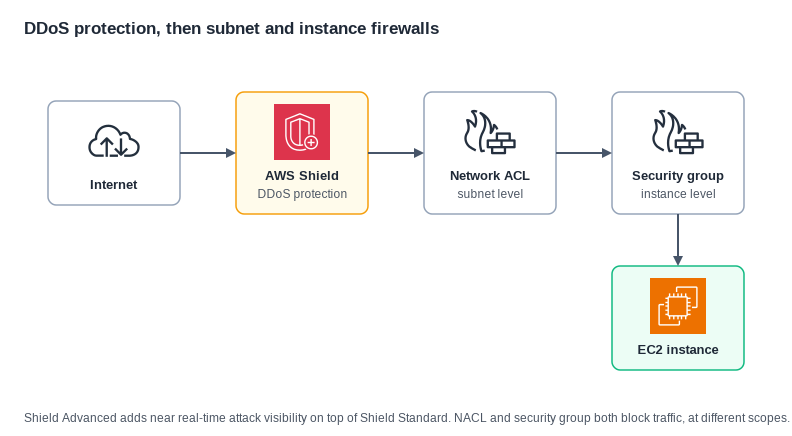
- AWS Shield Standard is free and automatic, defending every AWS customer against common network/transport-layer DDoS attacks.
- AWS Shield Advanced adds, on top of that, "additional detection and mitigation against large and sophisticated DDoS attacks, near real-time visibility into attacks, and integration with AWS WAF." It gives "complete visibility into DDoS events with near real-time notification through Amazon CloudWatch and detailed diagnostics on the AWS WAF and AWS Shield console or APIs." Whenever a question wants real-time attack visibility/reporting, it is Shield Advanced, not Standard.
- A security group "acts as a virtual firewall for your EC2 instances," filtering traffic per instance (or ENI).
- A network ACL filters at the subnet boundary, evaluated before traffic reaches any security group.
- AWS Firewall Manager centrally manages WAF/Shield/security-group policies across accounts — it doesn't itself give DDoS attack visibility or filter traffic. Amazon GuardDuty detects threats generally; it does not protect against DDoS or filter traffic.
High availability and failover across Regions
| Service | Mechanism | Scope |
|---|---|---|
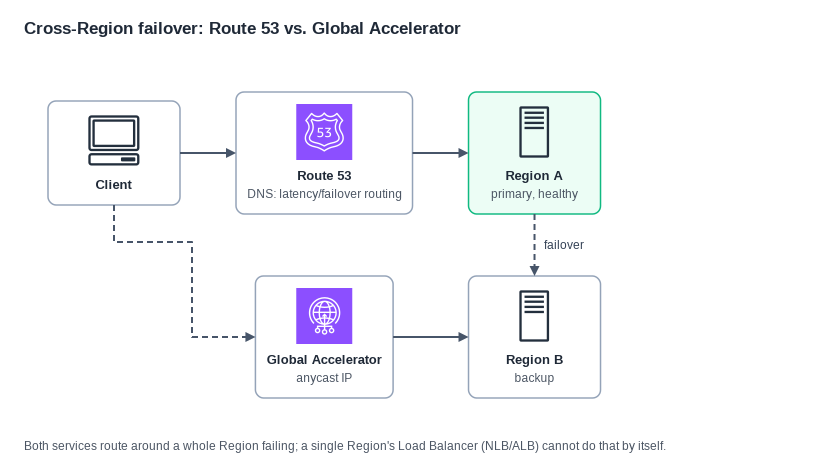
| Amazon Route 53 | DNS-level latency routing ("provides the best latency") or failover routing ("active-passive failover") | Across Regions, at the DNS layer |
| AWS Global Accelerator | Anycast IPs that "distribute incoming application traffic across multiple endpoint resources in multiple AWS Regions", rerouting to the optimal healthy endpoint | Across Regions, at the network layer |
| Application/Network Load Balancer | Distributes traffic across targets within one Region | Single Region only |
Surviving a Region-wide natural disaster specifically requires running EC2 instances in multiple Regions — AWS's global infrastructure is organized as "launched Regions each with multiple Availability Zones," and Regions are physically isolated from one another. Multiple AZs in a single Region, or edge locations (which only cache content, they don't run EC2 instances), do not protect against a Region-wide event.
Connecting networks: Transit Gateway as a hybrid hub
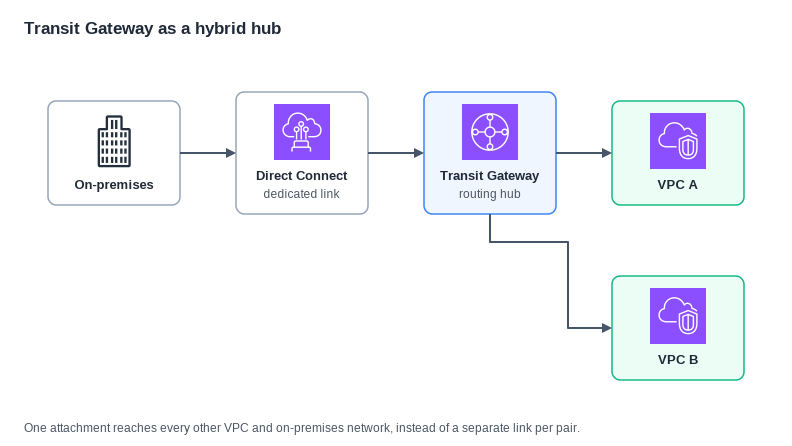
- AWS Transit Gateway is "a network transit hub used to interconnect virtual private clouds (VPCs)" and on-premises networks — one attachment per network reaches every other attached network through the shared hub, instead of a mesh of point-to-point links.
- AWS Direct Connect "create[s] a dedicated network connection to AWS," establishing "a network connection from your premises to an AWS Region" that bypasses the public internet for more consistent performance and lower latency — this is the answer whenever a question asks for a dedicated on-premises-to-AWS link, as opposed to AWS Managed VPN (which still rides the public internet).
- A virtual private gateway and a customer gateway are the two endpoints of a single VPN connection — neither is a multi-network hub. An internet gateway connects a VPC to the public internet, not to other networks.
EC2 purchasing and instance families
| Need | Choice | Why |
|---|---|---|
| Workload tolerates interruption, wants lowest cost | Spot Instances | "When you use Spot Instances, you must be prepared for interruptions" — AWS can reclaim capacity with short notice in exchange for a steep discount. Unsuitable for anything that cannot be interrupted. |
| GPU / hardware-accelerated compute | Accelerated computing instances | "Use hardware accelerators, or co-processors, to perform functions, such as floating point number calculations, graphics processing, or data pattern matching." |
| Deploy a container app, auto-build images from source, no infra to manage | AWS App Runner | "Provides a fast, simple, and cost-effective way to deploy from source code or a container image directly to a scalable" running service, redeploying automatically on every new commit or image. Plain ECS expects a pre-built image; Elastic Beanstalk needs more platform configuration; raw EC2 means managing everything yourself. |
Data: discover, transform, visualize
- AWS Glue lets teams "discover and connect to more than 70 diverse data" sources and "discover, prepare, move, and integrate data" — the catalog/ETL layer.
- Amazon QuickSight (being rebranded AWS Quick Sight inside the new "AWS Quick" suite — "AWS Quick evolved from Amazon QuickSight... QuickSight continues as AWS Quick Sight") is the BI layer: interactive dashboards with built-in ML Insights that "uncover hidden insights and trends in your data." "Discover + transform" points to Glue; "interactive dashboard + ML insights" points to QuickSight/Quick Sight — same product either name, same exam answer.
- Amazon Redshift (data warehouse) and Amazon Athena (serverless SQL query service) can sit behind these tools but are not themselves the discovery/cataloging or dashboarding layer being tested.
Databases: picking the right engine
| Need | Service | Note |
|---|---|---|
| Fully managed NoSQL (key-value/document) | Amazon DynamoDB | "Serverless, fully managed, distributed NoSQL database with single-digit millisecond performance at any scale." |
| Run the MySQL engine directly | Amazon RDS | "Amazon RDS supports several versions of MySQL for DB instances," along with PostgreSQL, MariaDB, Oracle, SQL Server. |
| Fully managed, MySQL/PostgreSQL-compatible relational engine | Amazon Aurora | "A fully managed relational database engine that's compatible with MySQL and PostgreSQL," with AWS handling provisioning, patching, backups, and failure recovery. |
RDS runs the stock MySQL engine; Aurora is a separate AWS-built engine that is compatible with it — both answers can be correct depending on whether the question says "supports the MySQL engine" (RDS) or "MySQL-compatible, AWS-managed, high-performance" (Aurora).
Storage and account-management grab bag
| Need | Service | Note |
|---|---|---|
| Store/retrieve S3 objects over NFS/SMB | AWS Storage Gateway — file gateway (S3 File Gateway) | "Store and retrieve objects in Amazon S3 using industry-standard file protocols such as Network File System (NFS) and Server Message Block (SMB)." Volume gateway uses iSCSI instead; EFS is a separate, independent NFS service. |
| Fast, secure long-distance client-to-bucket transfer | S3 Transfer Acceleration | "Enables fast, easy, and secure transfers of files over long distances between your client and an S3 general purpose bucket" via CloudFront edge locations. |
| Most cost-effective store for bulk, queryable log data | Amazon S3 | Storage classes are "purpose-built to provide the lowest cost storage for different access patterns," with lifecycle rules to automate the trade-off as access patterns age. |
| Catalog an S3 bucket's objects, prefixes, and metadata on a schedule | S3 Inventory | A scheduled report that "lists objects with a shared prefix" together with configurable object metadata (including tags), without calling the List API. |
| Encrypt EBS volumes/snapshots | AWS KMS | EBS encryption "uses AWS KMS keys when creating encrypted volumes and snapshots" — the default AWS managed key, or a customer managed symmetric key. |
| Encrypt other AWS services' data at rest | AWS KMS | KMS integration lets services "encrypt and decrypt data at rest or in transit," with EBS, S3, RDS, and more as common use cases — ACM manages certificates (in transit), not general data-at-rest keys. |
| Continuous vulnerability scanning of EC2 (predefined assessment templates) | Amazon Inspector | "A vulnerability management service that automatically discovers workloads and continually scans them for software vulnerabilities and unintended network exposure." |
| Continuous threat detection across accounts, workloads, S3 | Amazon GuardDuty | "Continuously monitors, analyzes," and uses threat intel plus ML to flag malicious/unauthorized activity — distinct from Inspector (vulnerabilities) and Shield (DDoS). |
| ML-based detection/analysis of images and videos | Amazon Rekognition | Detects "objects, text, unsafe content, analyze images/videos," plus facial analysis — across both media types. |
| Sign-up/sign-in for mobile and web apps | Amazon Cognito | "An identity platform for web and mobile apps" — "most applications that need sign-up and sign-in start here." |
| Federate a third-party IdP for employee AWS access, no new credentials | AWS IAM Identity Center | Connects an "existing identity provider" so employees reuse existing credentials — formerly AWS Single Sign-On, renamed July 26, 2022. |
| Central portal for AWS accounts and third-party SaaS apps | AWS IAM Identity Center | The same service also serves as the one access portal end users open to reach both assigned AWS accounts and SaaS/cloud applications. |
| Model/provision resources with a programming language | AWS Cloud Development Kit (CDK) | "An open-source software development framework for defining cloud infrastructure in code," in TypeScript, Python, Java, C#/.NET, or Go, deployed via CloudFormation under the hood. |
| Create identical resource copies across Regions | AWS CloudFormation | Reuse a template to "provision the same resources over and over in multiple regions." |
| Event history of who created which resource, when | AWS CloudTrail | "Event history" captures and lets you analyze "user and API activity on AWS" from account creation onward — CloudWatch monitors metrics/logs, not an audit trail. |
| Strategic planning + Infrastructure Event Management + 24/7 real-time support for a critical release | AWS Enterprise Support | Includes "a designated Technical Account Manager (TAM)" and "Infrastructure event management – Short-term engagement with AWS Support" for critical launches, plus rapid round-the-clock incident response — AWS Professional Services is project consulting, without the ongoing TAM/IEM relationship. |
Exam traps
- Shield Standard (free, automatic) vs. Shield Advanced (near real-time visibility via CloudWatch/console/API) — "real-time DDoS visibility" always means Advanced.
- Security group (instance level) vs. network ACL (subnet level) — both filter traffic, at different scopes; GuardDuty/CloudTrail/Flow Logs only observe.
- Route 53 / Global Accelerator (cross-Region failover) vs. ALB/NLB (single-Region only) — "failover if a whole Region goes down" needs the first pair.
- Multiple Regions (survives a regional disaster) vs. multiple AZs in one Region (does not) — edge locations don't run EC2 at all.
- Transit Gateway (hub for many VPCs and on-premises networks) vs. VPC peering (exactly two VPCs) vs. Direct Connect (dedicated on-premises link, not a hub by itself).
- Spot Instances = cheapest but interruptible — never the answer for "cannot be interrupted."
- AWS Glue (discover/transform/ETL) vs. Amazon QuickSight/AWS Quick Sight (visualize, ML Insights) — QuickSight is being renamed AWS Quick Sight; same product, same exam answer.
- RDS for MySQL (runs stock MySQL) vs. Aurora (AWS-built engine, MySQL/PostgreSQL-compatible) — read the question's exact wording.
- Storage Gateway file gateway (NFS/SMB to S3) vs. volume gateway (iSCSI) vs. EFS (separate NFS service, no S3 link).
- Amazon Inspector (vulnerability scanning) vs. Amazon GuardDuty (behavioral threat detection) vs. AWS Shield (DDoS) — three different "security" services for three different jobs.
- Cognito (customer-facing app sign-up/sign-in) vs. IAM Identity Center (workforce federation + SaaS/AWS-account access portal).
- AWS CDK (code, deployed via CloudFormation) vs. CloudFormation itself (declarative templates).
- AWS Enterprise Support (TAM + Infrastructure Event Management + 24/7 rapid response) vs. AWS Professional Services (project-based consulting, no ongoing IEM).
Docs
- How AWS Shield and Shield Advanced work
- AWS Shield features
- Amazon EC2 security groups for your EC2 instances
- Amazon EBS encryption
- Choosing a routing policy - Amazon Route 53
- How AWS Global Accelerator works
- AWS Global Infrastructure
- What is AWS Glue?
- Amazon QuickSight / AWS Quick Sight
- Gaining insights with machine learning (ML) in AWS Quick Sight
- AWS CloudTrail User Guide
- How Spot Instances work
- What is AWS App Runner?
- What is Amazon S3 File Gateway
- What Is IAM Identity Center?
- Accelerated computing EC2 instance types
- What Is AWS CloudFormation?
- AWS Support Plans
- What is the AWS CDK?
- Using AWS KMS encryption with AWS services
- Amazon DynamoDB
- Amazon RDS for MySQL
- What is Amazon Aurora?
- What is Amazon Rekognition?
- Cost optimization - Amazon S3
- What Is AWS Transit Gateway?
- Configuring fast, secure file transfers using Amazon S3 Transfer Acceleration
- What Is Amazon Cognito?
- AWS Direct Connect
- What is AWS Direct Connect?
- Cataloging and analyzing your data with S3 Inventory
- What is Amazon Inspector?
- What is Amazon GuardDuty?