Exams / CLF-C02 / D2 Cloud Concepts
Cloud Concepts #3: The six advantages of cloud computing, AWS Well-Architected Framework
- Exam domain: Content Domain 1: Cloud Concepts
This pass covers the three highest-yield topics in Domain 1: the six advantages of cloud computing, the AWS Well-Architected Framework (pillars, reliability's design principles, loose coupling), and the AWS Cloud Adoption Framework (CAF) perspectives — plus the shared responsibility model, migration vocabulary, and a couple of free AWS tools.
The six advantages of cloud computing
AWS names exactly six advantages. Each one answers a specific on-premises pain point, and the exam loves testing the pairing — pick the advantage that matches the scenario's actual problem, not a plausible-sounding neighbor.
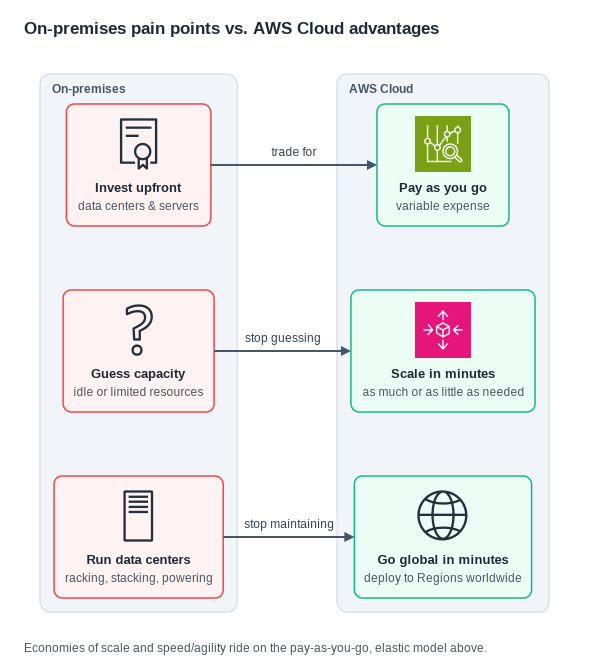
| Advantage | On-premises problem it solves | AWS's own wording |
|---|---|---|
| Trade fixed expense for variable expense | Heavy upfront capital investment | "Instead of having to invest heavily in data centers and servers" before knowing usage, "you can pay only when you consume computing resources" |
| Benefit from massive economies of scale | Small customers can't negotiate hardware discounts | Aggregated demand from hundreds of thousands of customers lets AWS "achieve a lower variable cost than you can get on your own" |
| Stop guessing capacity | Over-provisioning (wasted spend) or under-provisioning (outages) | Access "as much or as little capacity as you need, and scale up and down as required with only a few minutes'" notice |
| Increase speed and agility | Slow procurement cycles for dev/test environments | New IT resources become "available to your developers from weeks to just minutes" |
| Stop spending money running and maintaining data centers | Operational burden of "racking, stacking, and powering servers" | Frees the organization to focus on projects that differentiate the business |
| Go global in minutes | Expensive, slow international expansion | "Easily deploy your application in multiple regions around the world with just a few clicks" |
Common substitution traps:
- "Pay only for what you use / as-needed billing" → trade fixed for variable expense, not agility or data-center savings.
- "Test/develop/launch quickly" → speed and agility, not elasticity (elasticity is about scaling already-running capacity up/down, not the initial provisioning speed — though both involve "minutes, not weeks").
- "Deploy worldwide through Regions/AZs/edge locations" → global reach, not economies of scale or high availability.
- A question combining two advantages (e.g., "high availability + economies of scale") is testing that you know security and access control remain a shared responsibility even after migrating — AWS never "assumes all responsibility," and the customer never hands over "all operational controls."
AWS Well-Architected Framework
The six pillars
The Framework names exactly six pillars — nothing else (not "availability," "scalability," or "responsive design," which are related concepts but not pillars):
| Pillar | Focus |
|---|---|
| Operational excellence | Running and monitoring systems to deliver business value, improving processes |
| Security | Protecting data, systems, and assets |
| Reliability | A workload performing its intended function correctly and consistently throughout its lifecycle, including recovering rapidly from failure |
| Performance efficiency | Using computing resources efficiently as demand changes and technology evolves |
| Cost optimization | Running systems to deliver business value at the lowest price point |
| Sustainability | Minimizing the environmental impacts of running cloud workloads |
Reliability's design principles — the most-tested pillar
Reliability has exactly five named design principles. Exam questions substitute real tactics (increasing a service quota, deploying to a second Region) for these five — only the five below count as "design principles":
- Test recovery procedures — validate failure response in a non-production-like way before it happens for real.
- Automatically recover from failure — monitor workload KPIs and trigger automation when a threshold is breached.
- Scale horizontally to increase aggregate workload availability — replace one large resource with many smaller ones so a single failure has less impact.
- Stop guessing capacity — monitor demand/utilization and automate adding or removing resources instead of pre-committing to a fixed size.
- Manage change in automation — make infrastructure changes through automation, not manual steps.
Exam traps:
- "Plan to raise a service quota in a secondary Region" / "grant broad access to raise quotas" → these are implementation tactics, not named design principles. Don't pick them over the five above.
- "Design applications to run in a single Availability Zone" is the opposite of the Reliability pillar — it directly contradicts horizontal scaling and redundancy.
- "Perform operations as code" belongs to Operational excellence; "Enable traceability" belongs to Security — easy to mistake for Reliability principles because they also involve automation/monitoring.
Loose coupling: isolating failure between components
A separate but related design principle — tested on its own — is loose coupling: reducing direct dependencies between components so a failure in one does not cascade into another.
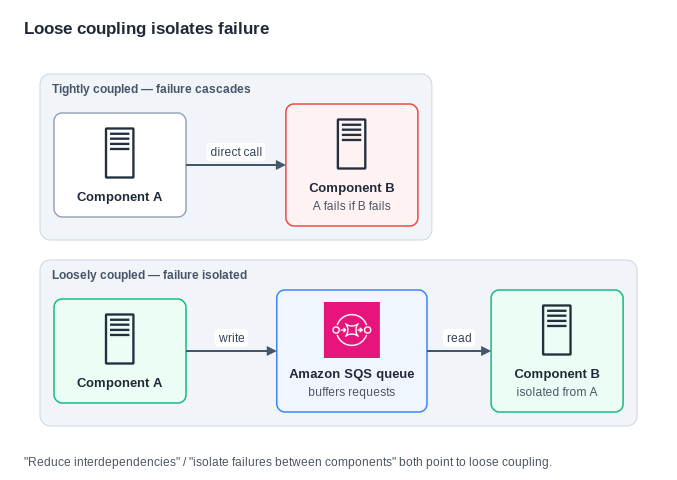
Loose coupling "isolates a component's behavior from affecting others that depend on it, improving resilience and agility." The classic implementation is inserting a managed queue (e.g., Amazon SQS) between two components, so a downstream failure doesn't propagate upstream.
- "Reduce interdependencies between components" and "isolate failures among dependent components" both describe loose coupling — not scalability, automation, or caching, which are different design principles entirely.
Durability vs. reliability vs. elasticity vs. latency
These four terms get confused with each other on the exam:
| Term | What it measures |
|---|---|
| Reliability | A workload performing correctly and consistently, including recovering from failure |
| Durability | A system/resource remaining functional even when it encounters operational problems (illustrated by S3's "99.999999999% durability" guarantee that an object itself survives) |
| Elasticity | The ability to scale capacity up or down on demand |
| Consistency | Whether reads reflect the latest writes to data |
| Latency | How long a request takes to get a response |
If a question asks specifically about "remaining functional through operational problems" (as opposed to the broader reliability pillar, or data read consistency, or scaling, or response time), durability is the term being tested.
AWS Cloud Adoption Framework (AWS CAF)
AWS CAF organizes transformation capabilities into six perspectives, split into a business-oriented group and a technology-oriented group:
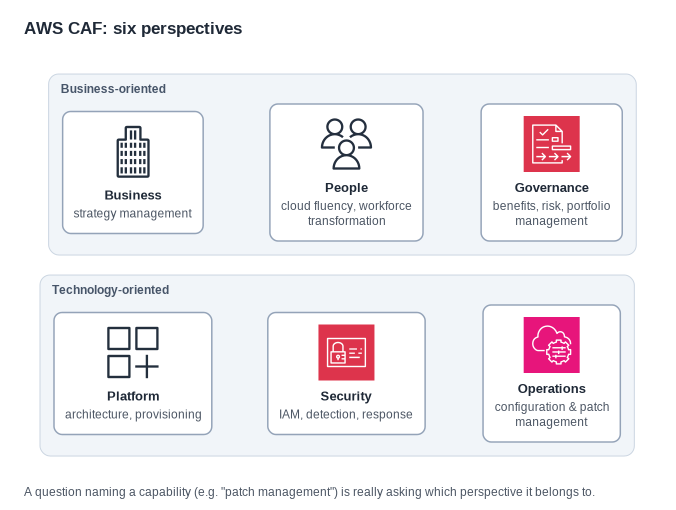
| Perspective | Example capabilities tested on the exam |
|---|---|
| Business | Strategy management — leverage cloud to accelerate business outcomes |
| People | Cloud fluency (build digital acumen); Workforce transformation (attract/develop/retain a digitally fluent, high-performing, diverse and inclusive workforce with the right technical/non-technical skill mix) |
| Governance | Benefits management (define/track business outcomes); Risk management; Program and project management; Application portfolio management; Cloud financial management; Data governance |
| Platform | Architecture, provisioning, software-defined infrastructure |
| Security | Identity and access management, detection, incident response |
| Operations | Configuration management; Patch management; Event management (AIOps) |
Capability-to-perspective mapping traps (the exam's favorite CAF question format — "which perspective does capability X belong to?"):
- Configuration management and patch management → Operations, not Platform or Security.
- Cloud fluency and workforce transformation (people/culture/diversity) → People, not Business.
- Strategy management → Business, not Governance (Governance covers oversight/control capabilities like risk and portfolio management, not strategy formulation itself).
- Benefits management, risk management, program and project management, application portfolio management, cloud financial management → Governance.
- Identity and access management → Security, even though it sounds like oversight ("Governance" is a tempting wrong answer).
- Portfolio management (general) and product management → Business; only application portfolio management is a Governance capability.
- Event management → Operations, not Governance.
AWS CAF itself is the tool to reach for when a question asks to assess migration readiness: its Migration Readiness Assessment (MRA) evaluates an organization against the six CAF perspectives and builds an action plan to close gaps — not the Well-Architected Framework (which reviews workload architecture quality, not organizational readiness), Pricing Calculator, or Budgets.
Migration vocabulary and free tools
- Migration type naming follows the architecture's end state relative to its starting state: moving from a pure on-premises setup into an architecture split between on-premises and AWS is an on-premises-to-hybrid migration (a hybrid deployment "connect[s] cloud-based resources and existing resources that are not located in the cloud").
- AWS Migration Evaluator (complimentary): builds a data-driven business case for migration by creating "a clear baseline of what your organization is running today" and projecting AWS costs from measured on-premises provisioning/utilization. It does not move any data itself — it only assesses and costs out a migration.
- AWS re:Post (free, part of the AWS Free Tier): a community-driven Q&A service at repost.aws, plus community-written best-practice Articles — not AWS Knowledge Center (official AWS-authored FAQs), AWS IQ (paid expert marketplace), or Enterprise Support (a paid plan).
- Availability Zone: "one or more discrete data centers" with independent power/networking, inside an AWS Region.
Exam traps
- Six advantages — match the problem, not just a plausible benefit. "As-needed/pay-as-you-go billing": trade fixed for variable expense; "quickly develop/test/launch" → speed and agility; "deploy worldwide via Regions/AZs/edge" → global reach; "eliminate data-center upkeep" → stop spending on data centers — don't swap these for each other.
- Well-Architected has exactly six pillars; Availability, Scalability, and Responsive design are not among them.
- Reliability has exactly five design principles; a specific tactic (raising a quota, deploying to a secondary Region) is an implementation detail, not one of the five.
- Single-AZ design contradicts Reliability — never pick it as aligned with the pillar.
- Loose coupling = isolate failure between components, implemented with queues/streams/workflows — don't confuse with scalability or automation principles.
- Durability = remains functional through operational problems, distinct from reliability (the broader pillar), elasticity (scaling), consistency (data accuracy), and latency (response time).
- CAF capability-to-perspective questions are pure recall: Operations = configuration/patch/event management; People = cloud fluency/workforce transformation; Business = strategy/portfolio/product management; Governance = benefits/risk/program-project/application-portfolio/financial management; Security = IAM/detection.
- AWS CAF assesses migration readiness; Migration Evaluator cost-justifies it; neither one moves data.
- Physical/environmental controls and infrastructure patching are AWS's job; guest-OS patching, IAM, and security groups are the customer's job under the shared responsibility model.
Docs
- Six advantages of cloud computing
- Reliability - AWS Well-Architected Framework
- The pillars of the framework — AWS Well-Architected Framework
- Reliability Pillar — design principles
- REL04-BP02 Implement loosely coupled dependencies
- AWS Well-Architected Framework: Design your workload to withstand component failures
- Amazon S3 Data Durability
- AWS Well-Architected Framework: Shared responsibility (Security Pillar)
- Shared Responsibility Model for Resiliency
- AWS CAF Business perspective
- AWS CAF People perspective: culture and change
- AWS CAF People perspective: Workforce transformation
- AWS CAF Governance perspective: control and oversight
- AWS CAF Operations perspective: health and availability
- Assess phase - AWS Prescriptive Guidance
- Organizational readiness - Migration Launch Guide
- AWS Regions and Availability Zones
- AWS Global Infrastructure
- Types of Cloud Computing
- Migration Evaluator features
- AWS Migration Evaluator
- Introducing AWS re:Post, a new, community-driven questions-and-answers service
- AWS re:Post introduces community-generated articles