Exams / CLF-C02 / D2 Cloud Concepts
Cloud Concepts #1: The AWS Cloud Adoption Framework, The cloud transformation journey
- Exam domain: Content Domain 1: Cloud Concepts
This pass covers three recall-heavy themes that dominate Domain 1: the AWS Cloud Adoption Framework (CAF) (its six perspectives, their capabilities, and the four-phase transformation journey), the six AWS Well-Architected Framework (WAF) pillars and their design principles, and the core cloud value propositions (elasticity, agility, economies of scale). None of these questions give you a scenario to reason through — they test whether you can place a term in the right bucket.
The AWS Cloud Adoption Framework: six perspectives, one capability each
AWS CAF organizes cloud-transformation guidance into six perspectives, and every capability belongs to exactly one of them: "AWS CAF groups its capabilities in six perspectives: Business, People, Governance, Platform, Security, and Operations. Each perspective comprises a set of capabilities that functionally related stakeholders own or manage in the cloud transformation journey." "Cloud fluency," "change acceleration," and "architecture" are not CAF perspectives — a trap option in several questions.
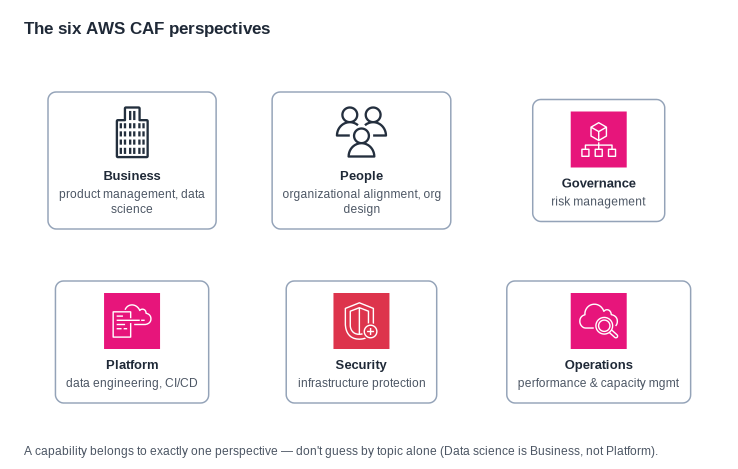
| Perspective | Signature capability (exam-tested) | Why not another perspective |
|---|---|---|
| Business | Product management — "identify product owners, understand customer journeys, define and create product roadmaps, and manage end-to-end product lifecycles and associated value streams"; also Data science | Realigning teams around products is a Business capability, not a People one, even though it changes how teams are organized |
| People | Organizational alignment, Organization design — the AWS CAF People perspective lists these among its capabilities | Portfolio management (Business), risk management (Governance), and modern application development (Platform) are not People capabilities |
| Governance | Risk management, program/project management across the portfolio | Don't confuse with Operations (which runs day-to-day) |
| Platform | Data engineering, CI/CD — "Data engineering – Automate and orchestrate data flows" and "Implement continuous integration and continuous delivery (CI/CD) pipelines"; also data/analytics architecture | A well-designed data-and-analytics architecture is Platform; data science itself is Business |
| Security | Infrastructure protection, identity and access management | — |
| Operations | Performance and capacity management — "monitor workload performance and ensure that capacity meets current and future demands" | Change/release management is also Operations, not Business or Platform |
The cloud transformation journey: Envision → Align → Launch → Scale
AWS CAF recommends four iterative, incremental phases — only these four are CAF phases; "Assess" and "Mobilize" are not AWS CAF terms (they belong to other frameworks and are a recurring wrong-answer trap).
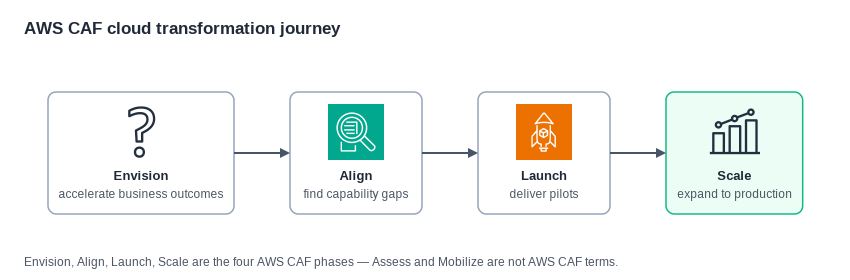
- Envision — "Envision phase focuses on demonstrating how cloud will help accelerate your business outcomes." The answer whenever a question asks which phase shows how cloud accelerates business outcomes.
- Align — "Align phase focuses on identifying capability gaps across the six AWS CAF perspectives, identifying cross-organizational dependencies, and surfacing stakeholder concerns and challenges."
- Launch — delivers pilot initiatives into production.
- Scale — expands successful pilots to full production scale and confirms the business benefits are realized.
The six AWS Well-Architected pillars
Every pillar has one or two design principles the exam quotes almost verbatim; match the wording, not just the topic.
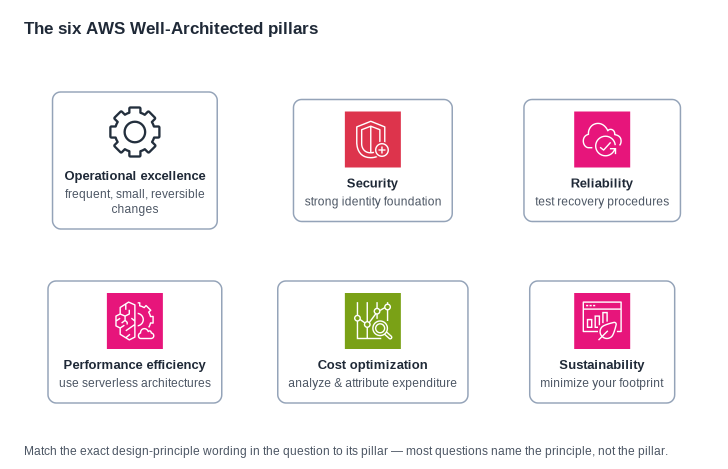
| Pillar | Signature design principle (exact exam phrasing) | Trap to avoid |
|---|---|---|
| Operational excellence | "Make frequent, small, reversible changes" — design workloads that are scalable and loosely coupled so components can be updated regularly, limiting blast radius; also "Learn from all operational events and metrics: Drive improvement through lessons learned from all operational events and failures" | "Reduce downtime by making infrastructure changes infrequently and in large increments" is the opposite of this principle |
| Security | Implement a strong foundation of identity and access management | — |
| Reliability | "Test recovery procedures" and automatically recover from failure; resiliency itself is "the ability of a workload to recover from infrastructure or service disruptions, dynamically acquire computing resources to meet demand, and mitigate disruptions" | "Scale horizontally" is also a Reliability principle, but it is not the same as "test recovery procedures" |
| Performance efficiency | "Use serverless architectures" — they "remove the need for you to run and maintain physical servers for traditional compute activities"; also "go global in minutes" and "experiment more often" | Horizontal scaling and managed services are good practice but are not named Performance Efficiency design principles |
| Cost optimization | Analyze and attribute expenditure | — |
| Sustainability | Minimize the environmental footprint of running workloads | Often confused with Performance Efficiency because both touch resource usage |
The pillar itself is defined this way: "The operational excellence pillar includes the ability to support development and run workloads effectively, gain insight into your operations, and to continuously improve supporting processes and procedures to deliver business value." Performance efficiency, in turn, is "the ability to use cloud resources efficiently to meet performance requirements, and to maintain that efficiency as demand changes and technologies evolve."
Core cloud value propositions
- Elasticity — the ability to acquire resources when needed and release them when no longer needed, so compute capacity is never over- or under-provisioned: "Use the elasticity of the cloud to scale your compute resources up or down dynamically to match your needs and avoid over- or under-provisioning capacity for your workload." AWS Compute Optimizer demonstrates the related practice of rightsizing: "you can analyze the configuration and utilization metrics of your AWS resources to get rightsizing recommendations and find idle resources."
- Agility — the speed at which new IT resources become available, enabling rapid experimentation: "Increase speed and agility - in a cloud computing environment, new IT resources are only a click away, which means that you reduce the time to make those resources available to your developers from weeks to just minutes." This also drives the "cost and time it takes to experiment and develop is significantly lower."
- Economies of scale — aggregating demand across many customers lets a provider like AWS achieve lower variable costs than a single company running its own infrastructure: "Benefit from massive economies of scale - by using cloud computing, you can achieve a lower variable cost than you can get on your own."
- Go global in minutes — "Easily deploy your application in multiple regions around the world with just a few clicks." This is the advantage behind "increased global reach and agility."
- AWS Outposts is the answer whenever a scenario needs to keep some workloads on premises for regulatory reasons and use the same APIs as the cloud workloads: "AWS Outposts is a fully managed service that extends AWS infrastructure, AWS services, APIs, and tools to virtually any datacenter, co-location space, or on-premises facility."
- AWS Organizations centrally manages multiple accounts: it lets a company "group accounts to organize your workflows, apply policies for governance," and "simplify billing by using a single payment method for all of your accounts," while also letting you "simplify account creation by programmatically creating new accounts."
Exam traps
- Envision, Align, Launch, Scale are the only AWS CAF phases — "Assess" and "Mobilize" are decoys from other frameworks.
- Six CAF perspectives: Business, People, Governance, Platform, Security, Operations — "cloud fluency," "change acceleration," and "architecture" are not perspectives.
- Data science is a Business-perspective capability, not Platform — Platform's data-related capability is data engineering (pipelines/architecture), not the science itself.
- Realigning teams around products and value streams is a Business capability (Product management), even though a third-party explanation may attribute it to "People" — People's capabilities are organizational alignment and organization design, which are about workforce/culture, not product structure.
- "Make frequent, small, reversible changes" = Operational Excellence, never Reliability or Performance Efficiency, even though reversibility sounds risk-related.
- "Use serverless architectures" is a named Performance Efficiency design principle — "use managed services" and "scale horizontally" are good practice but are not on that pillar's official list.
- "Test recovery procedures" = Reliability, not Operational Excellence, even though both pillars talk about operations and failure.
- Elasticity = acquire/release resources on demand (eliminates under/over-provisioning); agility = speed to provision and experiment. A question about "eliminating underutilized CPU capacity" wants elasticity, not agility.
- AWS Outposts requires genuine on-premises hardware with consistent APIs — Availability Zones and Dedicated Hosts are still inside AWS's own infrastructure, not the customer's site.
- AWS Organizations, not IAM or Trusted Advisor, is the service for programmatic account creation, SCPs, and consolidated billing across a multi-account company.
Docs
- AWS CAF: Business perspective
- AWS CAF business perspective whitepaper
- AWS CAF: Platform perspective
- AWS CAF Platform perspective (prescriptive guidance)
- AWS CAF: Operations perspective
- AWS CAF Operations perspective: performance and capacity management
- AWS CAF People perspective: organizational alignment
- AWS CAF People perspective: organization design
- Your cloud transformation journey
- AWS Well-Architected Framework — the pillars of the framework
- Operational Excellence Pillar
- Operational Excellence design principles
- Operational Excellence — make frequent, small, reversible changes
- Operational Excellence design principles (framework)
- Performance Efficiency Pillar
- Performance Efficiency design principles
- Reliability Pillar — resiliency and the components of reliability
- Reliability Pillar design principles
- REL11-BP02 Fail over to healthy resources
- Scale your compute resources dynamically
- Six advantages of cloud computing
- What is AWS Compute Optimizer?
- What is AWS Organizations?
- What is AWS Outposts?