Exams / CLF-C02 / D1 Cloud Technology and Services
Cloud Technology and Services #10: Shared responsibility, EC2 purchasing options
- Exam domain: Content Domain 3: Cloud Technology and Services
This pass covers the shared responsibility model applied to specific services, EC2 purchasing options, a handful of purpose-built databases and an analytics service, deployment/release automation, two migration tools, and the account-level monitoring, identity, and security tools the exam likes to mix up.
Shared responsibility: who patches the OS?
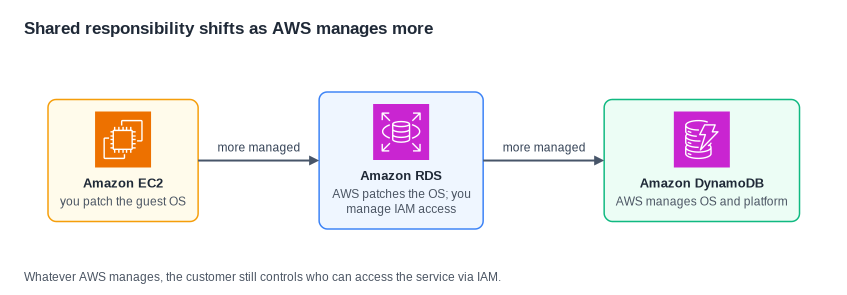
- Amazon EC2 is IaaS: "Customers that deploy an Amazon EC2 instance are responsible for management of the guest operating system (including updates and security patches), any application software or utilities installed by the customer on the instances, and the configuration of the AWS-provided firewall (called a security group) on each instance."
- Amazon RDS is a managed database: AWS runs and patches the DB engine's OS. The customer's remaining job is controlling who can administer it — "Patch Management – AWS is responsible for patching and fixing flaws within the infrastructure, but customers are responsible for patching their guest OS and applications" (EC2-style services only); for RDS the customer instead creates IAM policies that control administrative access to the service.
- Fully abstracted services such as Amazon S3 and Amazon DynamoDB: "AWS operates the infrastructure layer, the operating system, and platforms, and customers access the endpoints to store and retrieve data." There is no guest OS for the customer to touch at all.
- No matter how much AWS manages, installing cabling and provisioning the physical hardware is always AWS's job, never the customer's.
EC2 purchasing options
| Option | Fits | Why |
|---|---|---|
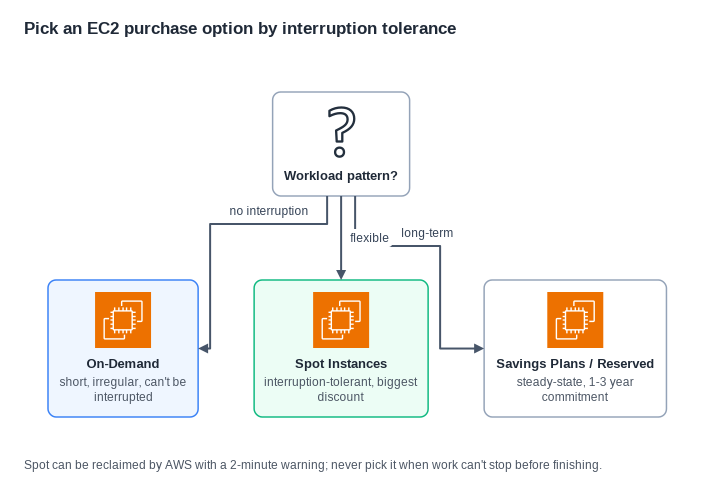
| On-Demand | Temporary, variable workload that cannot be interrupted | "With On-Demand Instances, you pay for compute capacity by the second with no long-term commitments." AWS explicitly recommends On-Demand "for applications with short-term, irregular workloads" that cannot be interrupted. |
| Spot Instances | Flexible, fault-tolerant, batch/stateless work | Steep discount, but AWS can reclaim the capacity — wrong choice whenever a question says work "cannot stop before finishing." |
| Savings Plans / Reserved Instances | Steady-state, predictable, long-term (1–3 yr) | A pricing commitment, not a capacity/availability feature — doesn't help with short bursts. |
EC2 Auto Scaling is about the number of instances, not their size: it "helps you ensure that you have the correct number of Amazon EC2 instances available to [handle] the load for your application," automatically launching instances as demand grows and terminating them as it falls. (Changing instance size/type to match utilization is rightsizing, a separate action — see AWS Compute Optimizer below.)
AWS Compute Optimizer reads EC2 CloudWatch utilization metrics (CPU, network, disk) to generate instance-type/size recommendations: "With AWS Compute Optimizer, you can analyze the configuration and utilization metrics of your AWS resources to get rightsizing recommendations and find idle resources," using "their use metrics from Amazon CloudWatch for the last 14 days."
Purpose-built databases and analytics
| Need | Service | Why |
|---|---|---|
| NoSQL workload, key-value or document model | Amazon DynamoDB | "Amazon DynamoDB is a serverless, fully managed, distributed NoSQL database with single-digit millisecond performance at any scale," and it "supports both key-value and document data models." |
| Continuous, unstructured data that must stay durable and easy to query | Amazon DynamoDB | Same NoSQL engine: durable storage plus indexed key-based queries beat a plain object store for this combination. |
| Key-value store needing sub-millisecond latency at huge scale | Amazon DynamoDB (+ DAX) | DynamoDB already delivers "single-digit millisecond performance," and its optional DAX cache pushes qualifying reads into microsecond territory. |
| Graph queries for real-time fraud-pattern detection | Amazon Neptune | Purpose-built graph engine: "Neptune powers graph use cases such as recommendation engines, fraud detection, knowledge graphs, drug discovery, and network security." |
| Occasional/ad-hoc SQL analysis over data already in S3, at lowest cost | Amazon Athena | "Athena SQL and Apache Spark on Amazon Athena are serverless, so there is no infrastructure to set up or manage, and you pay only for the queries you run" — no warehouse or DB capacity to provision for occasional use. |
Compute, containers, and release automation
| Need | Service | Why |
|---|---|---|
| Deploy and manage a web application with least setup | AWS Elastic Beanstalk | "With Elastic Beanstalk you can deploy web applications into the AWS Cloud," and it "provisions one or more AWS resources in your AWS account to run your application" automatically. |
| Container workload running ~4 hours at a time, no servers to manage | AWS Fargate | "AWS Fargate is a technology that you can use with Amazon ECS to run containers without having to manage" clusters of virtual machines. AWS Lambda is ruled out here: a standard synchronous invocation is still capped at 15 minutes, far short of a multi-hour container run. |
| Automate application releases across EC2/on-prem/Lambda/ECS | AWS CodeDeploy | "CodeDeploy is a deployment service that automates application deployments to Amazon EC2 instances" and also "deploy[s] a serverless Lambda" function version or ECS application. |
| Integrate AWS capabilities directly into application code | AWS SDK | Application code calls AWS through a language-specific SDK, which "choose[s] a method to authenticate the calls made to AWS by your application" and handles the API plumbing — distinct from CodeDeploy (releases), Lambda (runs code), or Batch (schedules jobs). |
| React to an EC2 instance entering the "stopping" state and invoke Lambda | Amazon EventBridge | "Amazon EC2 sends an EC2 Instance State-change Notification event to Amazon EventBridge" whenever an instance moves between states (such as into the stopping state), and EventBridge can route that event to a Lambda target. |
Storage, networking, and hybrid connectivity
- Amazon S3 hosts static websites with the least operational overhead: "You can use Amazon S3 to host a static website" — no servers to patch or scale, unlike EC2, Elastic Beanstalk, or Lightsail.
- Amazon EFS lets multiple EC2 instances share the same files concurrently: "Amazon Elastic File System (Amazon EFS) provides serverless, fully elastic file storage so that you can share file" systems across instances over NFS.
- AWS Storage Gateway is the hybrid-storage bridge: "AWS Storage Gateway connects an on-premises software appliance with cloud-based storage" so on-premises applications reach virtually unlimited S3-backed capacity.
- Network ACL is the firewall that filters traffic at the subnet boundary of a VPC: a custom network ACL can be built "with rules similar to your security group" but it evaluates "inbound (or outbound) traffic at the subnet level" rather than per-instance — the answer whenever the question says "subnet," not "instance" (that's a security group's job).
- AWS Direct Connect gives a dedicated, consistent link instead of the public internet: "Create a dedicated network connection to AWS" that "bypass[es] the public internet," reducing the chance of latency spikes or bottlenecks that a VPN (still internet-based) can't avoid.
Migration: moving data vs. moving whole servers
| Need | Service | Why |
|---|---|---|
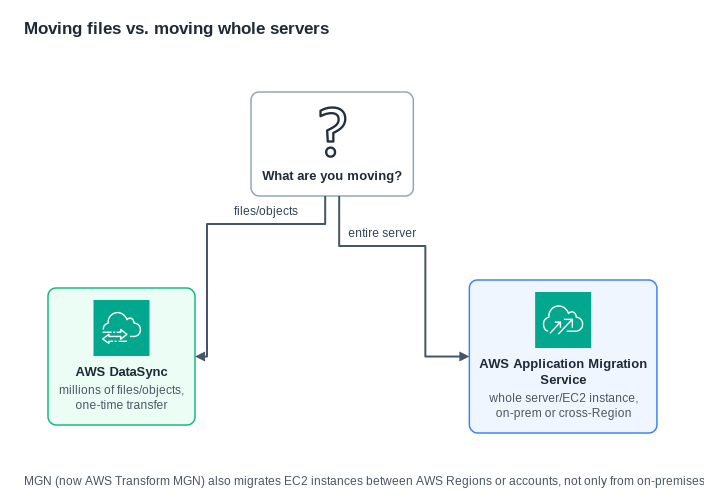
| One-time transfer of millions of files from on-premises to AWS | AWS DataSync | "AWS DataSync is a secure, reliable, high‑speed file transfer service" built to "quickly and easily transfer your file or object data to, from, and between AWS" storage, purpose-built for large one-time migrations. |
| Migrate EC2 instances between AWS Regions (or accounts) | AWS Application Migration Service (rebranded AWS Transform MGN) | Per AWS's own FAQ: "You can also use AWS Transform MGN to migrate Amazon EC2 instances between AWS Regions or between AWS accounts, and to migrate from EC2-Classic to a VPC." It is not limited to on-premises-to-cloud moves. |
| Choose where an Amazon RDS deployment physically runs | AWS Regions | "Each AWS Region is a separate geographic area," and an RDS DB instance "runs only in your current default AWS Region" — pick the Region nearest the existing location to minimize distance. |
Exam-content note: the service AWS documents as "AWS Application Migration Service" now appears in current AWS documentation as AWS Transform MGN; the capability (continuous block-level replication of physical, virtual, or cloud servers into AWS) is unchanged.
Account-level security, identity, and monitoring
| Need | Service | Why |
|---|---|---|
| Discover and protect sensitive data stored in S3 | Amazon Macie | "Amazon Macie is a data security service that discovers sensitive data by using machine learning" and automated classification, specifically over S3 data. |
| Find every S3 bucket whose ACL or bucket policy grants public/shared access | IAM Access Analyzer for S3 | Findings are generated "provided through a bucket access control list (ACL), a bucket policy, a Multi-Region Access Point policy, or an access point" — the console surfaces exactly which mechanism is responsible. |
| Centrally manage employee access across multiple AWS accounts | AWS IAM Identity Center | "IAM Identity Center gives you options to manage centrally your workforce access to" multiple accounts (formerly AWS Single Sign-On, renamed July 26, 2022). |
| Monitor and troubleshoot application logs and cloud resources | Amazon CloudWatch | Collects metrics, logs, and traces; a central CloudWatch account lets you "monitor and troubleshoot applications that span multiple accounts." |
| Check AWS service availability/operational issues, including an RSS feed | AWS Health Dashboard | View service health across Regions in the console; "an RSS feed is available for health events," though its format can change. |
| Deliver/share a custom AMI with prospective customers | AWS Marketplace | "As an AWS Marketplace seller, you can deliver your products to buyers with Amazon Machine Images (AMIs)." |
| Give remote employees a full Windows/Linux desktop from any device | Amazon WorkSpaces | Desktops "can run Microsoft Windows, Ubuntu Linux, Rocky Linux, or Red Hat Enterprise Linux," and "users can access their virtual desktops from multiple devices." AppStream 2.0 streams individual apps, not a full desktop. |
| Convert text into lifelike speech | Amazon Polly | "Amazon Polly is a cloud service that converts text into lifelike speech." |
| Deploy an application for global reach | Multi-Region architecture | A Multi-AZ deployment stays inside one Region; reaching users globally means placing resources across multiple geographic Regions — "AWS has the concept of a Region, which is a physical location around the world where we cluster data centers." |
EC2 backup and recovery building blocks
- Amazon Machine Images (AMIs): "You can launch multiple instances from a single AMI" — an AMI is an instance-level backup that can relaunch a replacement EC2 instance after loss.
- Amazon EBS snapshots: point-in-time volume backups — "You can back up the data on your Amazon EBS volumes by making point-in-time copies, known as" snapshots, restorable to new EBS volumes.
- Neither EC2 Reserved Instances (a pricing commitment) nor AWS Shield (DDoS protection) nor Amazon GuardDuty (threat detection) is a backup/recovery mechanism — AWS names only AMIs and EBS snapshots as EC2-level recovery tools.
Exam traps
- RDS's remaining customer job is IAM access control, not OS patching — AWS patches the RDS engine's OS; EC2 is the only one of the two where the customer patches the guest OS.
- On-Demand (no commitment, flexible, uninterruptible) vs. Spot (cheap but AWS can reclaim it) — "cannot stop before finishing" always rules out Spot.
- EC2 Auto Scaling changes the number of instances; Compute Optimizer/rightsizing changes instance size/type — don't confuse scaling out/in with resizing up/down.
- Network ACL = subnet-level firewall; security group = instance-level firewall — both block traffic; neither CloudWatch, CloudTrail, nor VPC Flow Logs can block anything.
- AWS Fargate (containers, no server management, hours-long runs) vs. AWS Lambda (15-minute cap) — a multi-hour containerized job needs Fargate, not Lambda.
- AWS Application Migration Service is now named AWS Transform MGN in current documentation, and it migrates EC2 instances between AWS Regions or accounts, not just from on-premises.
- AWS DataSync (files/objects, one-time or ongoing transfer) vs. AWS Application Migration Service/MGN (whole servers, continuous replication) — "millions of files" points to DataSync; "migrate the server/instance itself" points to MGN.
- Multi-Region (global reach) vs. Multi-AZ (resilience within one Region) — only Multi-Region spans more than one geographic Region.
- IAM Identity Center (workforce SSO across AWS accounts) was formerly named AWS Single Sign-On.
Docs
- Shared Responsibility Model
- AWS Well-Architected Framework – Shared responsibility
- Purchasing On-Demand Instances for Amazon EC2
- What is Amazon EC2 Auto Scaling?
- What is AWS Compute Optimizer?
- What is Amazon DynamoDB?
- In-memory acceleration with DynamoDB Accelerator (DAX)
- What Is Amazon Neptune?
- What is Amazon Athena?
- Getting started with Elastic Beanstalk
- AWS Fargate for Amazon ECS
- Lambda quotas
- What Is AWS CodeDeploy?
- Authentication and access using AWS SDKs and tools
- Monitor instance state changes with Amazon EventBridge
- Hosting a static website using Amazon S3
- What is Amazon Elastic File System?
- AWS Storage Gateway documentation
- Control subnet traffic with network access control lists
- AWS Direct Connect
- What is AWS DataSync?
- What Is AWS Application Migration Service?
- AWS Transform MGN FAQs
- Regions, Availability Zones, and Local Zones - Amazon RDS
- AWS Global Infrastructure
- What is Amazon Macie?
- Reviewing bucket access using IAM Access Analyzer for S3
- What is IAM Identity Center?
- What Is Amazon CloudWatch?
- AWS Health Dashboard – Service health
- AMI-based products in AWS Marketplace
- What is Amazon WorkSpaces?
- Amazon Polly documentation
- What are Amazon Machine Images?
- Amazon EBS snapshots