Exams / CLF-C02 / D2 Cloud Concepts
Cloud Concepts #2: The six advantages of cloud computing, AWS global infrastructure
- Exam domain: Content Domain 1: Cloud Concepts
This chapter covers the core "why cloud" vocabulary the exam drills hardest: the six advantages of cloud computing, elasticity vs. agility vs. economies of scale, AWS global infrastructure (Regions/AZs/edge locations), the shared responsibility model, the AWS Well-Architected Framework's six pillars and a few of its design principles, and the AWS Cloud Adoption Framework (CAF) — its six perspectives and the four-phase transformation journey.
The six advantages of cloud computing
AWS's whitepaper names exactly six advantages. The exam loves distractors that invert them (e.g. "trade variable expense for fixed expense") or that describe the on-premises world instead:
| Advantage | What it means | Typical exam phrasing |
|---|---|---|
| Trade fixed expense for variable expense | "Instead of having to invest heavily in data centers and servers... you pay only for how much you consume." | Pay-as-you-go pricing |
| Benefit from massive economies of scale | Aggregated demand across hundreds of thousands of customers lets AWS push unit costs down | High economies of scale |
| Stop guessing capacity | "Eliminate guessing on your infrastructure capacity needs" — scale up/down "with only a few minutes' notice" instead of over/under-provisioning | Elasticity, "scalable and high performance" |
| Increase speed and agility | "New IT resources are only a click away," cutting provisioning "from weeks to just minutes" — "a dramatic increase in agility" | Speed and agility, deploy in minutes |
| Stop spending money running and maintaining data centers | Focus on the business, not racking/stacking/powering servers | Reduced hardware troubleshooting, capacity planning, procurement |
| Go global in minutes | "Easily deploy your application in multiple regions around the world" for lower latency to international customers | Global reach |
Elasticity vs. agility is the single most tested distinction here:
- Elasticity = "the ability to acquire resources as you need them and release resources when you no [longer need them]" — it is about matching existing capacity to a changing load (rightsizing up or down).
- Agility = the speed of getting brand-new resources in the first place — "you can deploy technology services in a matter of minutes... several orders of magnitude faster than before."
A company that "cannot predict usage demand" needs elasticity/scalability; a company that "needs servers fast for a new line of business" needs agility. Both get marketed loosely as "scalable and high performance" in some AWS consumer-facing copy, so read the scenario (unpredictable load vs. lack of time) rather than keying only on the label.
AWS global infrastructure: Regions, Availability Zones, edge locations
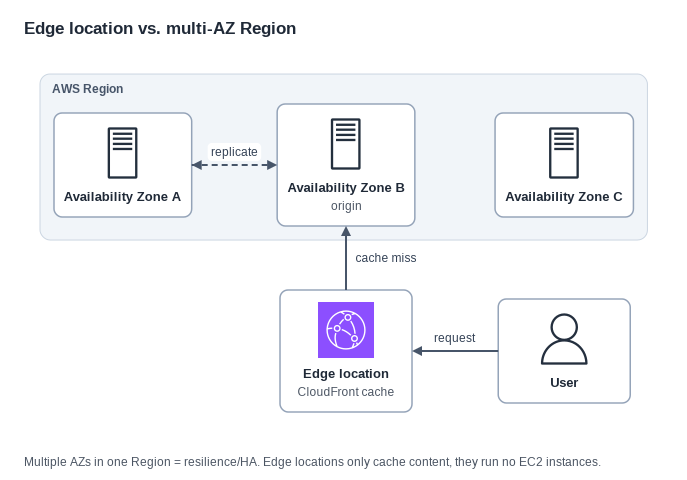
- A Region is a geographic area containing multiple, physically separate Availability Zones (AZs) — AWS states each Region has "multiple, independent locations known as Availability Zones." As of this writing AWS runs 124 AZs across 39 Regions — Regions are always the smallest of the three counts.
- An edge location (CloudFront point of presence / Regional edge cache) is a separate, much more numerous facility used to cache content and terminate DNS near end users — it is not an Availability Zone, and it runs no EC2 instances.
- Order of scale: Regions < Availability Zones < edge locations (hundreds of edge locations vs. a few dozen Regions, each holding multiple AZs).
- Multiple AZs in one Region → resilience / high availability: "It is a best practice to deploy your application in multiple Availability Zones, so that your application remains available even if one Availability Zone fails." This protects against a single data-center failure, not a Region-wide event.
- Multiple Regions → global reach / lower latency for international users, and survives a Region-wide disaster. A Region cannot be reproduced by just adding more AZs.
Shared responsibility model
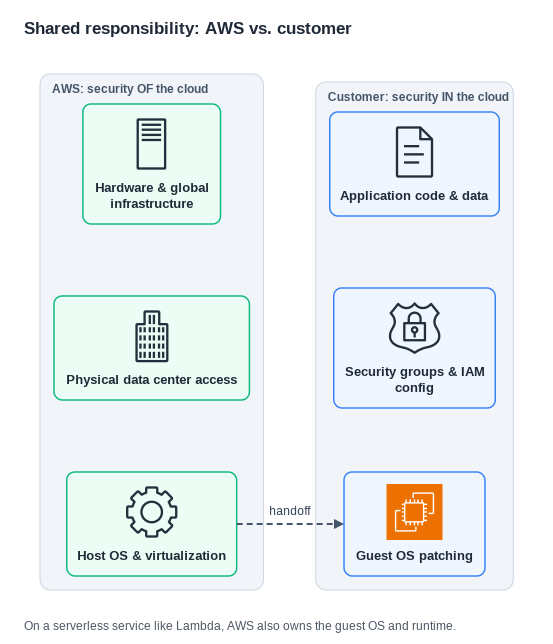
AWS is responsible for "security of the cloud"; the customer is responsible for "security in the cloud."
| Layer | Who, for EC2 | Who, for a managed/serverless service (e.g. Lambda, S3) |
|---|---|---|
| Physical facility access, underlying hardware | AWS | AWS |
| Host OS / virtualization (hypervisor) | AWS | AWS |
| Guest OS patching | Customer — "customers... are responsible for management of the guest operating system (including updates and security patches)" | AWS (no customer-facing guest OS exists) |
| Runtime / language runtime installation | Customer (self-managed on EC2) | AWS |
| Security group / firewall configuration | Customer | Customer |
| Application/business logic code, data, IAM configuration | Customer | Customer |
For AWS Lambda specifically: "AWS manages underlying infrastructure, instance patching, and" the runtime — the company is left responsible for writing the business-logic code and configuring IAM access to the function. For Amazon S3, there is no customer-managed host OS at all, so "patch the host OS on S3" is never the customer's job.
AWS Well-Architected Framework: the six pillars
The framework's "six pillars of operational excellence, security, reliability, performance efficiency, cost optimization, and sustainability" are a completely separate taxonomy from the AWS CAF perspectives below — a frequent trap when a question mixes the two lists.
| Pillar | Core idea | A tested design principle |
|---|---|---|
| Operational excellence | "A commitment to build software correctly while consistently delivering a great customer experience," with best practices for organizing teams and "evolving [the workload] over time" — i.e. continuous process/procedure improvement | Perform operations as code; make frequent, small, reversible changes |
| Reliability | Workload performs its function correctly and consistently | "Automatically recover from failure" by monitoring for failure conditions and triggering automated recovery; "test recovery procedures" |
| Performance efficiency | Use computing resources efficiently | Experiment, go global, use serverless architectures |
| Security | Protect data, systems, and assets | Apply security at every layer |
| Cost optimization | Avoid unneeded cost | Adopt a consumption model |
| Sustainability | Minimize environmental impact | "Maximize utilization" by right-sizing workloads; "reduce the downstream impact of your cloud workloads" — e.g. "eliminate the need for customers to upgrade their devices to use your services" |
A separate but related design principle, from the Reliability pillar's workload-segmentation guidance: "Monolithic architecture should be avoided whenever possible" — segment into SOA/microservices for better scalability, fault isolation, and agility, and favor loosely coupled components over tightly coupled ones.
AWS Cloud Adoption Framework (CAF): six perspectives
"AWS CAF groups its capabilities in six perspectives: Business, People," Governance, Platform, Security, and Operations. Each has named capabilities the exam likes to quiz individually:
| Perspective | What it covers | A named capability the exam tests |
|---|---|---|
| Business | Ensure cloud investment accelerates business outcomes | Data monetization — "leverage data to obtain measurable [business benefits]"; Business insights — "gain real-time insights and answer" strategic questions |
| People | "Serves as a bridge between" business and technology | Culture evolution — evolve to continuous growth/learning, making change business-as-normal |
| Governance | Orchestrate cloud initiatives while minimizing risk | Data curation — "collect, organize, access, and enrich" metadata "to organize an inventory of data products in a Data Catalog" |
| Platform | Build a scalable, hybrid cloud platform | Data architecture — organizing/storing data for quick, easy access |
| Security | Confidentiality, integrity, availability of data/workloads | Data protection, identity/access management |
| Operations | Operate, monitor and manage cloud workloads | Event management, service management |
Don't confuse CAF perspectives with Well-Architected pillars — "Governance" is a CAF perspective; "Reliability," "Performance efficiency," and "Sustainability" are Well-Architected pillars, not CAF perspectives, even though both lists contain six items.
The cloud transformation journey: four phases
| Phase | Focus | Exam phrasing |
|---|---|---|
| Envision | "Focuses on demonstrating how cloud" accelerates outcomes; identify/prioritize transformation opportunities and tie them to measurable business outcomes | "Identify measurable business outcomes that explain the value of migrating" |
| Align | "Focuses on identifying capability gaps across" the six CAF perspectives, surfacing cross-organizational dependencies | "Use CAF perspectives to identify capability gaps" |
| Launch | Delivers pilot initiatives in production | "Run pilots to validate the approach" |
| Scale | Expands proven pilots to full production, ensuring business benefits are realized | "Expand pilots to the whole organization" |
Exam traps
- Elasticity (match capacity to current load) vs. Agility (speed to get new resources in the first place) — read whether the scenario is about unpredictable demand (elasticity) or needing infrastructure fast (agility).
- Multiple AZs in one Region (resilience/HA) vs. multiple Regions (global reach, survives a Region-wide disaster) — edge locations run no EC2 instances at all, they only cache.
- Regions < Availability Zones < edge locations in count, by a wide margin at each step.
- Security of the cloud (AWS: hardware, host OS, facilities) vs. security in the cloud (customer: guest OS patches, app code, data, IAM, security groups) — for serverless/managed services (Lambda, S3) AWS also takes the guest OS/runtime, shrinking the customer's slice to code + data + IAM.
- AWS Well-Architected pillars (Operational Excellence, Security, Reliability, Performance Efficiency, Cost Optimization, Sustainability) vs. AWS CAF perspectives (Business, People, Governance, Platform, Security, Operations) — both lists have six items; don't swap them.
- CAF capability recall: Data monetization/Business insights: Business; Culture evolution → People; Data curation/catalog → Governance; Data architecture → Platform.
- Transformation journey order: Envision (business case): Align (capability gaps) → Launch (pilots) → Scale (expand to production).
- Avoid monolithic architecture; favor loosely coupled, segmented workloads and small frequent changes over large infrequent ones.
- "Stop guessing capacity" / "trade fixed for variable expense" are literal AWS phrases: watch for reversed distractors ("trade variable expense for fixed expense").
Docs
- Operational excellence - AWS Well-Architected Framework
- The pillars of the framework — AWS Well-Architected Framework
- AWS Well-Architected Framework — Reliability Pillar design principles
- REL03-BP01 Choose how to segment your workload
- Design principles for sustainability in the cloud
- AWS Regions and Availability Zones
- AWS Global Infrastructure
- What is AWS Outposts?
- AWS Shared Responsibility Model
- What is AWS Lambda?
- Six advantages of cloud computing
- What is cloud computing? – AWS
- Elastic - Reactive Systems on AWS
- AWS Cloud Adoption Framework: foundational capabilities
- AWS CAF: Business perspective
- AWS CAF: People perspective
- AWS CAF Governance perspective: Data curation
- AWS CAF Platform perspective: Data architecture
- AWS Cloud Adoption Framework: Your cloud transformation journey
- AWS Cloud Adoption Framework: Business Perspective