Exams / CLF-C02 / D1 Cloud Technology and Services
Cloud Technology and Services #7: Hybrid connectivity, Infrastructure as code
- Exam domain: Content Domain 3: Cloud Technology and Services
This pass covers hybrid connectivity, infrastructure-as-code, a wide band of AI/ML services, a few storage/database recognition questions, and a cluster of account-management and security tools. As in earlier parts, most questions want the one service that owns a job among plausible-sounding neighbours.
Hybrid connectivity: VPN vs. Direct Connect
Both let an on-premises network reach a VPC, but they are opposite trade-offs between setup speed and network guarantees.
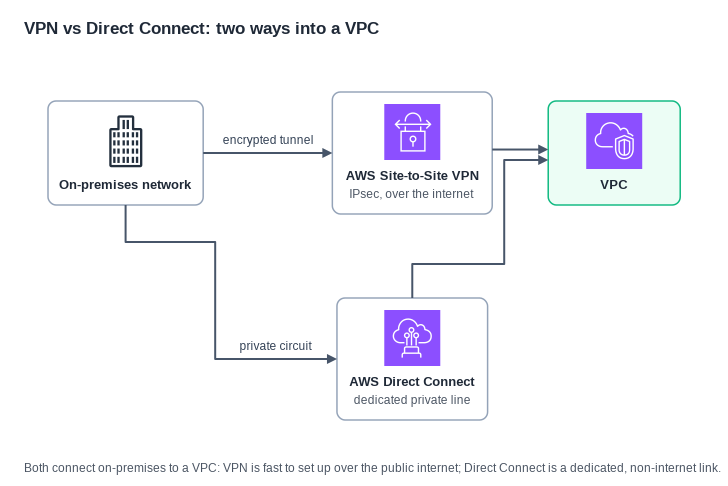
- AWS Site-to-Site VPN — "You can create an IPsec VPN connection between your VPC and your remote network." It runs over the public internet, so it is quick to provision but inherits internet variability.
- AWS Direct Connect — "Create a dedicated network connection to AWS" that "link[s] your AWS and on-premises networks to build applications that span environments without compromising performance." It is a private, non-internet circuit — the answer whenever a question says dedicated connection.
- A question asking for "two" ways to connect on-premises to a VPC (Choose two) wants both of these — Elastic Load Balancing, VPC peering, and CloudFront are all unrelated to hybrid on-premises connectivity.
Infrastructure as code: CDK vs. plain CloudFormation
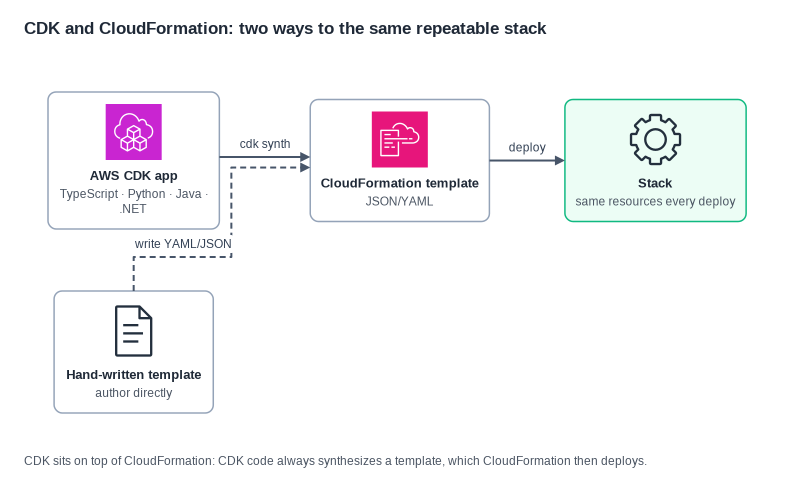
- AWS CloudFormation uses templates to model and provision stacks of resources; the exam's signal phrase for it is "reuse templates to replicate stacks in multiple environments" — the answer whenever a scenario needs the same environment stood up quickly and repeatedly (e.g., multiple test environments).
- AWS CDK is "an open-source software development framework for defining cloud infrastructure in code and provisioning it through AWS CloudFormation." It is the answer whenever the question names programming languages: "you can use any of the following programming languages to define your cloud infrastructure: TypeScript, JavaScript, Python, Java, C#/.Net, and Go."
- Don't confuse CDK with a replacement for CloudFormation — CDK code is synthesized into a CloudFormation template, which CloudFormation then deploys. If the question only mentions a template/stack with no programming language, the answer is plain CloudFormation; if it names TypeScript/Python/Java/.NET, it is CDK.
AI/ML services: match the input/output, not just "AI"
| Need | Service | Why not the others |
|---|---|---|
| Conversational chatbot (text/voice) | Amazon Lex | "Amazon Lex V2 enables any developer to build conversational chatbots quickly." |
| Automated image/video analysis (e.g., facial recognition) | Amazon Rekognition | "Amazon Rekognition provides you with APIs you can use to detect and analyze faces in images and [videos]." |
| Text-to-speech / accessibility audio | Amazon Polly | "Amazon Polly is a fully-managed service that generates voice on demand, converting any text to an audio stream." |
| Product recommendations from customer/interaction data | Amazon Personalize | "Amazon Personalize is a fully managed machine learning service that uses your data to generate item recommendations." |
| BI dashboards / ask questions in natural language over data | Amazon QuickSight (QuickSight Q for the NL layer) | See the rename note below — same job, new name. |
A quick way to tell these apart: Lex talks with a user, Rekognition looks at images/video, Polly turns text into speech, Personalize turns past behavior into recommendations, and QuickSight turns data into dashboards (optionally driven by natural-language questions).
Naming update: AWS has folded Amazon QuickSight into a broader product called AWS Quick — current docs say "AWS Quick evolved from Amazon QuickSight" and "AWS Quick Sight delivers AI-powered BI capabilities within Quick, transforming your scattered data into strategic insights for everyone." The natural-language querying feature (formerly "QuickSight Q") is now described as part of Quick Sight: it lets you "perform advanced data analysis in natural language ... and answer 'what-if' questions with step-by-step guidance." Exam material still says "Amazon QuickSight" / "QuickSight Q" — answer with that name, but recognize AWS Quick Sight if you see it in current AWS material.
Storage and databases seen in this batch
- Amazon S3 is "an object storage service that offers industry-leading scalability" at the lowest per-GB cost among AWS storage options — the answer for "durable, infinitely scalable, lowest cost" static content storage (EBS and EFS are block/file storage for compute, not internet-facing static content; Storage Gateway is a hybrid-storage bridge, not primary object storage).
- S3 Lifecycle — "S3 Lifecycle helps you store objects cost effectively throughout their lifecycle by" transitioning or expiring them automatically. This is the answer for "archive data that is no longer frequently accessed," not Versioning (keeps object history), Object Lock (prevents deletion), or Inventory (reports on objects).
- Amazon DynamoDB — "Amazon DynamoDB is a serverless, fully managed, distributed NoSQL database with single-digit millisecond performance at any scale," and its on-demand mode "instantly accommodates up to double the previous peak traffic on a table" without capacity planning — the answer whenever a NoSQL workload must auto-scale throughput.
- Amazon RDS — "Amazon Relational Database Service (Amazon RDS) is a web service that makes it easier to set up, operate, and scale a" relational engine such as MySQL, taking over hardware, patching, and replication from the customer.
- RDS for PostgreSQL vs. Amazon Aurora — both are managed, PostgreSQL-compatible choices: "Amazon RDS supports DB instances running several versions of PostgreSQL," and "Amazon Aurora (Aurora) is a fully managed relational database engine that's compatible with" MySQL and PostgreSQL. A "Choose two" migration question that says "compatible with PostgreSQL" wants both RDS and Aurora — Athena queries S3 data, EC2 is unmanaged self-hosting, and DynamoDB is NoSQL, so none of those three fit.
Account management, governance, and security tools
| Tool | Job | Signal phrase |
|---|---|---|
| AWS Management Console | Graphical, web-based interface to manage services | "Access and manage over 200 AWS services from one web interface." |
| AWS CLI | Unified, consistent command-line tool across services | "The AWS Command Line Interface (AWS CLI) is an open source tool that enables you to interact with AWS" |
| AWS access key | Credential required for CLI/API programmatic access | access keys "sign programmatic requests to the AWS CLI or AWS API" — username/password is for the Console only |
| AWS Trusted Advisor | Best-practice checks spanning cost, security, performance, and more | "continuously evaluates your AWS environment using best practice checks across the categories of cloud cost optimization, performance, resilience, security, operational excellence, and service limits" and helps "identify unused resources and opportunities to lower your costs" |
| AWS Cost Explorer + AWS Compute Optimizer | EC2 rightsizing recommendations | Cost Explorer's "rightsizing recommendations feature" flags underutilized EC2 instances; Compute Optimizer analyzes utilization data for the same purpose — the exam's "Choose two" rightsizing answer |
| AWS Backup | Centralized, automated backup across AWS + hybrid workloads | "AWS Backup is a fully-managed service that makes it easy to centralize and automate data" protection |
| AWS CloudTrail | Records account activity, including every API call | "An event in CloudTrail is the record of an activity in an AWS account." |
| AWS IAM Access Analyzer | Finds resources shared with entities outside the account/org | "IAM Access Analyzer external access analyzers help identify resources in your" organization shared externally |
| AWS Marketplace | Catalog to deploy third-party software (e.g., a pre-installed firewall) as an AMI | "AWS Marketplace is a curated digital catalog that customers can use to find, buy, deploy, and manage" third-party software |
| AWS WAF | Custom rules to filter/control web traffic, including by country | "A protection pack (web ACL) gives you fine-grained control over all of the HTTP(S) web requests"; geo-blocking uses "geographic or geo match statements to manage web requests based on country" |
Naming update: AWS WAF's web ACL is being renamed a protection pack in current documentation (shown as "protection pack (web ACL)"). The service and its job are unchanged — expect either name on the exam.
Global performance: CloudFront, Route 53, and Global Accelerator
- Amazon CloudFront is the CDN: it "securely deliver[s] content with low latency and high transfer speeds" by caching content at edge locations close to users — the answer for "global audience, minimum latency" when the content itself can be cached.
- Amazon Route 53 is DNS, not a performance accelerator: "Amazon Route 53 is a highly available and scalable Domain Name System (DNS) web service." It only resolves names to IP addresses.
- AWS Global Accelerator improves performance and failover for traffic across multiple Regions by routing over the AWS global network: "AWS Global Accelerator is a service in which you create accelerators to improve the performance" of internet applications, including handling multi-Region deployments that need both speed and resilience (CloudFront is content-focused; Global Accelerator works for any TCP/UDP traffic, not just cacheable content).
Loose coupling: SQS and Step Functions
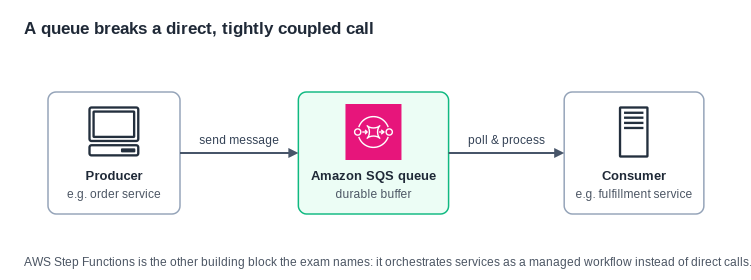
- Amazon SQS — "You can use Amazon Simple Queue Service (Amazon SQS) to integrate and decouple distributed systems." A queue sitting between producer and consumer means neither has to call the other directly or be available at the same time.
- AWS Step Functions — "Step Functions help you coordinate multiple AWS services into flexible workflows," which is also a recognized way to loosely couple components (the orchestrator calls each step, not one component calling another directly).
- A "loosely coupled architecture, choose two" question wants SQS + Step Functions: WorkSpaces is a virtual desktop, Connect is a contact center, and Trusted Advisor is a recommendations tool — none of them decouple application components.
Other services seen in this batch
- Amazon Lightsail launches from "a pre-configured application, or development stack—such as WordPress, Windows," and similar blueprints — the answer for "preconfigured application stacks, simple instances."
- AWS Glue — "AWS Glue is a fully managed ETL (extract, transform, load) service that allows you to easily move data between different data sources," performing transformations along the way.
Exam traps
- VPN (internet, fast to set up) vs. Direct Connect (dedicated, private line) — "dedicated network connection" always points to Direct Connect; a plain "connect on-premises to a VPC" with no dedication requirement can be either, and a "Choose two" version wants both.
- CDK names a programming language (TypeScript/Python/Java/.NET); plain CloudFormation does not — CDK always synthesizes into a CloudFormation template; it is a layer on CloudFormation, not a competitor to it.
- Amazon Elastic Transcoder was discontinued on November 13, 2025 — AWS's current advice is to migrate to AWS Elemental MediaConvert. Exam material (written before the retirement) still expects "Amazon Elastic Transcoder" as the answer for "convert video/audio to play on smartphones"; know that MediaConvert is the service that actually does this job today.
- Amazon QuickSight → AWS Quick / AWS Quick Sight is a live rebrand — answer with "QuickSight" / "QuickSight Q" if that is what the exam material names, but don't be confused if current AWS docs call it Quick Sight.
- AWS WAF's "web ACL" is now called a "protection pack" in current docs — same feature, same service, new label.
- Cost Explorer + Compute Optimizer = EC2 rightsizing (Choose two) — Trusted Advisor also flags underutilized resources but is the broader best-practices tool, not the dedicated rightsizing answer when the question names "Choose two" from a list that includes Cost Explorer/Compute Optimizer.
- Access key = CLI/API credential; username+password = Console only. Note also that AWS's current best-practice guidance favors temporary credentials (IAM roles) over long-term access keys, even though the exam still tests "access key" as the CLI requirement.
- S3 Lifecycle (archiving over time) vs. S3 Versioning/Object Lock (protecting objects) vs. S3 Inventory (reporting) — only Lifecycle changes storage class or deletes objects automatically to cut cost.
- CloudFront (CDN, caches content) vs. Route 53 (DNS only) vs. Global Accelerator (routes any TCP/UDP traffic over AWS's network, improves multi-Region failover) — don't substitute one for another.
- SQS and Step Functions both loosely couple components, through a queue and through managed orchestration respectively — a "Choose two" loose-coupling question wants both.
Docs
- What is Amazon Lex V2?
- Connect your VPC to remote networks using AWS Virtual Private Network
- What is Direct Connect?
- AWS Direct Connect
- AWS Trusted Advisor
- What is Amazon DynamoDB?
- DynamoDB on-demand capacity mode
- Optimizing your cost with rightsizing recommendations
- What is AWS Marketplace?
- What is Amazon Lightsail?
- AWS CloudFormation best practices
- Amazon Elastic Transcoder
- AWS Management Console
- Detecting and analyzing faces
- What is the AWS CDK?
- What is Amazon Route 53?
- Managing the lifecycle of objects - Amazon S3
- Using AWS IAM Access Analyzer
- What is Amazon Personalize?
- Amazon QuickSight (what is / AWS Quick)
- Amazon QuickSight
- What is AWS Backup?
- Configuring protection in AWS WAF
- AWS WAF geographic match rule statement
- Getting started with Amazon S3
- Amazon Polly
- What Is Amazon CloudFront?
- What is Amazon RDS?
- Amazon RDS for PostgreSQL
- What is Amazon Aurora?
- AWS Well-Architected Framework: Implement loosely coupled dependencies
- Manage access keys for IAM users
- AWS Glue concepts
- What is AWS Global Accelerator?
- What is the AWS Command Line Interface?
- Understanding CloudTrail events