Exams / CLF-C02 / D1 Cloud Technology and Services
Cloud Technology and Services #3: Compute and deployment, Messaging, caching, search, and BI
- Exam domain: Content Domain 3: Cloud Technology and Services
This chapter groups a wide spread of services that CLF-C02 tests one fact at a time: compute, messaging, migration, content delivery, networking/security layers, identity, storage/file access, databases, and the Well-Architected Framework. The goal is to pin down which service does which one thing, because the exam's distractors are almost always a plausible-sounding neighbour service that does something adjacent but different.
Compute and deployment: picking the right launch model
| Need | Service | Why not the others |
|---|---|---|
| Run code with zero server management, pay per invocation | AWS Lambda | Elastic Beanstalk still provisions EC2/EKS capacity; CloudFormation only provisions infrastructure |
| Deploy a non-containerized web app fast, with automatic capacity/load-balancing/scaling/health monitoring | AWS Elastic Beanstalk | ECS/EKS need container orchestration; Lambda is event-driven, not a persistent web host |
| Plan, schedule, and run hundreds of thousands of batch compute jobs | AWS Batch | Step Functions orchestrates workflow steps, not raw job scheduling at this scale; SQS is just a queue |
| Stream a compute-/graphics-intensive application to lightweight laptops | Amazon AppStream 2.0 (now Amazon WorkSpaces Applications) | AppSync builds GraphQL APIs; Elastic Beanstalk hosts a backend, it doesn't stream a UI |
| Deliver managed virtual desktops to employees, reachable by client or browser | Amazon WorkSpaces | Fargate runs containers; Dedicated Hosts are physical EC2 capacity, not desktops |
| Define infrastructure in a general-purpose language, deploy it via CloudFormation | AWS CDK | The CLI only calls APIs; CodeStar is CI/CD project scaffolding, not an IaC framework |
AWS Lambda is defined plainly as "a serverless compute service" — no server to provision, patch, or scale by hand. Elastic Beanstalk sits one level up the stack: it "provisions Amazon EC2 instances or EKS clusters, configures load balancing, sets up health monitoring, and dynamically scales your environment" automatically, which is exactly why it is the answer whenever a question wants fast deployment and hands-off capacity management for a traditional (non-containerized) runtime such as Node.js or Java. AWS Batch exists for the opposite shape of problem — not "run my web app" but "run an enormous number of discrete jobs" — and documentation is explicit that it "is a fully managed batch computing service that plans, schedules, and runs your" workloads at scale.
AppStream 2.0 is a renamed service — a genuine exam trap for anyone studying from current AWS docs. The AWS Cloud Development Kit is unambiguous about its own job: it is "an open-source software development framework for defining cloud infrastructure in code and provisioning it through AWS CloudFormation." CDK never replaces CloudFormation — it generates the templates CloudFormation still deploys.
Messaging, caching, search, and BI: one-line identities
| Service | One-line identity | Common distractor |
|---|---|---|
| Amazon SNS | Pub/sub: publishers send to a topic, every subscriber gets the message | Amazon SQS (a queue, not pub/sub) |
| Amazon CloudFront | CDN that caches content at globally distributed edge locations | Amazon Route 53 (DNS, no caching) |
| Amazon Kendra | Indexes and searches text inside documents, including an S3 bucket as a data source | Amazon Athena (SQL over structured S3 data, not free text) |
| Amazon QuickSight | BI dashboards with built-in ML Insights (anomaly detection, forecasts, narratives) | Amazon Redshift (the warehouse data lives in, not the dashboard) |
| Amazon Neptune | Fully managed graph database for highly connected data | DynamoDB/RDS/Aurora (key-value, relational — not graph) |
SNS's model is stated directly: "In SNS, publishers send messages to a topic, which acts as a communication channel" and every subscriber on that topic receives it — the textbook publisher/subscriber pattern, and the only AWS service among typical choices built around it. CloudFront's value is that static and dynamic objects "are now held (or cached) in multiple edge locations around the world," so a request is served from whichever edge location is closest to the viewer. Kendra's distinguishing feature versus Athena or S3 Select is that it understands document content, not just metadata — "you can use Amazon Kendra to index your Amazon S3 bucket repository" and then run natural-language search over it. Neptune is purpose-built, not a general database pressed into service: it is "a fast, reliable, fully managed graph database service that makes it easy to build and run applications that work with highly connected datasets" — social graphs, recommendation engines, knowledge graphs.
Migration and storage protocol gateways
| Need | Service | Why not the others |
|---|---|---|
| Rehost a whole on-prem VM to run natively on AWS infrastructure, automatically | AWS Application Migration Service (MGN) | DataSync moves files, DMS migrates databases, Application Discovery Service only assesses servers |
| Fully managed Windows file server, native SMB + NTFS/AD support | Amazon FSx for Windows File Server | EFS is Linux/NFS-oriented; FSx for Lustre targets HPC; EBS is single-instance block storage |
| Let on-prem apps read/write S3 objects over standard NFS or SMB | Amazon S3 File Gateway | DataSync and Transfer Family move/transfer data, they don't mount S3 as a live file share |
| A connection that needs both an ISP/network provider and a colocation facility | AWS Direct Connect | AWS VPN only needs internet access; an internet gateway is a VPC-side component |
| Keep part of a workload on-premises for compliance, still "AWS" underneath | AWS Outposts | AWS Config only audits configuration; Lightsail and Connect are unrelated services |
AWS MGN replicates a source server continuously and, at cutover, "converts the disks of your source server to boot and run on AWS" — no manual re-platforming. For Windows-native file sharing, FSx for Windows File Server "has native support for Windows file system features" and "the industry-standard Server Message Block (SMB) protocol to access file storage," which is the whole reason it beats EFS (NFS, Linux-oriented) on any Microsoft-workload question. S3 File Gateway solves a related but different problem — not replacing a file server, but exposing S3 through "protocols such as Network File System (NFS) and Server Message Block (SMB)" so legacy on-prem apps keep working unchanged.
Direct Connect is the only connectivity option that is physically anchored to a building: it requires working "with an independent service provider to connect to" AWS, landing "in the same data center/colocation facility" as an AWS Direct Connect location. AWS Outposts takes the opposite direction — it brings AWS in, extending "AWS infrastructure and services to virtually any on-premises or edge location for a truly consistent hybrid experience," which is why it (not AWS Config, which only reports on compliance) is the answer whenever a question needs part of a workload to stay physically on-site.
Layered network security: WAF, NACL, security group, Firewall Manager
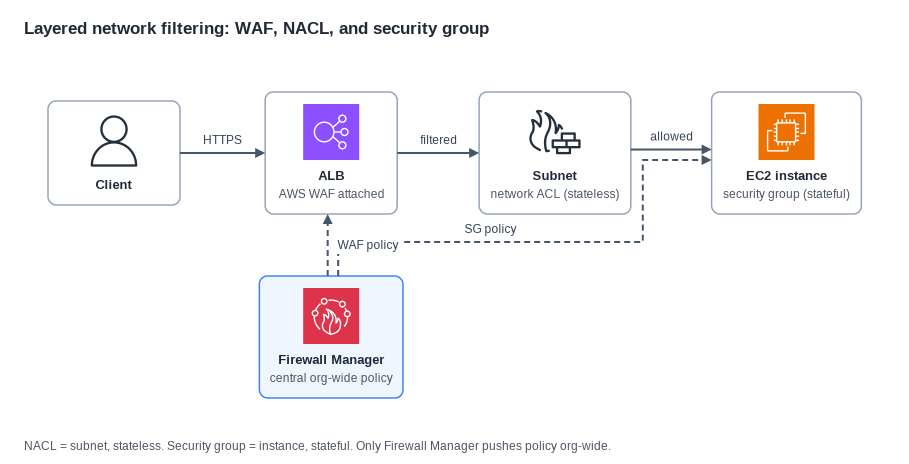
| Control | Layer | Stateful? | Scope |
|---|---|---|---|
| AWS WAF | Application (layer 7) | n/a (rule-based) | A single ALB, CloudFront distribution, API Gateway, etc. |
| Security group | Instance (ENI) | Stateful | One or more instances |
| Network ACL (NACL) | Subnet | Stateless | An entire subnet |
| AWS Firewall Manager | Organization-wide policy | n/a | Pushes/audits WAF and security-group policy across every account in an AWS Organizations org |
This is one of the exam's most recycled traps: subnet-level firewall = NACL, instance-level firewall = security group, and centrally managed across accounts = Firewall Manager, not WAF or GuardDuty. The NACL page is explicit that it lets you "control subnet traffic with network access control lists" — inbound and outbound for the whole subnet — while "a security group acts as a virtual firewall for your EC2 instances" one level down. AWS WAF only ever attaches to a short list of resources: you "can only associate a protection pack (web ACL) to an Application Load Balancer within AWS Regions" (plus CloudFront, API Gateway, AppSync, Cognito, App Runner, Verified Access) — never directly to an EC2 instance or a Network Load Balancer. Firewall Manager is the odd one out in that it manages other controls rather than filtering traffic itself: it lets an administrator "apply common security groups to specified accounts and resources" from one place, which is why "centrally manage security groups across multiple accounts" always resolves to Firewall Manager.
Identity: temporary credentials, roles, and groups
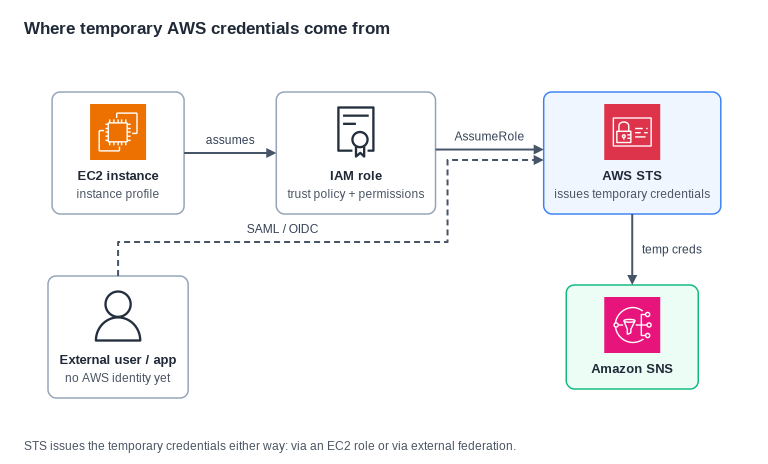
| Need | Use | Not |
|---|---|---|
| Temporary, short-lived credentials — for an EC2 app, a federated external user, or an assumed role | AWS STS | IAM policies/groups organize permissions but issue nothing; ACM and Secrets Manager handle certificates/long-term secrets |
| An EC2-hosted app needs to call another AWS service (e.g. SNS) without embedded keys | IAM role, attached via an instance profile | Access keys stored in code or Parameter Store are long-lived and higher-risk |
| Grant the same permissions to many people at once | IAM user groups | Security groups filter network traffic; resource groups just organize resources by tag |
Every temporary-credential question in this module — whether the scenario says "federated access," "a developer needs temporary credentials," or "an EC2 application needs permission" — resolves to AWS STS, because "temporary credentials are the basis for roles and identity federation." The two paths in the diagram both end at STS: an EC2 instance's attached IAM role is exactly how you "manage temporary credentials for applications that run on an Amazon EC2 instance" instead of hard-coding access keys, while an external identity provider reaches AWS through the same STS service via SAML or OIDC federation. For permissions management rather than credentials, IAM user groups do the job: "user groups let you specify permissions for multiple users, which can make it" far simpler to manage access at scale than editing each user individually.
Encryption keys, DDoS protection, and governance tools
| Need | Service | Not |
|---|---|---|
| Fully customer-controlled encryption keys, dedicated hardware | AWS CloudHSM | License Manager (software licenses), ACM (TLS certs), Directory Service (user directories) |
| Protect a public website from DDoS attacks | AWS Shield | Resource Access Manager, Amplify, and GuardDuty each do an adjacent but different job |
| Best-practice recommendations across cost, performance, security, fault tolerance, and service limits | AWS Trusted Advisor | Shield and WAF cover security only; Service Catalog manages a catalog of approved products |
| The Well-Architected practice demonstrated by splitting a monolith into microservices | Implement loosely coupled dependencies (Reliability pillar) | Functional testing, deployment automation, and multi-location deployment are separate, unrelated best practices |
CloudHSM's whole value proposition is hardware-backed, customer-owned key material: "a hardware security module (HSM) is a computing device that processes cryptographic operations and provides secure storage for cryptographic keys," giving a level of control that AWS KMS's shared-tenancy model does not offer. AWS Shield exists specifically because "protection against Distributed Denial of Service (DDoS) attacks is of primary importance for your internet-facing" applications — GuardDuty can tell you an attack is happening, but Shield is what actually mitigates it. Trusted Advisor is the one service whose job spans all five named categories at once, since it "inspects your AWS environment, and then makes recommendations" across cost, performance, security, fault tolerance, and service limits — a narrower tool like WAF or Shield only ever covers the security slice. Finally, decomposing a monolith into independent, interface-bound components is the textbook description of the Reliability pillar's practice: "loose coupling breaks this dependency so that dependent components only need to know the versioned and published interface," letting each piece scale and fail independently.
Exam traps
- Subnet-level firewall = network ACL (stateless). Instance-level firewall = security group (stateful). Mixing these up is the single most repeated trap in this module.
- AWS WAF only attaches to specific resources (ALB, CloudFront, API Gateway, AppSync, Cognito, App Runner, Verified Access) — never directly to an EC2 instance or a Network Load Balancer.
- Centrally managing security groups or WAF across an AWS Organizations org is AWS Firewall Manager's job, not plain AWS WAF, GuardDuty, or Detective.
- AWS STS is the service that actually issues temporary credentials, whether the scenario is an EC2 instance role or external SAML/OIDC federation — IAM policies and groups just define permissions.
- "Amazon AppStream 2.0" is now "Amazon WorkSpaces Applications" in current AWS documentation; the exam's older questions still use the AppStream 2.0 name and choice text.
- AWS Direct Connect is the only connectivity option needing a physical colocation facility plus a network/ISP provider — AWS VPN only needs internet access.
- AWS Trusted Advisor is the only tool spanning all five categories (cost, performance, security, fault tolerance, service limits) — Shield and WAF only cover security.
- AWS MGN converts whole servers/VMs automatically; it is not a file- or database-migration tool (that's DataSync and DMS respectively).
- An ELB does not scale compute capacity itself (Auto Scaling does) and does not span multiple Regions — it distributes traffic across targets within a Region's Availability Zones.
Docs
- What is AWS Lambda?
- What is AWS Elastic Beanstalk?
- What is AWS Batch?
- Amazon AppStream 2.0 / Amazon WorkSpaces Applications
- What is Amazon WorkSpaces?
- What is the AWS CDK?
- What is Amazon SNS?
- What Is Amazon CloudFront?
- Amazon S3 data source for Amazon Kendra
- Gaining insights with machine learning (ML) in Amazon QuickSight
- What Is Amazon Neptune?
- What Is AWS Application Migration Service?
- What is FSx for Windows File Server?
- What is Amazon S3 File Gateway
- What is AWS Direct Connect?
- Requesting cross connects at Direct Connect locations
- AWS Outposts
- Control subnet traffic with network ACLs
- Amazon EC2 security groups for your EC2 instances
- Associating a web ACL with an Application Load Balancer
- Using security group policies in Firewall Manager to manage Amazon VPC security groups
- Temporary security credentials in IAM
- Use an IAM role to grant permissions to applications running on Amazon EC2 instances
- IAM user groups
- What is AWS CloudHSM?
- AWS Shield Documentation
- Get started with Trusted Advisor Recommendations
- REL04-BP02 Implement loosely coupled dependencies
- AWS Managed Services
- Elastic Load Balancing