Exams / CLF-C02 / D1 Cloud Technology and Services
Cloud Technology and Services #2: Global infrastructure, Audit activity
- Exam domain: Content Domain 3: Cloud Technology and Services
Global infrastructure: Region, Availability Zone, edge location
| Term | What it is | Picked when the question asks for |
|---|---|---|
| Region | A physical geographic location (the region's "geography") | "A physical location within the AWS global infrastructure" |
| Availability Zone (AZ) | One or more discrete data centers in a Region, each with its own redundant power, networking, and connectivity | "Different physical locations, same geographic area, separate power grids/networking" |
| Edge location | A CloudFront point of presence, physically closer to end users than the nearest Region | Reducing latency for globally distributed users |
"The geography for a Region is the specific physical location of its infrastructure." — AWS Regions and Availability Zones
"Each Availability Zone consists of one or more discrete data centers, each with redundant power, networking, and connectivity, and housed in separate" [facilities] — AWS Regions and Availability Zones
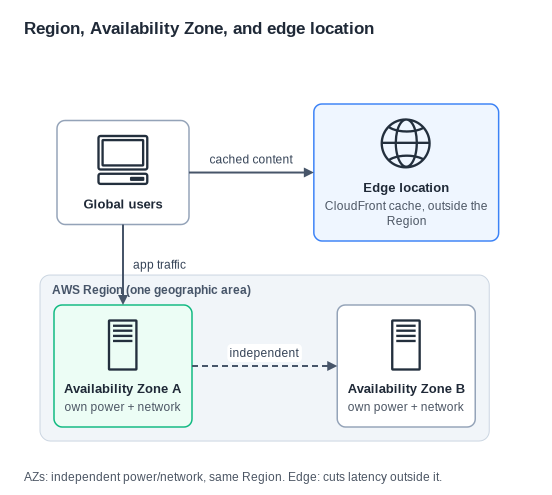
A question that names "a physical location" wants Region; one that adds "multiple locations, same geographic area, independent power and networking" wants multiple Availability Zones in that Region — never Amazon Connect, AWS Artifact, or any other service name mixed into the distractors. The broader reason users get low latency worldwide is AWS's global infrastructure itself (Regions + AZs + edge locations placed near users) — not pay-as-you-go pricing, managed services, or economy of scale, which are cost/operational benefits, not latency mechanisms.
"With nearly 20 million kilometers of fiber optic cabling, AWS's global network backbone enables faster data transfer, reduced latency, and enhanced application performance." — AWS Global Infrastructure
Audit activity vs. audit configuration vs. alert
| Need | Service | Captures |
|---|---|---|
| Who did what, when (API calls, console actions) | AWS CloudTrail | Caller identity + action + timestamp |
| How a resource's configuration changed over time | AWS Config | Configuration state history, compliance rules |
| Notify someone when a CloudWatch alarm fires | CloudWatch Alarm → Amazon SNS | Push notification (email/SMS) to subscribers |
| Cross-account/external sharing of a resource (e.g., an S3 bucket) | IAM Access Analyzer | External-access findings |
"You can identify who or what took which action, what resources were acted upon, when the event occurred, and other details to help" [you analyze and respond to activity] — AWS CloudTrail User Guide
"AWS Config provides a detailed view of the configuration of AWS resources in your AWS" [account] — What Is AWS Config?
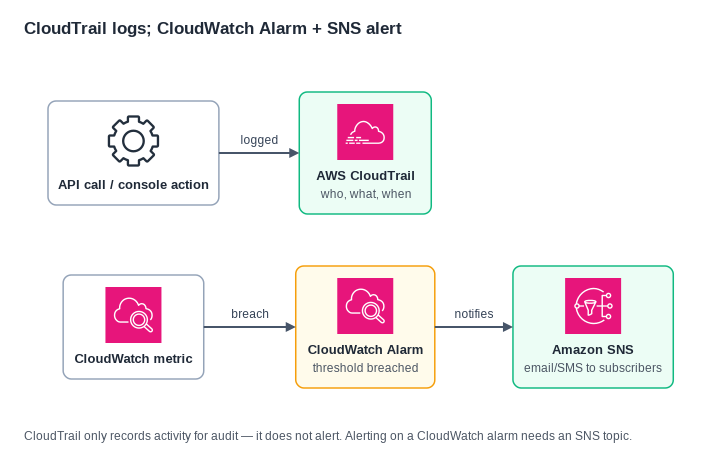
Exam trap: CloudTrail never sends a notification by itself — if a question's answer choices include CloudTrail as a way to "alert" on a CloudWatch alarm, it's a distractor. The alerting pair is always CloudWatch Alarm → Amazon SNS; EventBridge can route events but is not the documented primary CloudWatch-alarm notification target, and SQS only queues messages for a polling consumer, it does not push alerts.
"action can be sending a notification to an Amazon SNS topic, performing an Amazon EC2 action or an" — Using Amazon CloudWatch alarms
"IAM Access Analyzer helps you identify the resources in your organization and accounts, such as Amazon S3 buckets or IAM roles, shared with an external entity." — Using AWS IAM Identity and Access Management Access Analyzer
Multi-account identity: one login, many accounts
AWS IAM Identity Center (formerly AWS Single Sign-On) is the answer whenever a question describes "one set of credentials" to sign into several AWS accounts in an AWS Organizations structure — whether phrased as "authenticate and authorize across accounts" or "manage multiple logins." An IAM user is scoped to one account; AWS Organizations groups and governs accounts but doesn't itself provide sign-in; AWS Control Tower automates setting up the multi-account landing zone but delegates the actual federated sign-in to IAM Identity Center.
"IAM Identity Center gives you options to manage centrally your workforce access to" [multiple AWS accounts] — What Is IAM Identity Center?
"On July 26, 2022, AWS Single Sign-On was renamed to AWS IAM Identity Center." — What Is IAM Identity Center?
AWS Control Tower is the next layer up: it sets up a well-architected, governed multi-account environment (a "landing zone") on top of AWS Organizations, automating account creation and baseline guardrails.
"Your landing zone is a well-architected multi-account environment for all of your AWS resources." — How AWS Control Tower works
Infrastructure as code and service governance
| Need | Service |
|---|---|
| Template AWS resources once, provision repeatedly/consistently (IaC) | AWS CloudFormation |
| Govern and distribute approved IT products/templates (incl. CloudFormation and Terraform) with portfolios and constraints | AWS Service Catalog |
"Reuse your CloudFormation template to create your resources in a consistent and repeatable" [way] — What is CloudFormation?
"Service Catalog administrators prepare CloudFormation templates, configure constraints, and manage IAM roles for products to provide for advanced resource" [governance] — AWS Service Catalog: Overview
Exam trap: CodeDeploy, CodeBuild, Elastic Beanstalk, and Systems Manager all touch "deployment" or "operations," but none of them template infrastructure the way CloudFormation does.
Compute without managing servers
| Need | Service | Why |
|---|---|---|
| Run application code on events/API calls, no servers to provision | AWS Lambda | Serverless, general-purpose compute |
| Run containers without managing the underlying servers | AWS Fargate | Serverless compute engine for ECS/EKS |
| Run a simple SQL query directly over files already in S3, no infrastructure | Amazon Athena | Serverless, interactive, standard SQL |
"AWS Lambda is a serverless compute service." — What is AWS Lambda?
"AWS Fargate is a serverless, pay-as-you-go compute engine that lets you focus on building applications without managing servers." — AWS Fargate
"Amazon Athena is an interactive query service that makes it easy to analyze data directly in Amazon Simple Storage Service (Amazon S3) using standard SQL." — What is Amazon Athena?
Migrating an on-premises container platform to AWS while avoiding unplanned admin cost and moving toward serverless → Fargate, not EC2 (still server management) or Lightsail (simple VPS, not a container orchestrator).
Storage: S3 fundamentals and private access
Amazon S3 is object storage — not block storage (that's EBS) and not a native SMB/NFS file service (that needs Storage Gateway or FSx/EFS). Its documented storage capacity is virtually unlimited: no cap on total data or object count, with each object up to 5 TB.
"Amazon Simple Storage Service (Amazon S3) is an object storage service that offers industry-leading scalability," [data availability, security, and performance] — What is Amazon S3?
"The total volume of data and number of objects you can store in Amazon S3 are unlimited." — Amazon S3 FAQs
To reach S3 from inside a VPC without the internet, use a VPC endpoint (a gateway endpoint for S3/DynamoDB) — not a VPN, an internet gateway, or a NAT gateway, all three of which involve internet connectivity in some form.
"gateway endpoint to send traffic to Amazon S3 or DynamoDB." — VPC endpoints
Databases: pick the managed engine that matches the source and the HA need
- On-premises MariaDB (or any common relational engine) moving to AWS with least operational overhead → Amazon RDS for that same engine (not Neptune/graph, S3/object, or DynamoDB/NoSQL).
- High availability + fault tolerance for an RDS database → Multi-AZ deployment (automatic failover to a standby in another AZ) — single-AZ has no failover, snapshots are backup-only, and DMS migrates data rather than providing HA.
- Trillions of time-series events per day → Amazon Timestream, a purpose-built time-series database (not Neptune/graph, Forecast/ML, or DocumentDB/document).
- Moving a commercial database to an Amazon-managed open-source engine (e.g., Oracle → PostgreSQL/MySQL) → AWS Schema Conversion Tool (converts the schema) + AWS Database Migration Service (moves the data). Neither tool alone finishes a heterogeneous migration.
"Amazon RDS supports several versions of MariaDB for DB instances." — Amazon RDS for MariaDB
"A Multi-AZ DB instance deployment has one standby DB instance that provides failover support, but doesn't serve read traffic." — Configuring and managing a Multi-AZ deployment for Amazon RDS
"that makes it easy to store and analyze trillions of time series data points per day." — What is Amazon Timestream for LiveAnalytics?
"DMS Schema Conversion reads your source metadata, and you can run an assessment to see what converts automatically and what needs manual work." — Converting database schemas using DMS Schema Conversion
Private network connectivity
| Need | Service |
|---|---|
| Dedicated connection, on-premises ↔ AWS, no public internet | AWS Direct Connect |
| One connection scaling to hundreds of VPCs in a Region | AWS Transit Gateway (integrates with Direct Connect via a Direct Connect gateway + transit VIF) |
| Private access from a VPC to Amazon S3/DynamoDB, no internet | VPC endpoint (gateway endpoint) |
| Highly available, scalable DNS for a global application | Amazon Route 53 |
"Direct Connect links your internal network to a Direct Connect location over a standard Ethernet" [connection, bypassing internet service providers] — What is AWS Direct Connect?
"AWS Transit Gateway is a network transit hub used to interconnect virtual private clouds (VPCs)" [and on-premises networks] — What is AWS Transit Gateway for Amazon VPC?
"Amazon Route 53 provides highly available and scalable Domain Name System (DNS), domain name registration, and health-checking cloud services." — Amazon Route 53
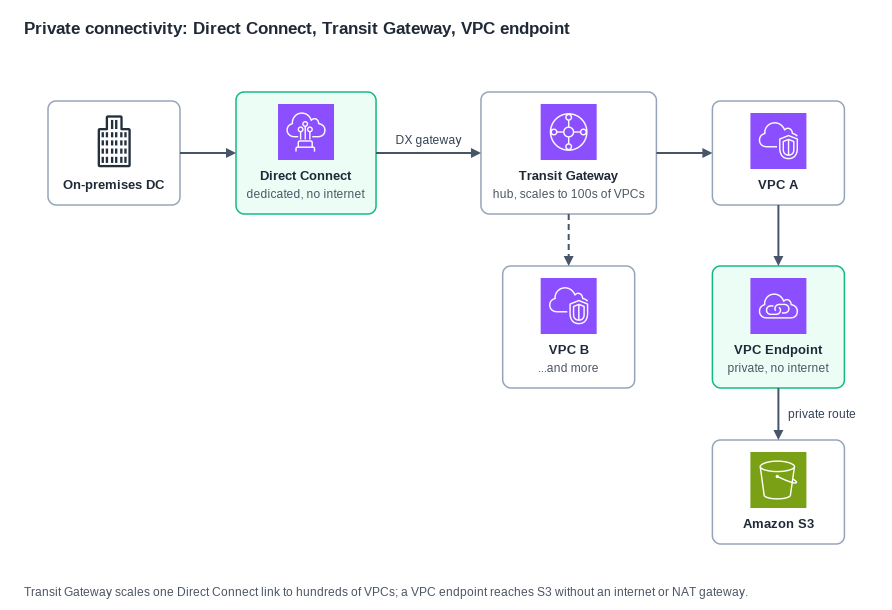
Exam trap: AWS Site-to-Site VPN is encrypted but still crosses the public internet; it does not satisfy a "no internet" requirement — only Direct Connect does.
Cloud economics for variable/seasonal demand
A seasonal, automatic, cost-effective capacity increase after migrating to AWS needs both: pay-as-you-go pricing (only pay for the extra capacity actually consumed) and Auto Scaling policies (capacity tracks real demand automatically). Cross-Region deployment, CloudTrail auditing, and centralized logging solve different problems (resilience/latency, activity audit, log aggregation) and do not scale capacity.
"reduce costs by adding capacity to handle peak loads and removing capacity" [when demand is lower] — What is Amazon EC2 Auto Scaling?
"Trade fixed expense for variable expense –" [pay only for the computing resources you consume] — Six advantages of cloud computing
Who delivers help: AWS Professional Services vs. the AWS Partner Network
- AWS Professional Services — AWS's own global team, engaged through paid, scoped consulting across specialty practice areas (migration, data/analytics, security…) to accelerate cloud adoption.
- AWS Partner Network (APN) — the community of third-party consulting and Managed Service Provider (MSP) partners who provide ongoing, external support/maintenance aligned to a business's needs.
- Solutions Architects and account managers give free pre-sales guidance; neither is a paid delivery or support team.
"AWS Professional Services combines AI-enhanced delivery, specialized solutions, deep industry expertise, and dedicated centers of delivery excellence (VMware, SAP, and more) to help organizations design, build, migrate, and manage their AWS workloads and applications." — AWS Professional Services
"AWS Managed Services Provider (MSP) Partners are specialized in providing end-to-end AWS solutions and services at any stage of the cloud journey including advisory, design, procurement, building, adopting, and managing." — Work with an AWS Partner
Programmatic access
AWS SDKs (Python, Java, Node.js, Go, and more) are the general-purpose way to connect to AWS and deploy/manage resources from application code — distinct from QuickSight (BI/visualization), PrivateLink (private service connectivity), and Direct Connect (dedicated network link), none of which are a programmatic deployment tool.
"When you develop an AWS SDK application or use AWS tools to use AWS services, you must" [configure programmatic access] — Authentication and access using AWS SDKs and tools
Two services the exam still tests that AWS has since retired
Two correct exam answers in this module name services that AWS has since closed to new customers. The exam still expects the historical answer; know both the exam answer and the current state:
-
AWS Snowball Edge — for a disconnected site (e.g., a ship at sea) that must collect, process, and later transfer sensor data, the exam answer is Snowball Edge's local storage + EC2-compatible compute. Today, Snowball Edge is no longer available to new customers; AWS now points edge-computing needs to AWS Outposts.
"AWS Snowball Edge is no longer available to new customers." — What is Snowball Edge?
-
AWS Migration Hub — for discovering, planning, and tracking server/application migration inventory across multiple migration tools, the exam answer is Migration Hub. Today, Migration Hub is closed to new customers as of November 7, 2025; AWS now points to AWS Transform for similar capabilities.
"AWS Migration Hub is no longer open to new customers as of November 7, 2025." — What Is AWS Migration Hub?
Exam traps
- "A physical location within AWS global infrastructure" = Region; "multiple locations, same geographic area, independent power/networking" = multiple Availability Zones.
- Low latency for global users comes from AWS's global infrastructure placement (Regions/AZs/edge locations) — not pricing, managed services, or economy of scale.
- CloudTrail never alerts — it only logs API/console activity for audit. Alerting on a CloudWatch alarm is always CloudWatch Alarm → Amazon SNS.
- AWS Config tracks resource configuration history; CloudTrail tracks caller activity (who did what, when) — don't swap them.
- IAM Identity Center = one login, many AWS accounts (formerly AWS SSO); Control Tower = sets up the governed multi-account landing zone itself.
- A VPC endpoint (gateway endpoint) is the only listed option that reaches S3/DynamoDB with zero internet involvement — VPN, internet gateway, and NAT gateway all touch the internet in some way.
- AWS Direct Connect bypasses the public internet entirely; AWS Site-to-Site VPN is encrypted but still crosses it.
- AWS Transit Gateway is the hub that scales one Direct Connect connection to hundreds of VPCs — VPC endpoints and Route 53 solve different problems.
- A heterogeneous database migration needs both the Schema Conversion Tool (schema) and DMS (data) — neither alone is sufficient.
- Seasonal, automatic, cost-effective scaling = pay-as-you-go pricing + Auto Scaling policies together, not CloudTrail, centralized logging, or Cross-Region deployment.
- AWS Professional Services is AWS's own paid delivery team; the AWS Partner Network (APN) is third-party consultants/MSPs — don't confuse the two when a question says "third-party."
- AWS Snowball Edge and AWS Migration Hub are both retired to new customers today, but the exam still expects them as the historical correct answer for their classic scenarios (offline edge processing; migration discovery/planning/tracking).
Docs
- AWS Regions and Availability Zones
- Regions and AZs overview
- AWS Global Infrastructure
- AWS CloudTrail User Guide
- Log EC2 API calls using CloudTrail
- What Is AWS Config?
- Using CloudWatch alarms
- Using IAM Access Analyzer
- What Is IAM Identity Center?
- How AWS Control Tower works
- What is CloudFormation?
- AWS Service Catalog: Overview
- What is AWS Lambda?
- AWS Fargate
- What is Amazon Athena?
- What is Amazon S3?
- Amazon S3 FAQs
- VPC endpoints
- Amazon RDS for MariaDB
- RDS Multi-AZ deployments
- What is Amazon Timestream?
- DMS Schema Conversion
- AWS Schema Conversion Tool
- What is AWS Direct Connect?
- What is AWS Transit Gateway?
- Amazon Route 53
- What is Amazon EC2 Auto Scaling?
- Six advantages of cloud computing
- AWS Professional Services
- Work with an AWS Partner
- Authentication using AWS SDKs and tools
- What is Snowball Edge?
- What Is AWS Migration Hub?