Exams / CLF-C02 / D1 Cloud Technology and Services
Cloud Technology and Services #9: Reaching the internet, Low-latency delivery
- Exam domain: Content Domain 3: Cloud Technology and Services
Another "name the one right service" pass, now weighted toward networking (who reaches what, and over which path), the three security tools that get confused with each other, and a cluster of account-level/governance services. Match the requirement's exact verb — outbound only, no internet, investigate, repeatable — to the one service built for it.
Reaching the internet vs. reaching an AWS service, privately
A private-subnet EC2 instance regularly needs two very different kinds of "outbound": the open internet (for OS updates) and a specific AWS service (for example, S3). Mixing these up is the exam's favorite networking trap in this pass.
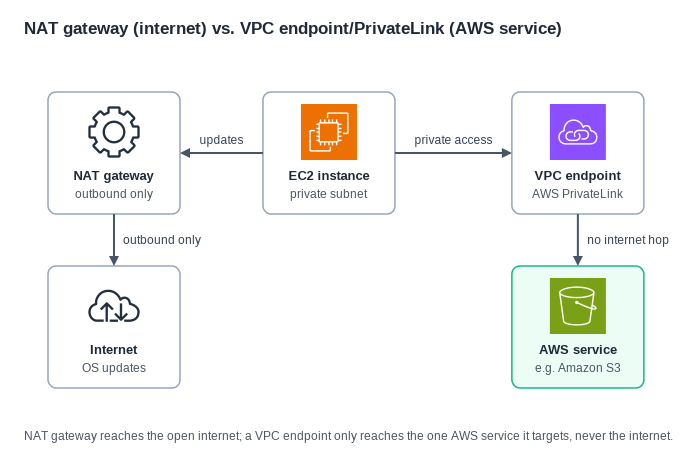
- NAT gateway — lives in a public subnet so instances in a private subnet can reach the internet outbound-only: "can connect to the internet through a public NAT gateway, but the instances can't receive" unsolicited inbound connections. The answer whenever a scenario says "needs internet access for updates, no unsolicited inbound."
- AWS PrivateLink / VPC endpoint — "a highly available, scalable technology that you can use to privately" connect a VPC to a supported AWS service or partner service over the AWS network, never the public internet. It only reaches the specific service it targets — it is not a substitute for general internet access.
- VPC Flow Logs — a separate, unrelated capability: it "enables you to capture information about the IP traffic" going to and from network interfaces in a VPC, subnet, or ENI (inbound and outbound both).
| Component | Reaches | Direction |
|---|---|---|
| NAT gateway | The public internet | Outbound-only from a private subnet |
| VPC endpoint (PrivateLink) | One named AWS/partner service | Private, both ways with that service |
| VPC Flow Logs | Nothing — it only observes | Captures inbound + outbound traffic metadata |
Low-latency delivery: CDN, global routing, and faster uploads
Three different services make "stuff gets to/from AWS faster," and the exam expects you to tell them apart by who the traffic is for and which direction it flows.
- Amazon CloudFront is AWS's CDN: it caches content at edge locations and can "securely deliver content with low latency and high transfer speeds." It can use any custom HTTP server, including one running on an Amazon EC2 instance, as its origin — the standard answer for "minimize latency for a website served from EC2, worldwide."
- AWS Global Accelerator optimizes the network path itself: "routing traffic through the AWS global network improves availability and performance" by getting client traffic onto AWS's backbone as close to the user as possible and routing it to the optimal healthy regional endpoint.
- S3 Transfer Acceleration speeds up uploads/downloads to a bucket: it takes advantage of "the globally distributed edge locations in Amazon CloudFront" and then routes the data "to Amazon S3 over an optimized network path."
| Need | Service | Why not the others |
|---|---|---|
| Serve a website/app/API to users worldwide, cached | CloudFront | Global Accelerator doesn't cache; Transfer Acceleration is S3-upload-specific |
| Route client traffic onto AWS's backbone to the best healthy regional endpoint | Global Accelerator | CloudFront caches content; it doesn't pick between regional endpoints |
| Speed up transfers into a specific S3 bucket | S3 Transfer Acceleration | CloudFront caches reads; it isn't built for arbitrary uploads |
Scan, detect, investigate: three different security jobs
These three AWS security services sound similar but each owns a distinct stage.
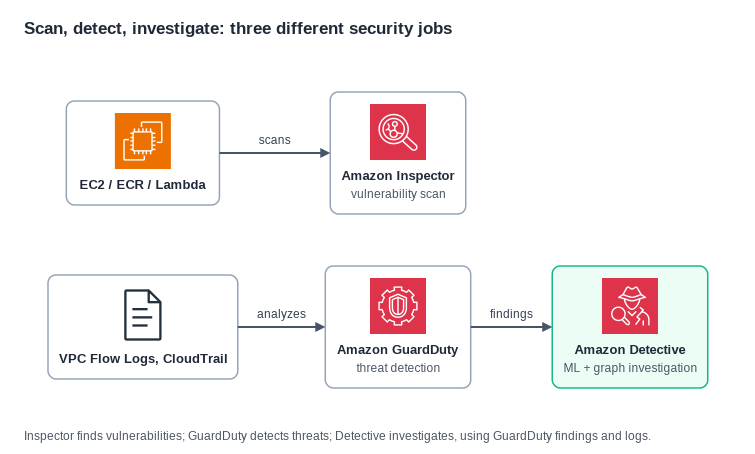
- Amazon Inspector — "a vulnerability management service that automatically discovers workloads and continually scans them for software vulnerabilities and unintended network exposure," covering EC2 instances, ECR images, and Lambda functions. Answer whenever a question says "discover vulnerabilities."
- Amazon GuardDuty — continuous threat detection from logs (VPC Flow Logs, CloudTrail, DNS logs); it flags suspicious activity but is not built for deep-dive investigation.
- Amazon Detective — the investigation tool: "by automatically aggregating data and providing visual tools, Amazon Detective lets you ... conduct faster, more efficient security investigations," using machine learning, statistical analysis, and graph theory over EC2 logs, VPC Flow Logs, CloudTrail, and GuardDuty findings. Answer whenever a question says "use machine learning to investigate."
Account-level tools, IAM, and secrets
- AWS CloudFormation is infrastructure as code: "reuse your CloudFormation template to create your resources in a consistent and repeatable" way, and the same template can stand up separate development, testing, and production stacks that differ only through parameters/mappings/conditions — the standard answer whenever a question asks for repeatable multi-environment infrastructure.
- AWS Compute Optimizer turns EC2 utilization history into concrete sizing advice: "you can analyze the configuration and utilization metrics of your AWS" resources to get rightsizing recommendations and find idle resources — AWS Pricing Calculator only estimates costs from inputs you give it, it does not look at real usage.
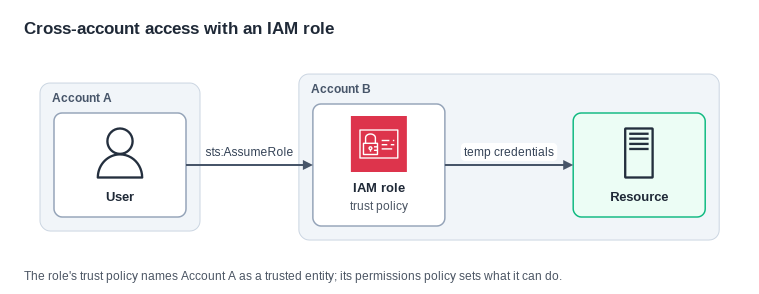
- A cross-account IAM role is how a user in Account A reaches a resource in Account B: the role's trust policy (in Account B) names Account A as a trusted entity, and the role grants temporary credentials once assumed.
- AWS Secrets Manager "helps you manage, retrieve, and rotate database credentials, application credentials, OAuth tokens, API keys, and other secrets throughout their lifecycles," with built-in automatic rotation.
- AWS Systems Manager Parameter Store is a free-tier, hierarchical config/secret store: "Parameter Store is a centralized configuration data store for named values called parameters," and its standard tier is free, while Secrets Manager bills roughly $0.40/secret/month plus API calls. For a question that explicitly asks for the MOST cost-effective way to store configuration data and passwords, Parameter Store (SecureString) wins on cost — even though current AWS guidance recommends Secrets Manager specifically for credentials when rotation or purpose-built secret controls matter: "if you manage credentials such as usernames, passwords, or any other secrets, we recommend using AWS Secrets Manager."
- AWS Managed Services (AMS)'s core operational scope is the landing zone and network foundation — AMS documents this directly as multi-account or single-account landing zone architectures that provide shared access, endpoint security, and networking before any workload is onboarded. Custom app development and DevSecOps pipelines are outside that scope.
Storage classes, gateways, and durability
| Need | Service / class | Key fact |
|---|---|---|
| Cheapest S3 class for rarely accessed, re-creatable data | S3 One Zone-IA | "use if you can re-create the" data — single-AZ storage is cheaper than Standard-IA |
| Extend on-prem file storage, keep local-speed access, lowest operational effort | Storage Gateway File Gateway | SMB/NFS share backed by S3 with "low-latency access to data through transparent local" caching |
| Highly durable object storage | Amazon S3 | "an object storage service that offers industry-leading scalability," availability, and durability |
| Petabyte-scale data warehouse, zero hardware/software management | Amazon Redshift | "petabyte-scale data warehouse service in the cloud," capacity is automatically provisioned/scaled |
| EC2 family for HPC/batch/scientific workloads | Compute optimized instances | "designed for compute intensive applications" including HPC |
| Who turns on EBS encryption | The customer | "you encrypt EBS volumes by enabling encryption, either using encryption by default or by" ... creating an encrypted volume — AWS KMS only supplies the keys |
Keeping data on-premises: AWS Outposts
AWS Outposts is the exam's answer whenever a scenario needs both data residency (data/processing must stay physically on the customer's site) and low latency to on-premises equipment: it "extends AWS infrastructure, services, APIs, and" Regions onto customer hardware, "while using local compute and storage resources for lower latency." Local Zones and Wavelength Zones are still AWS-operated sites, not the customer's own premises, so they don't satisfy a strict "must stay on our premises" requirement; Availability Zones are separate AWS data centers within a Region.
Services renamed since these questions were written
AWS has quietly rebranded a couple of long-standing services; the exam may still use the old names, so expect either:
- Amazon Connect → Amazon Connect Customer. The cloud contact center that unifies voice and chat channels is now documented as "Amazon Connect Customer," with "Amazon Connect" repositioned as a broader family of agentic AI products. The underlying capability — one platform consolidating multiple call centers' voice and chat — is unchanged.
- Amazon AppStream 2.0 → Amazon WorkSpaces Applications. Current AWS marketing describes it as "Amazon WorkSpaces applications (formerly AppStream 2.0)," still a fully managed service that streams desktop applications to users. Paired with Amazon WorkSpaces (full managed Windows/Linux virtual desktops, which kept its name), these are the two services for "deliver managed Windows desktops and applications to remote employees."
Exam traps
- NAT gateway (reaches the internet) vs. VPC endpoint/PrivateLink (reaches one AWS service only) — a scenario needing OS updates over the internet wants a NAT gateway; "connect VPCs/services without touching the public internet" wants PrivateLink/a VPC endpoint, never the reverse.
- CloudFront (CDN, can use EC2 as origin) vs. Global Accelerator (optimizes the network path to regional endpoints) vs. S3 Transfer Acceleration (speeds uploads into a bucket) — match the service to what's actually moving and where it ends up.
- Inspector scans for vulnerabilities; GuardDuty detects threats from logs; Detective investigates (ML + graph theory) using GuardDuty/Flow Logs/CloudTrail — "use machine learning to investigate" is always Detective, never Inspector or GuardDuty alone.
- Parameter Store (free standard tier) is the cost answer for config + passwords; Secrets Manager is the security/rotation answer — a "MOST cost-effective" question wants Parameter Store even though current AWS guidance recommends Secrets Manager for credentials specifically.
- AWS Outposts needs genuine on-premises residency — Local Zones and Wavelength Zones are still AWS sites, not the customer's own premises.
- The customer enables EBS encryption (per volume, or by default for the account/Region) — AWS KMS only supplies the keys, it doesn't turn the setting on.
- S3 One Zone-IA requires "can be re-created" — if a question's data must survive an AZ loss, it needs Standard-IA (or Standard), not One Zone-IA.
- AMS's defining scope is the landing zone/network foundation, not application development or pipeline configuration.
- Amazon Connect → Amazon Connect Customer, and AppStream 2.0 → Amazon WorkSpaces Applications — same services, newer names; the exam choice text may still use the old name.
Docs
- AWS Storage Gateway documentation
- Amazon EBS encryption
- What is Amazon Detective?
- Amazon CloudFront
- How AWS Global Accelerator works
- Amazon Transcribe - Speech to Text
- What is AWS CloudFormation?
- CloudFormation best practices
- What is AWS Compute Optimizer?
- What is Amazon Connect?
- Amazon Connect
- AWS Reference Architecture Diagrams
- What is Amazon Inspector?
- Specifications for Amazon EC2 compute optimized instances
- NAT gateways - Amazon VPC User Guide
- Origin - Amazon CloudFront API Reference
- How CloudFront delivers content
- AWS Elastic Beanstalk
- What is Amazon Redshift?
- Configuring fast, secure file transfers using Amazon S3 Transfer Acceleration
- What is AWS Outposts?
- Logging IP traffic using VPC Flow Logs
- What is AWS PrivateLink?
- Amazon S3 User Guide — What is Amazon S3?
- IAM roles for cross-account access
- What Is AWS Secrets Manager?
- AWS CloudShell Documentation
- AMS Network architecture
- Amazon EC2 Auto Scaling
- AWS Systems Manager Parameter Store
- Registering and managing domains using Amazon Route 53
- What is Amazon WorkSpaces?
- Amazon WorkSpaces Applications (formerly AppStream 2.0)
- What is the AWS Management Console?
- Understanding and managing Amazon S3 storage classes
- What is Amazon S3 File Gateway