Exams / SC-900 / D3 Describe the capabilities of Microsoft security solutions
D3.2
Describe security management capabilities of Azure
- Describe Microsoft Defender for Cloud
- Describe Cloud Security Posture Management (CSPM)
- Describe how security policies, standards, and recommendations improve the cloud security posture
- Describe enhanced security features provided by cloud workload protection
Microsoft Defender for Cloud
Defender for Cloud is a CNAPP with three pillars: "Cloud Security Posture Management (CSPM) checks and improves the security posture of cloud resources." "Development Security Operations (DevSecOps) manages code-level security across multicloud and multi-pipeline environments." "Cloud Workload Protection Platform (CWPP) defends workloads such as virtual machines (VMs), containers, storage, databases, and serverless functions from threats."
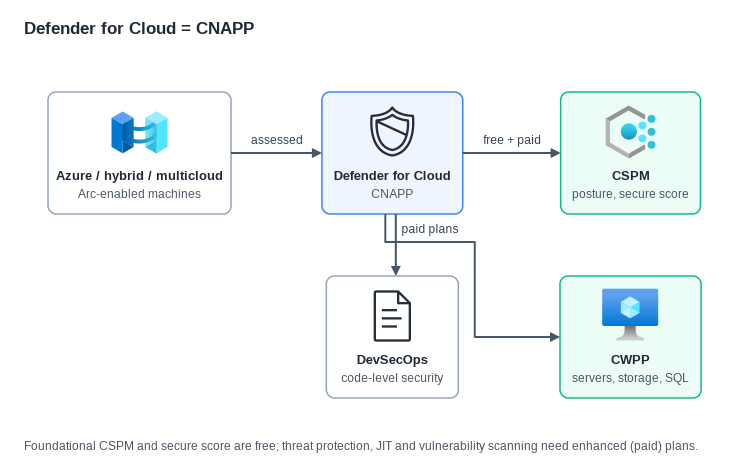
| Pillar | What it does | Cost |
|---|---|---|
| CSPM | Assess configuration, recommendations, secure score | Foundational CSPM free; Defender CSPM paid |
| CWPP | Threat protection per workload (Servers, Storage, SQL, containers...) | Paid plans |
| DevSecOps | Code-level security across pipelines | Mostly paid |
- Works on Azure, hybrid (on-premises via Azure Arc) and multicloud (AWS, GCP).
- Plans are enabled in the Azure portal: Microsoft Defender for Cloud > Environment settings. Not the Defender portal, Entra or M365 admin center.
- Formerly Azure Security Center / Azure Defender. The portal tile "Security Center" in older exam images = Defender for Cloud.
CSPM, policies, standards, recommendations
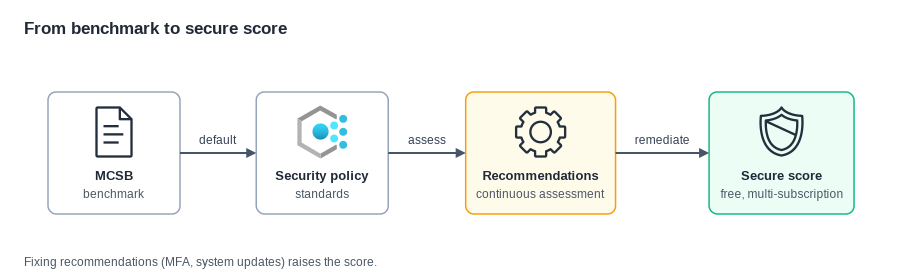
- "Defender for Cloud continuously evaluates your resources against these standards." So the answer to "how often" is continuously.
- Security policy → standards (MCSB by default, regulatory standards, custom standards) → recommendations → secure score.
- Microsoft cloud security benchmark (MCSB): "prescriptive best practices and recommendations to help improve the security of workloads, data, and services on Azure and your multicloud environment." Each control has a Security principle (technology-agnostic what/why), Azure guidance (how to implement on Azure, e.g. create a VNet) and framework mappings.
- Secure score: shown "for your environments overall and for each environment separately"; aggregates multiple subscriptions with a weighted model. Remediating recommendations such as Enable MFA and Apply system updates raises it. Available in the free tier.
Enhanced security features (CWPP)
| Feature | Purpose |
|---|---|
| Just-in-time VM access | Reduces attack surface by minimizing open management ports |
| Adaptive application controls | Approved-application lists; block malware / unwanted apps |
| Defender for Servers | Vulnerability scanning (agent-based and agentless) via Defender Vulnerability Management |
| Defender for Storage | Malware scanning, exfiltration/malicious-upload alerts |
| Defender for SQL | Threat protection and vulnerability assessment incl. SQL managed instances |
Exam traps
- Defender for Cloud is not part of Microsoft 365 E5; it is billed through Azure plans.
- Free tier: secure score and foundational CSPM recommendations. Paid: threat protection alerts, JIT, vulnerability scanning.
- "Security Center" = Defender for Cloud; secure score is viewed there.
- Defender for Cloud (not Sentinel, not Azure Bastion, not ASGs) gives threat detection for Azure SQL Managed Instance.
- Defender for Cloud plans: Azure portal, not Microsoft Defender portal.
- Defender for Storage = threats/malware; wording on "vulnerabilities" in storage varies between question versions.
Docs
- https://learn.microsoft.com/en-us/azure/defender-for-cloud/defender-for-cloud-introduction
- https://learn.microsoft.com/en-us/azure/defender-for-cloud/concept-cloud-security-posture-management
- https://learn.microsoft.com/en-us/azure/defender-for-cloud/secure-score-security-controls
- https://learn.microsoft.com/en-us/azure/defender-for-cloud/security-policy-concept
- https://learn.microsoft.com/en-us/security/benchmark/azure/introduction
- https://learn.microsoft.com/en-us/security/benchmark/azure/mcsb-network-security
- https://learn.microsoft.com/en-us/azure/defender-for-cloud/defender-for-storage-introduction
- https://learn.microsoft.com/en-us/azure/defender-for-cloud/defender-for-servers-overview
- https://learn.microsoft.com/en-us/azure/defender-for-cloud/defender-for-sql-introduction
- https://learn.microsoft.com/en-us/azure/defender-for-cloud/disable-plans
- https://learn.microsoft.com/en-us/azure/security/fundamentals/virtual-machines-overview