Exams / SC-900 / D1 Describe the concepts of security, compliance, and identity
Define identity concepts
- Define identity as the primary security perimeter
- Define authentication
- Define authorization
- Describe identity providers
- Describe the concept of directory services and Active Directory
- Describe the concept of federation
Identity as the primary security perimeter
Traditional models rely on network boundaries and assume assets inside the perimeter are safer. Today attacks use identity compromise, phishing and session hijacking and do not depend on network location, so in hybrid (on-premises + cloud) environments identity is the primary perimeter (Zero Trust).
Authentication vs authorization
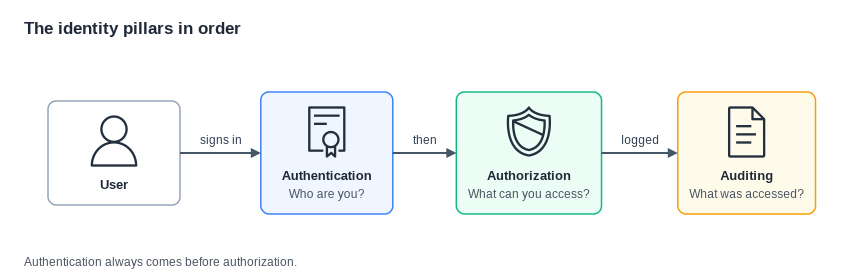
| Concept | Question | Example |
|---|---|---|
| Authentication (AuthN) | Who are you? | Password, fingerprint, certificate, one-time passcode, MFA |
| Authorization (AuthZ) | What can you access? | Read/write on a file, Azure RBAC role |
| Auditing | What was accessed? | Sign-in and access reports |
| Administration | Who manages identities and policies? | Roles, permissions, lifecycle |
Authentication is done before authorization. The Microsoft identity platform uses OpenID Connect for authentication and OAuth 2.0 for authorization.
Identity providers and directory services
- An identity provider (IdP) tracks and manages user identities and their permissions and access levels. Microsoft Entra ID (formerly Azure AD) is a cloud IdP.
- A directory stores information about network objects. AD DS is the on-premises directory service; its objects include servers, printers and user and computer accounts.
- Modern apps (SaaS, LOB with modern authentication) use Microsoft Entra ID, not AD DS.
Federation
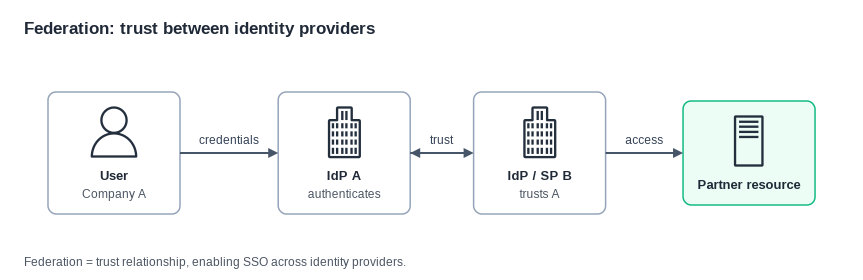
Federation is a collection of domains that have established trust, typically covering authentication and almost always authorization. It lets users use their own company credentials at a partner and gives SSO across identity providers.
Exam traps
- Read/write on a file or "level of access" = authorization, never authentication.
- Tracking resources accessed = auditing.
- SSO between several IdPs / partner access with own credentials = federation (not pass-through authentication or password hash sync).
- Federation establishes a trust relationship, not a VPN or account sync.
- Computer accounts belong in AD DS; apps and devices in modern auth belong in Entra ID.
- In hybrid environments, the perimeter is identity, not a firewall.
Docs
- https://learn.microsoft.com/en-us/entra/fundamentals/identity-fundamental-concepts
- https://learn.microsoft.com/en-us/entra/identity-platform/authentication-vs-authorization
- https://learn.microsoft.com/en-us/entra/identity/hybrid/connect/whatis-fed
- https://learn.microsoft.com/en-us/security/zero-trust/zero-trust-overview
- https://learn.microsoft.com/en-us/windows-server/identity/ad-ds/get-started/virtual-dc/active-directory-domain-services-overview
- https://learn.microsoft.com/en-us/entra/identity/enterprise-apps/what-is-single-sign-on