Exams / SC-900 / D1 Describe the concepts of security, compliance, and identity
Describe security and compliance concepts
- Describe the shared responsibility model
- Describe defense-in-depth
- Describe the Zero Trust model
- Describe encryption and hashing
- Describe Governance, Risk, and Compliance (GRC) concepts
Shared responsibility
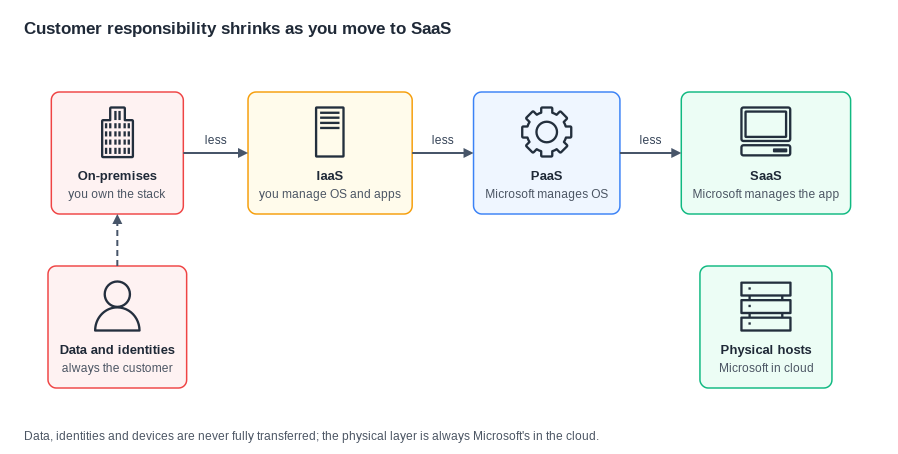
Responsibilities vary by service model. In an on-premises datacenter you own the whole stack. The more the provider runs, the less you do.
| Model | Customer manages | Microsoft manages |
|---|---|---|
| On-premises | Everything | Nothing |
| IaaS | VMs, operating systems, applications, network controls | Physical hosts, physical network, datacenter |
| PaaS | Application configuration, code security, access controls | Operating systems, runtime, middleware, plus physical layer |
| SaaS | Data, identities, accounts, devices | Application, network security, platform, physical layer |
Whatever the deployment, you always retain data, identities and devices. The physical layer (security, network, hosts) is Microsoft's in the cloud.
Defense in depth
Defense in depth uses several layers of controls (physical, identity, perimeter, network, compute, application, data). If one layer fails, the next one still protects. Microsoft datacenters apply it physically with access approval at the facility perimeter, the building perimeter, inside the building and on the datacenter floor.
The CIA triad: confidentiality (no disclosure), integrity (data is accurate and unaltered), availability (data is accessible when needed).
Zero Trust
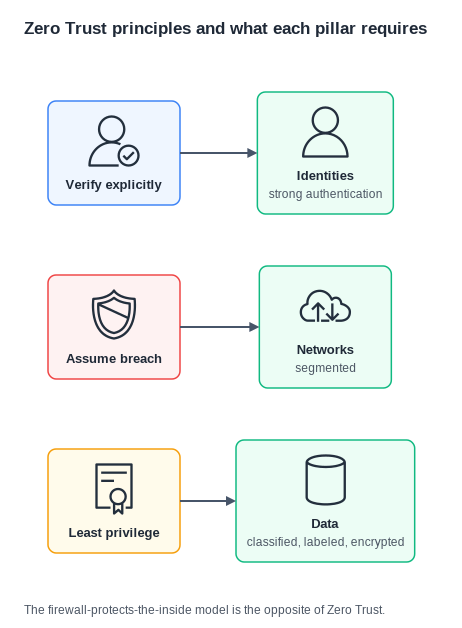
Zero Trust assumes breach and verifies each request as though it came from an uncontrolled network. It replaces the perimeter model.
| Principle | Meaning |
|---|---|
| Verify explicitly | Authenticate and authorize using all available data points |
| Use least privilege access | Limit access to what is needed |
| Assume breach | Minimize impact, segment access, encrypt, monitor |
| Pillar | Requirement |
|---|---|
| Identities | Verified with strong authentication |
| Networks | Segmented |
| Data | Classified, labeled and encrypted |
Encryption and hashing
| Concept | Key point |
|---|---|
| Symmetric encryption | One shared key encrypts and decrypts; fast, used for data at rest |
| Asymmetric encryption | Public and private key pair |
| Hashing | One-way; the original content cannot be retrieved by decryption |
| Digital signature | Signed with the signer's private key, verified with the public key |
| At rest | Data in storage, such as a VM disk |
| In transit | Data on the network: HTTPS, VPN, encrypted email |
Governance, risk and compliance (GRC)
| Tool | Purpose |
|---|---|
| Cloud Adoption Framework | Guidance in phases: Strategy, Plan, Ready, Adopt, Govern, Manage |
| Azure Policy | Enforces standards, assesses compliance, remediates; evaluates on create/update, assignment and every 24 hours |
| Resource locks | CanNotDelete and ReadOnly on subscription, resource group or resource; a Delete lock blocks deleting the group |
| Azure Blueprints | Repeatable environments across subscriptions; being retired January 31, 2027, replaced by template specs and deployment stacks |
Exam traps
- Data, identities and devices are never fully transferred to Microsoft, even in SaaS.
- Policy = rules and compliance; Blueprints = repeatable deployment (legacy).
- "Only on create or modify" is false for Azure Policy.
- Hashes cannot be decrypted.
- Zero Trust never trusts a firewall or network location.
- VPN, HTTPS and encrypted email are in transit, not at rest.