Exams / SC-900 / D3 Describe the capabilities of Microsoft security solutions
Describe core infrastructure security services in Azure
- Describe Azure DDoS Protection
- Describe Azure Firewall
- Describe Azure Web Application Firewall (WAF)
- Describe network segmentation with Azure virtual networks
- Describe network security groups (NSGs)
- Describe Azure Bastion
- Describe Azure Key Vault
Virtual networks (segmentation)
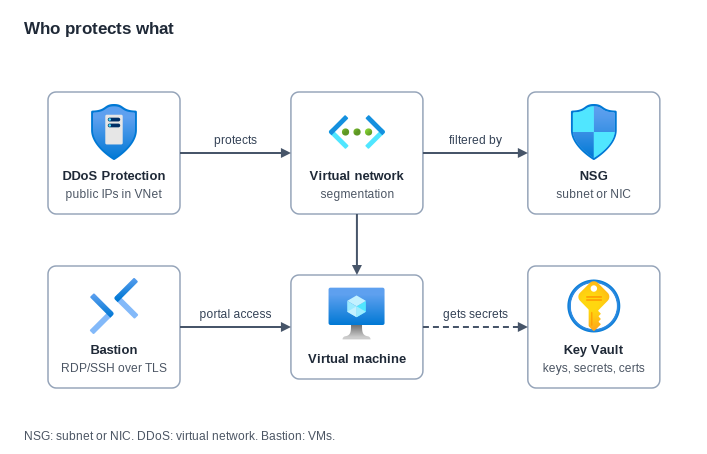
A virtual network (VNet) is "an isolated, private network in Azure". Subnets organise resources inside it and are the scope for NSG and route table association. Use several VNets to isolate resources and apply governance boundaries.
Network security groups (NSGs)
| Topic | Fact |
|---|---|
| What | Rules that allow or deny inbound/outbound traffic |
| Associated with | Subnets and network interfaces (not VNets, resource groups or App Service) |
| Rule match | Five-tuple: source, source port, destination, destination port, protocol |
| Rule name | Unique within the NSG |
| Priority | Custom rules 100-4096; default rules have the lowest priority (highest numbers) |
| Default rules | Cannot be removed, but can be overridden by higher-priority rules |
| Protocol | TCP, UDP, ICMP (or Any) |
Azure Firewall
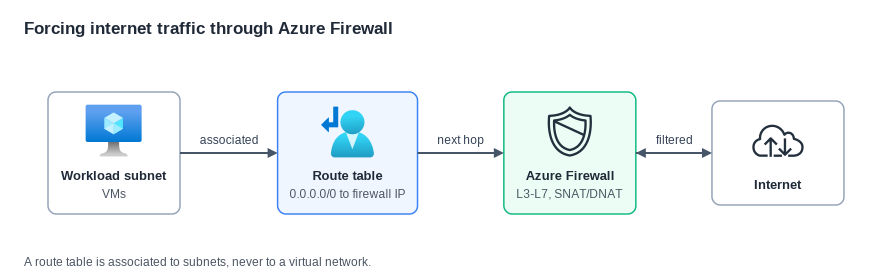
A cloud-native, stateful network firewall as a service, Layer 3 to Layer 7. It provides SNAT for outbound traffic and DNAT for inbound internet traffic. To force traffic through it, associate route tables (UDRs) to subnets with 0.0.0.0/0 pointing to the firewall's private IP.
Azure DDoS Protection
- Enabled on a virtual network; protects the public IP resources in it.
- Auto-tuned TCP SYN, TCP and UDP mitigation policies; attack metrics and alerts at attack start/stop.
- Mitigates volumetric and protocol (L3/L4) attacks such as SYN floods; it is not a MITM protection.
- Infrastructure protection is free and automatic; Network Protection (formerly Standard) is opt-in, with a fixed monthly charge covering up to 100 public IPs.
Azure Web Application Firewall (WAF)
Protects web apps against common web attacks such as SQL injection and cross-site scripting (L7). It runs on Application Gateway, Front Door and CDN.
Azure Bastion
Fully managed PaaS giving RDP/SSH over TLS to VMs from the Azure portal; VMs need no public IP, agent or client software. Needs a dedicated AzureBastionSubnet (/26 or larger) in the VNet.
Azure Key Vault
Stores and controls access to secrets (passwords, API keys, connection strings), encryption keys and TLS certificates. Premium tier adds HSM-protected keys.
Exam traps
- NSG default rules: override, never delete.
- NSG attaches to subnet or NIC, not the VNet.
- DDoS protects virtual networks / public IPs, not users or apps; not MITM; not on by default.
- NAT = Firewall; RDP/SSH from portal = Bastion; secrets = Key Vault; web attacks = WAF.
- Route table forces traffic through the firewall; peering/service endpoints do not.
Docs
- https://learn.microsoft.com/en-us/azure/virtual-network/network-security-groups-overview
- https://learn.microsoft.com/en-us/azure/virtual-network/manage-network-security-group
- https://learn.microsoft.com/en-us/azure/virtual-network/manage-route-table
- https://learn.microsoft.com/en-us/azure/ddos-protection/ddos-protection-overview
- https://learn.microsoft.com/en-us/azure/ddos-protection/types-of-attacks
- https://learn.microsoft.com/en-us/azure/ddos-protection/ddos-faq
- https://learn.microsoft.com/en-us/azure/firewall/features
- https://learn.microsoft.com/en-us/azure/networking/design-guide/azure-firewall
- https://learn.microsoft.com/en-us/azure/networking/design-guide/vnets-subnets
- https://learn.microsoft.com/en-us/azure/web-application-firewall/overview
- https://learn.microsoft.com/en-us/azure/bastion/bastion-overview
- https://learn.microsoft.com/en-us/azure/bastion/configuration-settings
- https://learn.microsoft.com/en-us/azure/key-vault/general/overview