Exams / CSCO-100-160 / D4 Incident Handling
D4.1
Incident Handling
- Exam domain: Incident Handling
Incident response lifecycle (NIST SP 800-61)
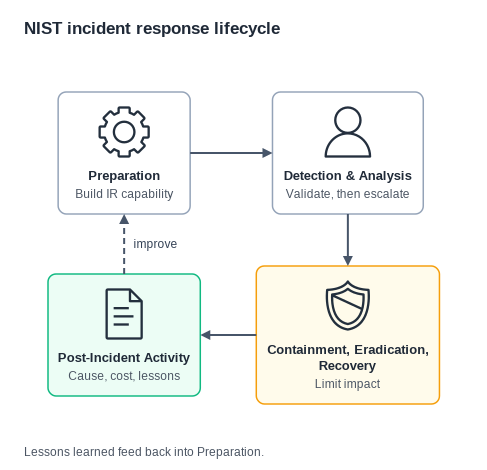
| Phase | What happens |
|---|---|
| Preparation | Establish the incident-response capability and secure assets |
| Detection and Analysis | Evaluate indicators, decide whether they are real attacks, alert the organization; escalate a validated incident |
| Containment, Eradication, and Recovery | Mitigate impact, remove the threat, restore operations |
| Post-Incident Activity | Report cause and cost, lessons learned, prevention steps |
- Validated incident: escalate to the incident-response team. Microsoft's SOC guidance: "Respond to incident detections for well-known attack techniques and follow documented procedures to rapidly resolve them (or escalate them to investigation analysts as appropriate)."
Threat types
| Symptom / scenario | Threat |
|---|---|
| Site unavailable, crashes again after restart | Denial of service: "A DDoS attack attempts to exhaust an application's resources, making the application unavailable to legitimate users." |
| Data locked, payment demanded | Ransomware: "a ransomware attack blocks access to your data until a ransom is paid." |
| Employee accidentally leaks data | Insider threat (inadvertent as well as malicious) |
| Crashes and pop-ups on workstations | Malware: scan and remove, deploy auto-updating antivirus; do not reinstall if data must be kept |
| Form over port 80 | HTTP is unencrypted: data exposed in transit browser-to-server |
Alert classification
| Class | Meaning |
|---|---|
| True positive | Real threat, detected |
| False positive | Benign entity flagged as malicious |
| False negative | "A false negative is a malicious entity that the solution doesn't detect." Most dangerous |
| True negative | Benign, not flagged |
Analysis tools
| Need | Tool |
|---|---|
| Collect and correlate logs, alert | SIEM |
| Orchestration, case management, automated response playbooks | SOAR |
| Capture packets to a file | Wireshark, tcpdump |
| Scan hosts / list connections | Nmap / netstat (not captures) |
| Check a suspicious URL | Submit it to a threat-intelligence/analysis service; do not browse to it |
| Detect password guessing on Windows | Audit account logon failure (event 4625) and account lockout |
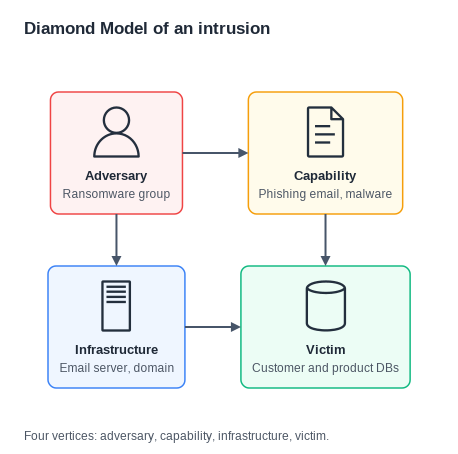
The Diamond Model describes an intrusion by Adversary, Capability, Infrastructure and Victim.
Reading logs
Order events by time: here repeated failed logons, brute-force alert and IP block, then disk at 92%, database timeout, automatic failover.
Exam traps
- Blocking is containment, done after analysis; analysis comes first.
- Netstat and Nmap do not capture packets.
- TLS to the database does not protect an HTTP form submission.
- Insider threats can be accidental.
- Logoff success and object-access failure do not show bad credentials.