Exams / CSCO-100-160 / D2 Basic Network Security Concepts
D2.1
Basic Network Security Concepts
- Exam domain: Basic Network Security Concepts
Threats and attacks
| Scenario | Attack |
|---|---|
| Skilled group keeps long-term hidden access to steal/sabotage | APT |
| Many half-open TCP connections, server unreachable | TCP SYN flood (DoS) |
| Rogue AP captures then forwards traffic | Man-in-the-middle (evil twin) |
| Port scan, probing hosts | Active reconnaissance (WHOIS, page source, social media = passive) |
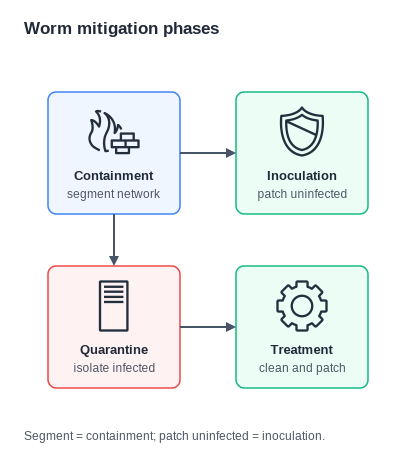
Worm response: containment (segment the network), inoculation (patch uninfected hosts), quarantine (block/remove infected hosts), treatment (clean and patch infected hosts).
Defensive devices
| Device | Role |
|---|---|
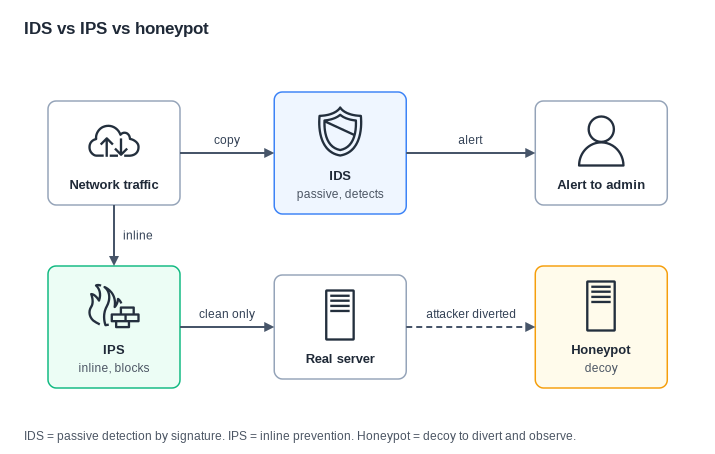
| IDS | Passive, signature-based detection and alerting |
| IPS | Inline, blocks malicious traffic |
| Proxy | Filters/controls outbound web access |
| Honeypot | Decoy that diverts and lets you observe attackers |
| ACL | Filters packets by source address; used for anti-spoofing |
VPN and AAA
- VPN gives remote workers authentication, integrity and confidentiality.
- RADIUS (for example Windows NPS) provides centralized authentication, authorization and accounting for VPN, wireless and switch access; it can authenticate against Active Directory and log accounting.
- Secure transfer to routers: SSH (SCP/SFTP). TFTP, HTTP, Telnet are cleartext.
Wireless
| Item | Fact |
|---|---|
| WPA2 / WPA3 | AES (CCMP) |
| WPA | TKIP; WEP: RC4 |
| MAC filtering | Blocks or allows specific devices; can stop association |
| Hidden SSID | Weak obscurity, expected exam answer for a staff network |
Addressing and tools
- RFC 1918 private ranges: 10.0.0.0/8, 172.16.0.0/12 (172.16–172.31), 192.168.0.0/16.
netstat: LISTENING = port open, waiting for connections.nslookup: shows the DNS server used and resolves names. Works by IP but not by name = check DNS.- Syslog severity Warning = a condition that may cause errors later.
Exam traps
- 203.0.113.x is documentation space and 224.x is multicast, not RFC 1918.
- IDS is passive; IPS is inline.
- Authorization is not a core VPN function; WAN and password management are not VPN functions.
- Changing the SSID or IP does not block a specific device; MAC filtering does.