Exams / CSCO-100-160 / D3 Vulnerability Assessment and Risk Management
D3.1
Vulnerability Assessment and Risk Management
- Exam domain: Vulnerability Assessment and Risk Management
Vulnerability management
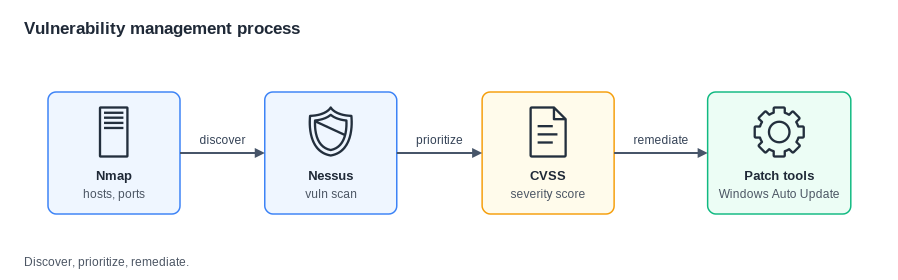
| Step | Tools | Purpose |
|---|---|---|
| Discover | Nmap, Nessus | Inventory hosts/ports; find known CVEs |
| Prioritize | CVSS | Numerical severity score |
| Remediate | Windows Auto Update, patch management | Deploy fixes |
- CVSS: "The benefits of CVSS include the provision of a standardized vendor and platform" independent scoring. Base score = Exploitability + Impact metrics.
- Severity = impact of exploitation + likelihood/ease of exploitation (not hardware age).
- A new CVE: first check whether it applies to your environment.
- Findings worth escalating: missing patches, open ports. Firmware is updated to fix security holes.
- Windows scan results: Windows Security app (Defender Antivirus).
Linux tools
| Tool | Function |
|---|---|
| tcpdump | Capture packets to .pcap |
| nmap | Scan hosts and open ports |
| netstat -a | List TCP/UDP connections |
| nslookup | DNS lookups |
Passive reconnaissance = public sources only (websites, searches, social media); active = touching the target.
Risk management
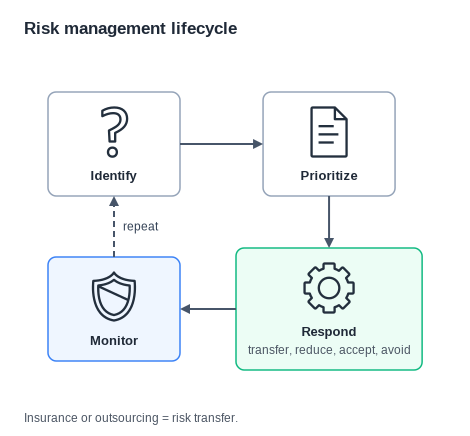
| Strategy | Example |
|---|---|
| Transfer | Insurance, outsourcing |
| Reduce | Apply controls |
| Accept | Live with it |
| Avoid | Drop the activity |
Identifying risks with leadership = determining a risk profile. Information assurance protects availability, integrity, authentication, confidentiality and non-repudiation of information (e.g. PII).
Disaster recovery
- DR plan: "A written plan for recovering one or more information systems at an alternate facility in response to a major hardware or software failure or destruction of facilities."
- Main purpose: restore data access and IT infrastructure; keeping the business running is business continuity.
- Natural disasters: floods, volcanic eruptions; nuclear contamination and hazmat spills are man-made.
- Daily backups must be off-site: cloud and removable media stored elsewhere.
Exam traps
- DR (restore IT) vs business continuity (keep operating).
- Insurance/outsourcing is transfer, not reduction.
- Scanning is discovery; CVSS prioritizes.
- Verifying safeguards (audit, pen test) is not implementing them.