Exams / CSCO-100-140 / D2 Identifying Security Threats
D2.1
Identifying Security Threats
- Exam domain: Identifying Security Threats
Phishing and social engineering
Attackers impersonate trusted people (HR, the President, IT) to make you click, pay or disclose data.
| Red flag | Example |
|---|---|
| External or lookalike sender domain | HR mail from mybenefits.biz |
| Urgency or threat | "Register or lose benefits" |
| Unusual request from an executive | Buy gift cards |
| Unsolicited call asking you to change settings | "Networking dept" gives you Wi-Fi details (rogue Wi-Fi → Man-in-the-Middle) |
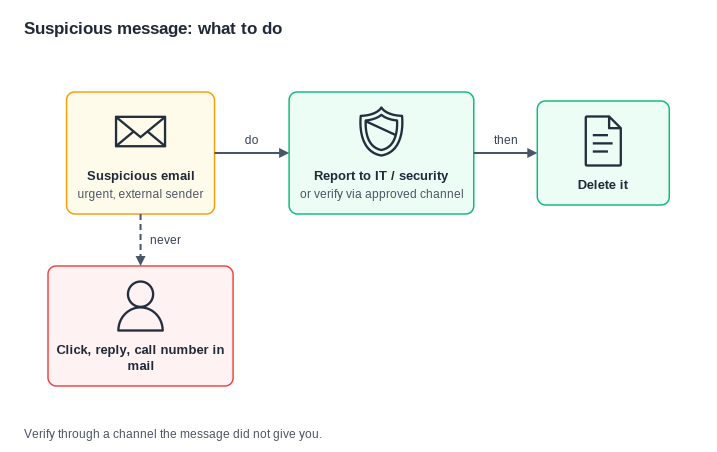
Correct response: do not click, reply or call numbers in the message; report to IT/security, delete, and verify through an approved, independent channel. Outlook offers a built-in Report button.
Identity verification
Before disclosing personal information, confirm the requester with company-approved methods. A requester's own email reply or self-provided details are not independent verification.
Authentication
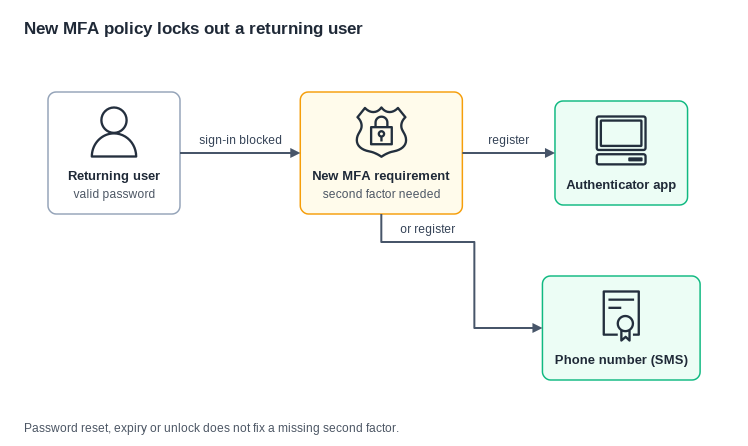
- Newly enforced MFA blocks users with a valid password until they register a second factor (authenticator app or phone/SMS).
- Password reset, never-expire or complexity changes do not fix it.
- Strong passwords: long and unpredictable; Microsoft recommends at least 14 characters. Avoid names plus suffix, keyboard patterns and single words.
Mobile Device Management
MDM enrolls devices, applies policy and reports compliance; Conditional Access uses compliance state to allow or block access to company resources.
PII handling
| Usually PII (identifies a person) | Weaker / broad category |
|---|---|
| SSN, credit card number, driver's license number, email address, fingerprint, date of birth | Gender, race, marital status, language preference, first name alone |
- Store sensitive data (e.g. card details) in encrypted storage; never on personal devices or shared openly.
- Retention policies must delete the most sensitive identifiers (government ID numbers) on schedule.
Exam traps
- "Click the link to check it's real" or "ask a colleague" is never right.
- Calling the number or replying to the suspicious email reaches the attacker.
- Choose the "report/verify through IT" answer for executive gift-card scams.
- MFA lockout after a policy change: register a factor, not reset the password.
- PII questions: pick direct identifiers (SSN, card, email, fingerprint, DOB), not broad demographics.
Docs
- https://learn.microsoft.com/en-us/entra/identity/authentication/concept-mfa-howitworks
- https://learn.microsoft.com/en-us/intune/intune-service/fundamentals/what-is-intune
- https://learn.microsoft.com/en-us/defender-office-365/submissions-outlook-report-messages
- https://learn.microsoft.com/en-us/defender-office-365/anti-phishing-policies-about
- https://learn.microsoft.com/en-us/microsoft-365/admin/misc/password-policy-recommendations
- https://learn.microsoft.com/en-us/azure/security/fundamentals/encryption-atrest