Exams / AIF-C01 / D5 Guidelines for Responsible AI
D5.3
Guidelines for Responsible AI (part 3 of 3)
- Exam domain: Guidelines for Responsible AI
Core dimensions of responsible AI
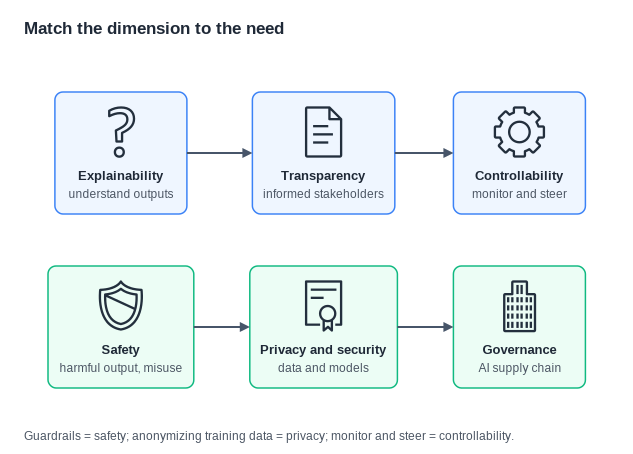
The AWS Generative AI Lens defines the dimensions below. Match the wording of the scenario to the definition.
| Dimension | Definition (AWS Generative AI Lens) | Typical scenario |
|---|---|---|
| Explainability | Understanding and evaluating system outputs. | Doctors and patients must understand a recommendation. |
| Transparency | Enabling stakeholders to make informed choices about their engagement with an AI system. | Documenting a model for users and auditors. |
| Controllability | Having mechanisms to monitor and steer AI system behavior. | Monitoring and steering a GenAI app. |
| Safety | Reducing harmful system output and misuse. | Bedrock Guardrails. |
| Privacy and security | Appropriately obtaining, using, and protecting data and models. | Anonymizing training data. |
| Governance | Incorporating best practices into the AI supply chain, including providers and deployers. | Cross-functional AI governance group. |
| Fairness | Considering impacts on different groups of stakeholders. | Training data that omits demographics. |
Bias, datasets and fairness
- Biased data may under-represent demographic groups or contain biased labels; a model trained on it can reproduce or exacerbate the bias. Unrepresentative training data is sampling bias.
- Dataset characteristics named in the exam guide: inclusivity, diversity, curated data sources, balanced datasets.
- Evaluation datasets must be diverse and representative of real-world usage, not skewed, arbitrary or stripped of outliers.
- Fix bias at the source: detect it (SageMaker Clarify), collect balanced data and retrain. Prompting, output filtering or per-group endpoints do not remove it.
- Hiring and lending are consequential decisions: test for discrimination against protected groups and keep human review.
Transparency, explainability and documentation
| Need | Tool or idea |
|---|---|
| Document model purpose, performance, risks, for audit | SageMaker Model Cards (standardized, versioned, exportable) |
| Compare and choose models | Amazon Bedrock Model Evaluations |
| Feature attributions (SHAP) and bias analysis | SageMaker Clarify (closed to new customers today) |
| Model documentation from AWS for its own services | AI service cards |
Greater transparency helps identify bias and improves governance. It does not remove bias, validation or compliance monitoring.
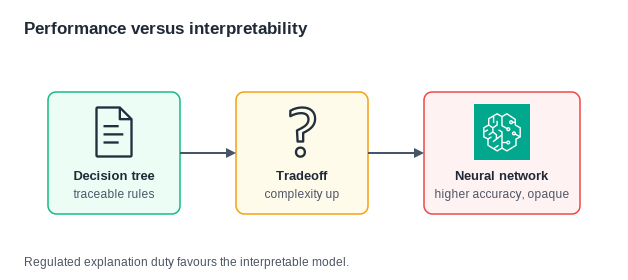
Tradeoff: a neural network gives higher performance for lower interpretability than a decision tree. When regulation demands explanations to customers and auditors, prefer the interpretable model.
Governance process and GenAI challenges
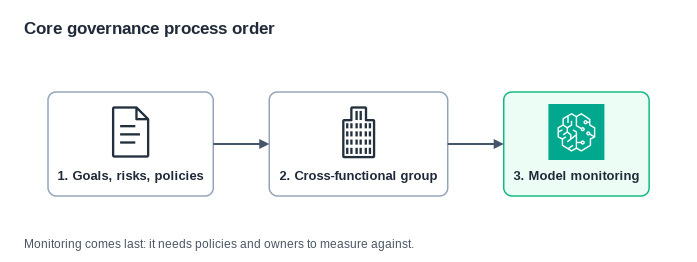
- Determine governance goals, risks and policies.
- Put together a cross-functional AI governance group.
- Set up model monitoring.
| Scenario | Challenge |
|---|---|
| Student copies AI output as own work | Plagiarism |
| Voice or likeness cloned without consent | IP infringement (exam logic; privacy also argued) |
| "Ignore previous instructions..." in user input | Prompt injection (jailbreaking is the related, broader term) |
| Block or mask PII, detect hallucinations, least overhead | Amazon Bedrock Guardrails (sensitive information filters, contextual grounding checks) |
Exam traps
- Explainability (understand outputs) differs from Transparency (informed stakeholders) and Controllability (monitor and steer).
- Guardrails = safety; model cards = transparency/documentation; Clarify = bias and explainability.
- "Least operational overhead" means the managed feature, never Lambda or EC2 custom builds.
- Higher accuracy usually costs interpretability; it never improves it.
- Transparency does not automatically remove bias.
- Prompt injection overrides instructions; data poisoning corrupts training data; model inversion extracts training data.