Exams / AIF-C01 / D5 Guidelines for Responsible AI
D5.2
Guidelines for Responsible AI (part 2 of 3)
- Exam domain: Guidelines for Responsible AI
Core dimensions
| Dimension | Meaning (AWS Well-Architected GenAI Lens) |
|---|---|
| Fairness | Considering impacts on different groups of stakeholders |
| Explainability | Understanding and evaluating system outputs |
| Transparency | Enabling stakeholders to make informed choices about their engagement with an AI system |
Other dimensions you may see: privacy and security, safety, controllability, veracity and robustness, governance.
Bias and fairness
- Bias starts in the data: unrepresentative groups or biased labels are learned and reproduced by the model.
- Use diverse, representative data and consistent labeling standards.
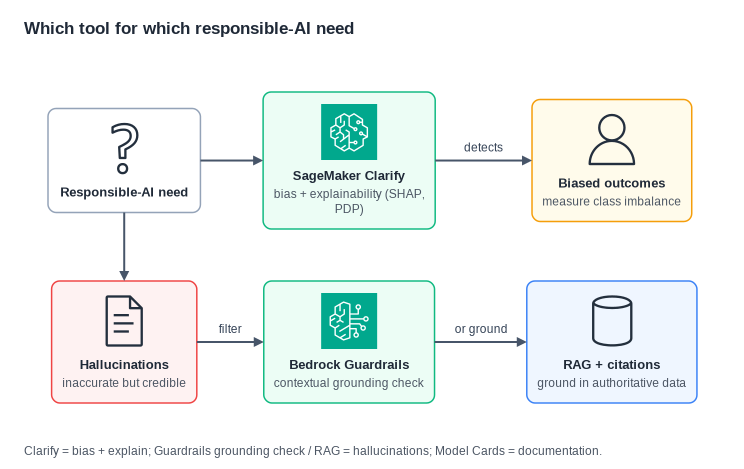
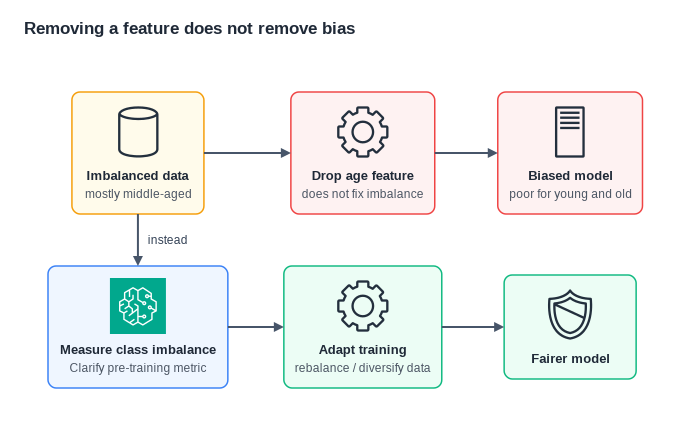
- SageMaker Clarify measures pre-training bias (for example class imbalance, CI) and post-training bias, and monitors it.
- Class imbalance: a facet value has fewer training samples than another. Measure it, then adapt training (rebalance, collect data).
- Removing a sensitive feature (such as age) does not fix imbalance; under-represented groups still get poor predictions.
- Reusing historical outcomes embeds past bias; separate models per demographic is not a fix.
Explainability and transparency
| Need | Tool |
|---|---|
| Explain predictions (feature attribution, SHAP, PDP) | SageMaker Clarify |
| Document business problem, assumptions, risk rating, training and evaluation | SageMaker Model Cards |
| Describe an AWS managed AI service | AWS AI Service Cards |
| Let users verify answers | Citations from Bedrock Knowledge Bases (source links) |
- PDPs show the marginal effect of a feature on the prediction; SHAP gives per-feature importance.
Hallucinations and safety
- Hallucination = plausible but inaccurate/ungrounded output.
- Mitigate with RAG (ground in authoritative data), Bedrock Guardrails contextual grounding check (detects and filters ungrounded responses; default thresholds 0.7).
- Guardrails also provides content filters and denied topics (e.g., child-appropriate apps).
- Nova Canvas: use a negative prompt (
negativeText) to exclude objects from images. - Aligning an LLM with company values and evolving moderation: feedback-based training (RLHF / reward signals) from skilled humans.
Governance and sustainability
- ISO/IEC 42001 certifies an organization's AI management system (AIMS), not people or individual AI systems.
- Data retention = rules for how long data is stored and when it is deleted.
- Sustainability: choose energy-efficient models and optimize inference.
Exam traps
- Removing the sensitive feature does not remove bias.
- Clarify = bias + explainability; Model Cards = documentation; Data Wrangler = data prep; Ground Truth = labeling.
- Guardrails "prevent" hallucinations by detecting/filtering ungrounded answers; RAG grounds them.
- Fairness (bias between groups) vs. transparency (understanding/disclosure) vs. explainability.
- ROUGE is a text-overlap metric, not a fairness or "100% accuracy" guarantee.