Exams / AIF-C01 / D1 Security, Compliance, and Governance for AI Solutions
Security, Compliance, and Governance for AI Solutions (part 2 of 3)
- Exam domain: Security, Compliance, and Governance for AI Solutions
This chapter covers the AWS services and concepts for governing, securing, and monitoring AI/generative-AI workloads: collaborative/governed development environments (SageMaker Unified Studio, Catalog, Model Cards), keeping Bedrock traffic private (PrivateLink), who-owns-what-security under the Generative AI Security Scoping Matrix, the four Bedrock Guardrails filter types plus jailbreak/prompt-injection attacks, production monitoring (Model Monitor, drift, retraining), discovering sensitive data and proving compliance (Macie, CloudTrail, Artifact), Bedrock's two inference-cost models, and the regulatory concepts of data residency and algorithm accountability.
Governed, collaborative AI environments
Three different services look similar ("helps govern AI work") but each targets a different need:
| Need | Service | What it actually does |
|---|---|---|
| One shared environment where teams discover, build, and share data/models/GenAI apps | SageMaker Unified Studio | "a single data and AI development environment" with built-in governance |
| Restrict training to approved data only, enforcing policy/ethics | SageMaker Catalog | lets users "securely discover and access approved data and assets" through a governed publish/subscribe workflow |
| Standardized, versioned documentation of a model across collaborators | SageMaker Model Cards | every edit "creates a new model card version in order to have an immutable record" of changes |
Model Cards matter for multi-party collaboration (e.g., a company and research institutes): instead of ad hoc notes or generic Git history, each edit produces a new, immutable, structured version capturing training details, evaluation results, intended use, and risk rating.
Keeping Bedrock traffic private: AWS PrivateLink
Several exam scenarios share the same shape: "calls to Amazon Bedrock must not cross the public internet" — whether the caller is an EC2/VPC application, SageMaker Studio, or a fine-tuning job touching data in a VPC. The answer is always an interface VPC endpoint powered by AWS PrivateLink:
"You can use AWS PrivateLink to create a private connection between your VPC and" Amazon Bedrock, without the "use of an internet gateway, NAT device, VPN connection, or Direct Connect connection."
IAM roles/policies and KMS encryption are frequent wrong answers here — they control who can call Bedrock or protect data confidentiality, but neither changes the network path traffic takes. Only a PrivateLink interface endpoint removes the public-internet hop.
| Wrong answer | Why it doesn't fit "keep traffic off the internet" |
|---|---|
| IAM role/resource policy | Controls permissions, not network path |
| KMS customer managed key | Encrypts data; traffic can still traverse the public internet |
| VPC peering with a "Bedrock VPC" | Bedrock is a managed service reached via API endpoints, not a peerable VPC |
| On-premises + public endpoint | Still crosses the public internet |
The Generative AI Security Scoping Matrix: who owns what
AWS extends its shared-responsibility model ("security of the cloud" vs. security in the cloud) to generative AI: the more of the GenAI stack a company builds itself, the more security responsibility shifts from the provider to the company.
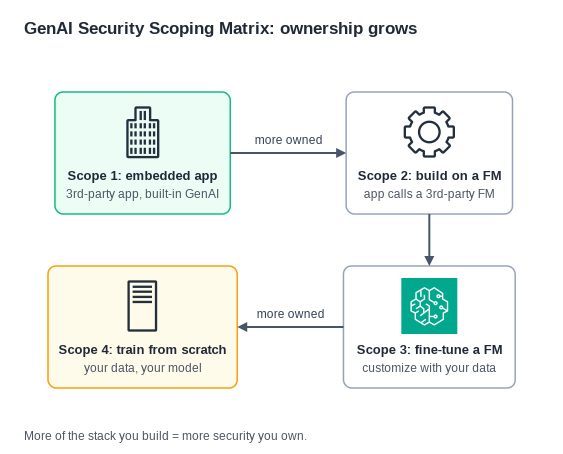
| Scope | Example | Who owns most of the security work |
|---|---|---|
| 1 — Consume an embedded app | Using a 3rd-party SaaS app with built-in GenAI features | Mostly the provider |
| 2 — Build on a 3rd-party FM | An app calling an existing FM (e.g., via Bedrock) | Shared, leaning provider |
| 3 — Fine-tune a 3rd-party FM | Customizing an existing FM with your own data | Shared, leaning customer |
| 4 — Train from scratch | Training your own model on your own data | Mostly the customer |
This mirrors the general AWS principle that "customer responsibility will be determined by the AWS Cloud services that a customer selects" — an EC2-like, build-it-yourself scope always carries more customer-side security work than a fully-managed, provider-run scope.
Bedrock Guardrails: four filter policies, four different jobs
Guardrails for Amazon Bedrock evaluate both the user's prompt and the model's response. Four distinct policy types exist, and the exam tests whether you can match a described mitigation to the right one:
| Filter policy | Targets | Doc wording |
|---|---|---|
| Content filters | Harm categories: hate, insults, violence, sexual, misconduct | "detect and filter harmful user inputs and" model responses |
| Denied topics | A whole, context-dependent subject (e.g., politics, legal/investment advice) | "specify a set of denied topics in a guardrail that are undesirable" |
| Word filters | A fixed list of specific words/phrases (profanity, competitor names) | "custom words or phrases that you want to block" |
| Contextual grounding check | Response content not supported by the supplied source (hallucinations) | "detect ... if they are not grounded ... in the source" |
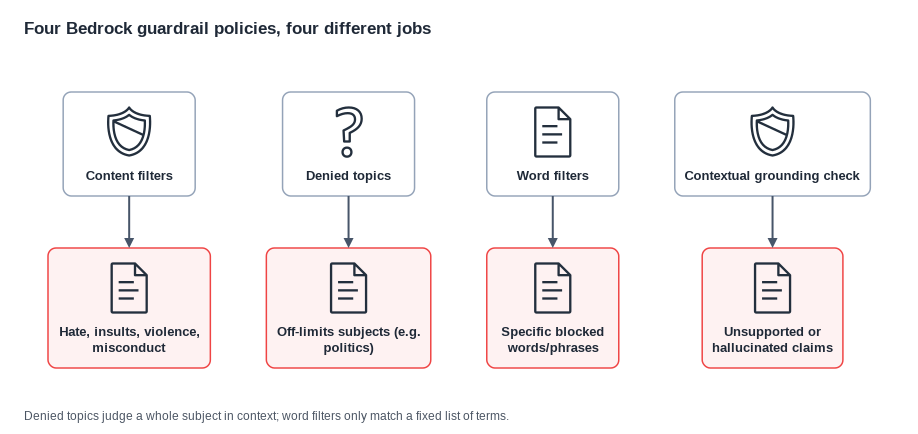
The trap: denied topics judge an entire subject in context (so "avoid political content" is a denied topic, not a word filter), while word filters only do exact/fuzzy matching on a defined term list.
Jailbreak vs. prompt injection
Both are prompt-attack techniques, but they target different things:
- Jailbreak — a prompt "designed to bypass the native safety and moderation capabilities" of the model itself, to make it produce content it was built to refuse.
- Prompt injection — a prompt "designed to ignore and override instructions specified by the developer" (e.g., "ignore all prior instructions..."), hijacking the application's intended behavior rather than the model's built-in safety training.
Bedrock Guardrails' prompt-attack detection and the "denied topics"/"content filters" policies are the main defenses against both.
Monitoring production models: drift and retraining
Once a model is deployed, a family of questions revolves around SageMaker Model Monitor:
- It "monitors the quality of Amazon SageMaker AI machine learning models in production" and "can set alerts that notify you when there are deviations."
- It covers data quality drift, model quality drift, bias drift, and feature-attribution drift (bias/feature-attribution drift monitoring runs through Model Monitor, using SageMaker Clarify's analysis).
- Detecting drift only tells you there's a problem — retraining the model with fresh, representative data is what actually fixes degraded accuracy; Model Monitor's alerts are what let you catch the next degradation before it goes unnoticed again.
Documentation note: AWS now states that Amazon SageMaker Model Monitor "is no longer open to new customers" while "existing customers can continue to use the service as normal." Exam scenarios describing a company already using Model Monitor are unaffected, but don't assume it's the tool to newly adopt going forward.
Discovering sensitive data and proving compliance
Four more AWS services get confused with each other because they all sound like "compliance tools," but each answers a different question:
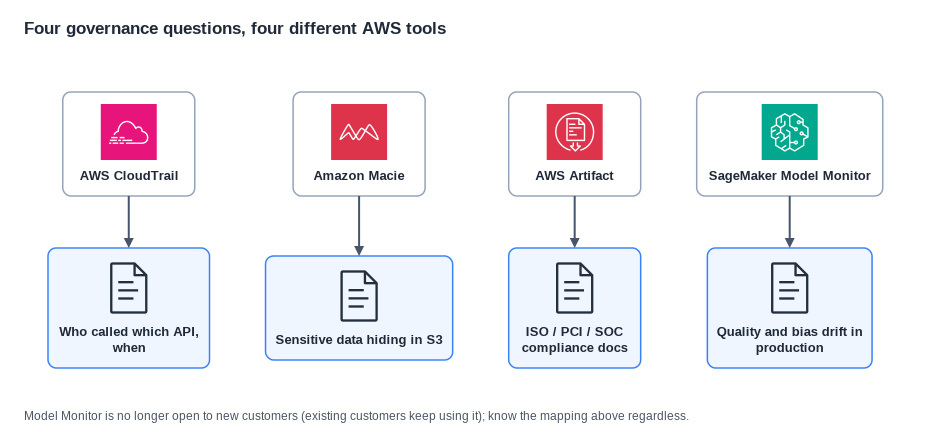
| Question | Tool | Why |
|---|---|---|
| "Who called the Bedrock API, and when?" (detect unauthorized activity) | AWS CloudTrail | "integrated with AWS CloudTrail, a service that provides a record of actions" including caller identity |
| "Is there sensitive data hiding in this S3 dataset before we share it?" | Amazon Macie | "automate discovery, logging, and reporting of sensitive data" in S3 |
| "Give me AWS's own ISO/PCI/SOC compliance documents for an audit" | AWS Artifact | "on-demand downloads of AWS security and compliance documents" |
| "Is this production model's quality/bias drifting?" | SageMaker Model Monitor | see previous section |
CloudTrail also directly answers "retain a record of each AI practitioner's actions in the account" — every action by a user, role, or AWS service is recorded as a CloudTrail event.
For live content safety (e.g., stop a medical model from leaking PII in its responses, with notification), the combination is Bedrock Guardrails (to filter the output) + CloudWatch alarms (to notify on a violation) — Macie only scans data at rest in S3, and CloudTrail only logs API calls, neither inspects live model output.
Bedrock inference modes and cost
| Mode | Billing | Best for |
|---|---|---|
| On-Demand Throughput | "you only pay for what you use" | Unpredictable, low-volume workloads (e.g., a pilot with unknown future usage) |
| Provisioned Throughput | "billed hourly for a Provisioned Throughput that you purchase," required if you need guaranteed capacity | Predictable, steady, high-volume workloads |
Self-managed GPU EC2 instances or SageMaker JumpStart endpoints both run (and cost) continuously regardless of actual usage — worse for an unpredictable low-volume scenario than On-Demand Throughput.
Data protection and access control basics
- Custom model artifacts default to AWS owned KMS keys; switch to a customer managed KMS key for full company control over the encryption key lifecycle (Bedrock requests scoped KMS grants to use it).
- Training-data access control for "only authorized personnel" is an IAM policy question (attached to users/groups/roles) — KMS protects the key, EMR/Redshift are compute/warehouse services, neither controls who may reach the data.
- S3 data encrypted with SSE-KMS needs the caller's role to hold explicit decrypt permission on that KMS key ("Permissions to describe and decrypt the KMS key that encrypted the S3 bucket"); this requirement is tied specifically to a KMS-encrypted bucket, not plain SSE-S3 (where AWS manages the key transparently).
- Third-party models on Bedrock: the model provider's account has no access to the AWS-managed deployment account, so "model providers don't have any access" to Bedrock logs, prompts, or completions — nothing is shared with them unless the customer explicitly opts in.
- Model invocation logging (not CloudTrail, not EventBridge) is Bedrock's built-in way to capture full request/response content for monitoring, delivered to an S3 and/or CloudWatch Logs destination you configure.
- SageMaker network isolation runs training/inference containers with no outbound internet access at all — the specific feature for a "no internet access" regulatory requirement (distinct from VPC-only restriction).
Data residency and algorithm accountability
- Data residency = where data is physically stored/processed (e.g., "customer PII must stay in the company's AWS Region"). Compare with data sovereignty (which laws apply to data because of where it sits) — residency is the storage-location requirement itself.
- Algorithm accountability laws is the general compliance category for regulations governing automated decision-making (e.g., AI-driven credit scoring) — transparency, bias assessment, and accountability requirements that must be reviewed whenever such a system expands into a new jurisdiction. This is generic legal/governance terminology, not a specific AWS feature.
Exam traps
- PrivateLink, not IAM/KMS, is the answer whenever the requirement is "don't cross the public internet" — IAM and KMS control permissions/confidentiality, not the network path.
- Denied topics vs. word filters: a whole subject (politics, legal advice): denied topic; a fixed list of specific terms → word filter. Content filters are about harm categories, not topics or terms.
- Jailbreak bypasses the model's safety training; prompt injection overrides the application's instructions (e.g., "ignore all prior instructions"). Both are prompt attacks, caught by Guardrails.
- Detecting drift ≠ fixing drift. Model Monitor only detects/alerts; retraining with fresh data is the remediation.
- CloudTrail vs. Macie vs. Artifact vs. Model Monitor: "who called the API": CloudTrail; "sensitive data in my S3 dataset" → Macie; "AWS's own compliance reports" → Artifact; "my production model's drift" → Model Monitor. Don't swap them.
- On-Demand vs. Provisioned Throughput: unpredictable/low volume: On-Demand (pay per use); steady/high volume needing guaranteed capacity → Provisioned (hourly, regardless of use).
- SSE-S3 vs. SSE-KMS: AWS documents the "role needs decrypt permission" requirement for an S3 bucket encrypted with a KMS key, not plain S3-managed keys (SSE-S3) — watch for questions that blur this distinction.
- Data residency (where data sits) vs. data sovereignty (which laws apply there) vs. algorithm accountability laws (rules on automated decisions) are three different governance concepts the exam can test as distractors against each other.
Docs
- What is Amazon SageMaker Unified Studio?
- Amazon SageMaker Model Cards
- Edit a model card
- Encryption of custom models (Amazon Bedrock)
- Use interface VPC endpoints (AWS PrivateLink) to create a private connection between your VPC and Amazon Bedrock
- Protect your data using Amazon VPC and AWS PrivateLink
- AWS Shared Responsibility Model
- Block harmful words and conversations with content filters - Amazon Bedrock
- Block denied topics to help remove harmful content - Amazon Bedrock
- Detect and filter harmful content by using Amazon Bedrock Guardrails
- Detect prompt attacks with Amazon Bedrock Guardrails
- Prompt injection security (Amazon Bedrock)
- Data and model quality monitoring with Amazon SageMaker Model Monitor
- SageMaker Model Monitor
- Bias drift for models in production
- Data quality - Amazon SageMaker AI
- Monitor Amazon Bedrock API calls using CloudTrail
- What Is AWS CloudTrail?
- Discovering sensitive data with Macie
- What is AWS Artifact?
- Using Amazon CloudWatch alarms
- Set up inference for a custom model - Amazon Bedrock
- Increase model invocation capacity with Provisioned Throughput in Amazon Bedrock
- Monitor model invocation using CloudWatch Logs and Amazon S3
- Data protection - Amazon Bedrock
- Configure access to Amazon S3 buckets - Amazon Bedrock
- Access management for AWS resources
- Run Training and Inference Containers in Internet-Free Mode - Amazon SageMaker AI
- What is Data Sovereignty?