Exams / AIF-C01 / D1 Security, Compliance, and Governance for AI Solutions
Security, Compliance, and Governance for AI Solutions (part 1 of 3)
- Exam domain: Security, Compliance, and Governance for AI Solutions
This chapter covers the controls the exam tests for securing and governing AI/ML workloads on AWS: protecting Amazon Bedrock model access and network paths, defending against prompt-level attacks, documenting and monitoring models for governance, and the AWS services used to prove regulatory compliance.
Securing access to Bedrock models and data
Access control for Bedrock is layered, and the exam expects you to pick the right layer for the stated requirement:
| Requirement | Control | Why the others are wrong |
|---|---|---|
| Limit which Bedrock models employees can invoke | IAM identity-based policy, Resource scoped to the model's ARN (arn:aws:bedrock:*::foundation-model/<model-id>) |
STS only issues temporary credentials — the permissions still come from the attached policy |
| Give every team access to only its own S3 customer data through Bedrock | A custom Bedrock service role per team, scoped to that team's data | A single shared role (even behind separate IAM roles elsewhere) still leaves Bedrock able to reach everything |
| Restrict which publicly available foundation models are even discoverable | SageMaker JumpStart private curated hubs | Cost Explorer, Artifact and OpenSearch have no model-discoverability control |
| Secure LLM use on Bedrock in general | Clear/specific prompts + least-privilege IAM roles and policies | Audit Manager, automatic evaluation jobs and CloudWatch Logs monitor/evaluate — they don't restrict who can call the model |
Shared Responsibility Model on Bedrock. AWS secures "the cloud" — patching Bedrock itself and protecting the infrastructure that hosts it. The customer secures "in the cloud" — its own data in transit and at rest, encryption choices, and IAM configuration. A question naming what the company is responsible for almost always lands on data protection, never on patching or infrastructure.
Keeping traffic off the public internet
A recurring requirement: a VPC (often for a regulated industry) must reach Bedrock without any internet exposure. The answer is always an interface VPC endpoint powered by AWS PrivateLink — never CloudFront (a public CDN), never an internet gateway (what must be avoided), and never a logging/monitoring service (CloudTrail, Macie) which has no bearing on the network path.
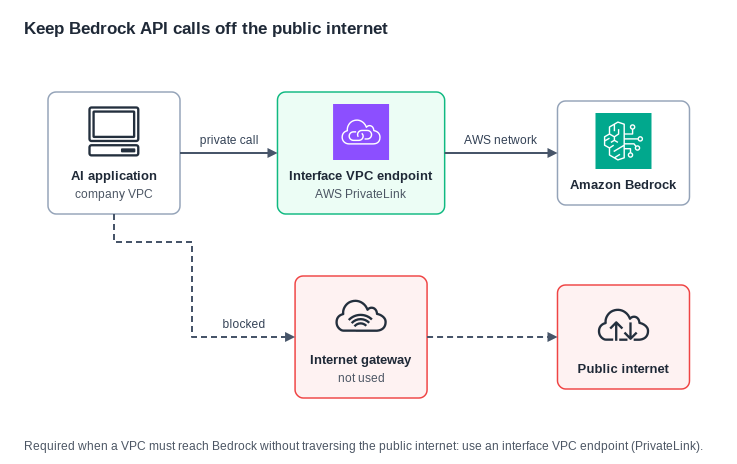
This pattern is identical whether the requirement is phrased as "no internet gateway," "must not traverse the public internet," or "multiple offices worldwide, never use the public internet" — PrivateLink's interface endpoint removes the internet gateway/NAT/public-IP requirement entirely, regardless of how many accounts or Regions are involved.
Guardrails: the managed defense against prompt-level attacks
Amazon Bedrock Guardrails is a configuration-only safety layer that inspects both the input prompt and the model's output, which is why it is almost always the "least implementation effort" answer whenever a chatbot needs hardening against prompt injection or harmful content — no fine-tuning, no model swap required.
| Guardrail policy | Stops | Exam phrasing to recognize |
|---|---|---|
| Prompt attacks | Jailbreaks and prompt injection that try to override instructions or bypass the model's built-in safety | "bypass the assistant's built-in safety capabilities" |
| Content filters | Hate, Insults, Sexual, Violence, Misconduct, Prompt Attack categories, on input and output | "harmful responses involving hate speech/insults/sexual content/violence" |
| Denied topics | Application-specific subjects the business wants to avoid entirely | "must never discuss X" |
| Sensitive information filters | PII and custom-regex sensitive data in prompts/responses | "redact personal data in responses" |
| Contextual grounding check | Responses that are not factually grounded in / relevant to a provided source | "reduce hallucinated or off-topic answers" |
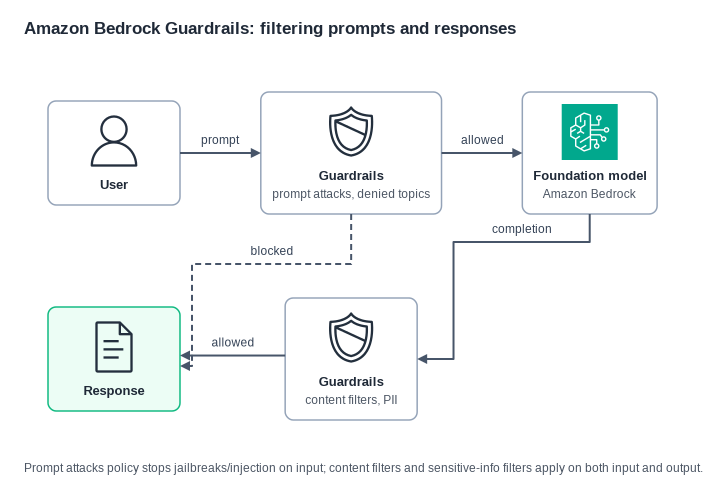
Prompt-template defenses complement Guardrails at the application layer: embedding instructions in the prompt template that explicitly teach the model to recognize common attack patterns reduces the chance of manipulation, and designing clear, specific prompts reduces the chance of unintended or harmful output. Prompt/system-prompt extraction is the attack that most directly exposes an LLM's configured behavior — recovering the system prompt reveals the instructions, roles and constraints that shape its responses; AWS's guidance is that this risk cannot be fully eliminated, only reduced (shorter exposure window, decoy content, Guardrails' prompt-attack filter with leakage detection).
Confidential data baked into a trained model. Once a custom model is fine-tuned on a dataset, that data is reflected in the model's weights — it cannot be selectively redacted afterward. Masking or encrypting the output does not remove information the model has already learned; the only fix is to delete the custom model, scrub the dataset, and retrain from a clean copy.
Documenting and monitoring models for governance
Two SageMaker features get confused on the exam because both relate to "model governance," but they solve different problems:
| Feature | What it captures | When it runs |
|---|---|---|
| SageMaker Model Cards | Static documentation: intended use, training/inference details, evaluation results, risk rating | Once, when publishing/auditing a model |
| SageMaker Model Monitor | Live production drift: data quality, model quality (e.g. accuracy), bias drift, feature-attribution drift | Continuously, against a deployed endpoint |
Model Cards is the answer whenever the question is about auditing, publishing, or governance/reporting of a model; Model Monitor is the answer whenever the question is about alerting on performance/accuracy drift of a model already in production. Note that AWS now documents Model Monitor as no longer open to new customers (existing customers can keep using it as-is) — the exam still tests its drift-monitoring role, but newer designs should expect AWS to point toward alternatives.
Federated learning is the ML technique associated with data compliance/privacy during training: a shared model is trained across distributed datasets while each client keeps its raw data in place, sharing only model parameters with a central aggregator — useful whenever a question stresses regulated, sensitive, or geographically distributed training data.
Anomaly detection is the general technique for flagging an observation (e.g. a suspicious source IP address, an unusual traffic pattern) that diverges from normal behavior — distinct from classification tasks like NER, speech recognition, or fraud forecasting that answer a different question.
Proving compliance: picking the right AWS governance service
These services are frequently listed together as distractors; know which one actually does what:
| Need | Service | Not |
|---|---|---|
| Full audit trail of every Bedrock/AWS API call, with caller identity | AWS CloudTrail | CloudWatch (metrics), Config (resource compliance) |
| Continuous evaluation of resource configuration against rules | AWS Config | CloudTrail (activity log), Inspector (vulnerability scan) |
| Automated evidence collection against prebuilt/custom compliance frameworks | AWS Audit Manager | Trusted Advisor (recommendations), Config (per-resource rules) |
| On-demand AWS and ISV compliance reports, with email alerts on new reports | AWS Artifact | Audit Manager (internal controls), Data Exchange (datasets) |
| Threat detection extended to Bedrock/SageMaker workloads | Amazon GuardDuty (AI Protection) | Inspector, Trusted Advisor |
| Automated sensitive-data discovery in S3, least development effort | Amazon Macie | Custom regex/LLM-based redaction (both cost far more effort) |
| Highly scalable monitoring of ML system performance | Amazon CloudWatch | CloudTrail, Config |
For long-term, low-cost log retention (e.g. "5 years, lowest possible cost"), pair CloudTrail for the log source with the S3 Intelligent-Tiering storage class, which automatically moves infrequently accessed objects to cheaper tiers as access patterns change — no manual lifecycle rules needed.
Data lifecycle management is the data-governance component that tracks data from creation through retention and scheduled deletion — distinct from data residency (geographic location), data observability (pipeline/data quality), and logging (recording events, not a retention policy by itself).
Where compliance requirements get set. In the AWS ML lifecycle, business goal identification — the first phase, where the business problem is framed — is where legal, regulatory, and industry constraints are scoped; every later phase (data collection, feature engineering, training) executes within constraints already defined there, rather than deciding what they are.
Exam traps
- "No internet access" + Bedrock → always PrivateLink. CloudFront, an internet gateway, and logging services are never the fix for a network-path requirement.
- "Least implementation effort" + prompt injection → Guardrails, not fine-tuning, not swapping the foundation model.
- Model Cards (static documentation/audit) vs. Model Monitor (live drift detection) — same vendor, two different jobs; don't swap them.
- CloudTrail vs. Config vs. Audit Manager vs. Artifact — activity log, configuration-rule compliance, evidence-collection-against-frameworks, and on-demand compliance reports (incl. ISV) respectively. Four different answers to four different-sounding questions.
- Confidential data already used to train a model cannot be masked or encrypted away after the fact — only delete-and-retrain removes it.
- IAM policy (model ARN) restricts which models; IAM service role restricts what the role can touch — read the question for "limit employee access to models" (policy) vs. "per-team data isolation" (per-team role).
- S3 Intelligent-Tiering, not S3 Standard, whenever a question asks for lowest cost over a multi-year retention period with changing access patterns.
Docs
- Amazon SageMaker Model Cards
- Data and model quality monitoring with Amazon SageMaker Model Monitor
- Delete a custom model (Amazon Bedrock)
- Best practices to avoid prompt injection attacks — AWS Prescriptive Guidance
- Detect prompt attacks with Amazon Bedrock Guardrails
- Detect and filter harmful content by using Amazon Bedrock Guardrails
- Use interface VPC endpoints (AWS PrivateLink) to create a private connection between your VPC and Amazon Bedrock
- What is AWS PrivateLink?
- Service roles for Amazon Bedrock
- Identity-based policy examples for Amazon Bedrock
- Private curated hubs for foundation model access control in JumpStart
- Implementing least privilege access for Amazon Bedrock — AWS Security Blog
- Designing for the inevitable: system prompt leakage and mitigations — AWS Security Blog
- AWS Shared Responsibility Model
- Federated learning on AWS using FedML, Amazon EKS, and Amazon SageMaker
- Use the built-in Amazon SageMaker Random Cut Forest algorithm for anomaly detection
- Monitor Amazon Bedrock API calls using CloudTrail
- Amazon S3 Intelligent-Tiering storage class
- What is AWS Audit Manager?
- Components of an AWS Config Rule
- AWS Artifact now sends email notifications for new reports
- GuardDuty AI Protection
- Analyzing findings from automated sensitive data discovery — Amazon Macie
- Amazon SageMaker AI metrics in Amazon CloudWatch
- Define scalable data lifecycle management — AWS Well-Architected Framework
- The ML lifecycle — AWS Well-Architected Machine Learning Lens
- SUS05-BP02 Use instance types with the least impact — Sustainability Pillar
- Amazon EC2 Trn1 Instances
- MCP security — Amazon Q Developer