Exams / CSCO-100-150 / D4 Network Access
Network Access
- Exam domain: Network Access
Cabling and connectors
| Medium | Connector | Note |
|---|---|---|
| UTP copper (1000BASE-T) | RJ-45 | "The 10/100/1000 ports use RJ-45 connectors with Ethernet pinouts." |
| Fibre | LC, SC, ST | SFP modules: "The modules have LC connectors for fiber-optic connections or RJ-45 connectors for copper connections." |
| Coax | BNC | not Ethernet twisted pair |
| RJ-11 | telephone | never Ethernet |
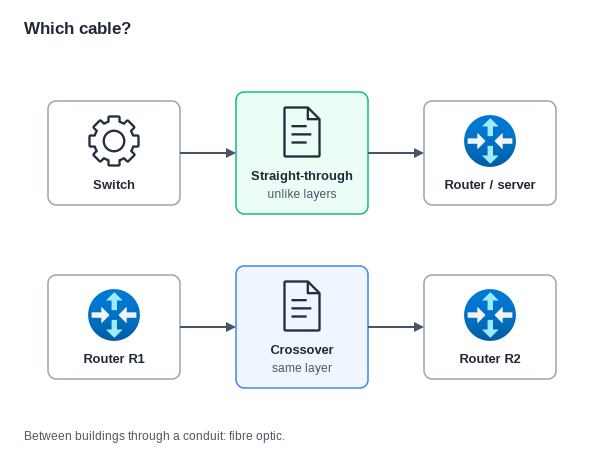
Straight-through when connecting unlike devices (PC, server, router to switch); crossover for the same OSI layer: "A convenient rule of thumb is to use a crossover cable when the two ports that are connected are in the same layer of the OSI model." Long runs between buildings use fibre.
Switch LEDs and ports
| LED | Meaning |
|---|---|
| Solid green | link present, no activity |
| Blinking green | link with activity |
| Alternating green-amber | link fault: "errors such as excessive collisions, CRC errors, and alignment and jabber" |
PoE ports are the RJ-45 access ports; SFP slots are uplinks; the console port is out-of-band access.
Switch forwarding
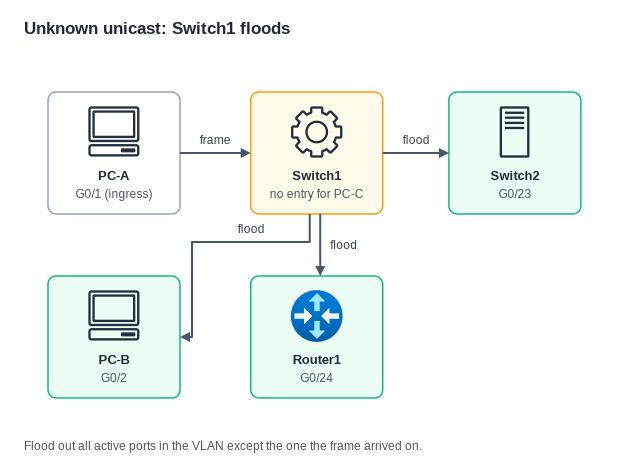
A switch learns source MACs from incoming frames (dynamic) or has static entries. A frame with an unknown destination is flooded out all ports except ingress. Many MACs from several VLANs on one port means a trunk to another switch. show cdp neighbor lists Device ID, local interface, holdtime, capability, platform and port ID.
Management access
- Console = out-of-band; Telnet, SSH, SNMP need IP connectivity (in-band).
- An IP address on the management VLAN SVI lets a Layer 2 switch be reached by SSH/Telnet; it does not make it a gateway or DHCP server.
- New Catalyst interfaces: enabled, Layer 2, no IP address.
- IPv6 uses NDP (ICMPv6 Neighbor Solicitation/Advertisement) instead of ARP.
Exam traps
- Blinking green is activity, not instability or cable faults.
- Alternating green-amber = high error rate, not shutdown or firewall.
- Layer 2 switches never send ARP or error messages for unknown unicast; they flood.
- Home Wi-Fi: WPA2-PSK = pre-shared key; hide SSID = disable broadcast; disable WPS = no push-button.
- Ticket triage: impact and urgency first; first ticket = fault description and conditions.
Docs
- https://www.cisco.com/c/en/us/td/docs/switches/lan/catalyst9200/hardware/install/b-c9200-hig/leds.html
- https://www.cisco.com/c/en/us/td/docs/switches/lan/catalyst2960c_3560c/hardware/installation/guide/2960c_3560c_hig/higoverview.html
- https://www.cisco.com/c/en/us/support/docs/lan-switching/ethernet/10561-3.html
- https://learn.microsoft.com/en-us/dotnet/fundamentals/networking/ipv6-overview