Exams / CSCO-100-150 / D1 Networking Fundamentals
Networking Fundamentals
- Exam domain: Networking Fundamentals
Network types and cloud models
| Type | Scope | Exam example |
|---|---|---|
| PAN | A person's devices, about 10 m | Phone to Bluetooth headset |
| LAN | Room, home, building, small group of buildings | Two PCs on a switch |
| MAN | A city | Buildings in one city via a cable company |
| WAN | Large distance, carrier links, leased lines, VPN | Branches via a telecom provider |
| Cloud model | What you get |
|---|---|
| IaaS | Virtual machines and virtual networks: "You manage virtual machines, operating systems, and applications." |
| PaaS | A managed platform to build applications on |
| SaaS | "You use ready-made applications." (subscription web app) |
An IoT device is a physical, connected endpoint (for example an internet-accessible thermostat), not a server or a storage array.
Addressing
| Item | Facts |
|---|---|
| Private IPv4 (RFC 1918) | 10.0.0.0/8, 172.16.0.0/12 (172.16.0.0 to 172.31.255.255), 192.168.0.0/16 |
| Mask to prefix | 255.255.252.0 = 8+8+6 = /22; 248 = /21, 254 = /23, 240 = /20 |
| IPv6 compression | Drop leading zeros per hextet; :: once only, for a run of zero hextets; never strip trailing zeros |
| IPv6 types | Link-local fe80::/10, unique local fc00::/7, multicast ff00::/8, global 2000::/3 |
Example: 2001:0db8:0000:0016:0000:001b:2000:0056 becomes 2001:db8:0:16::1b:2000:56.
Models and encapsulation
| OSI layer | Examples | TCP/IP layer |
|---|---|---|
| Application | SMTP, HTTP, FTP | Application |
| Transport | TCP, UDP | Transport |
| Network | IP, router | Internet |
| Data Link | Ethernet, Layer 2 switch | Network access |
| Physical | Cable, hub, NIC | Network access |
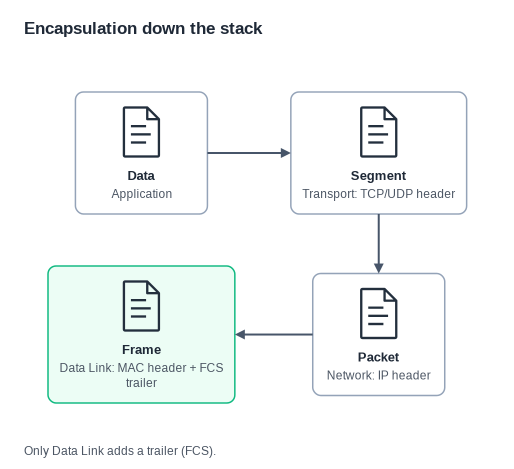
The Data Link layer builds the frame: MAC header plus an FCS trailer.
Switching and media
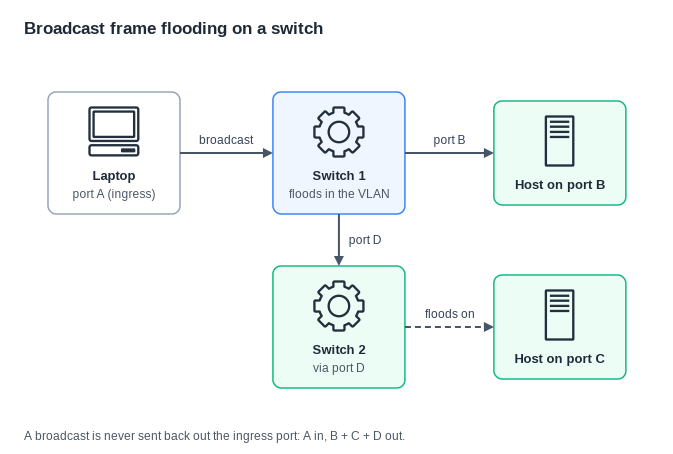
A switch learns source MACs per port. Its MAC address table holds MAC addresses (dynamic or static) with ports, no IP addresses (those are in the ARP table). Broadcasts are flooded out every port in the VLAN except the ingress port.
| Medium or standard | Fact |
|---|---|
| Fiber | Immune to EMI and RFI |
| Copper, twisted pair, wireless | Susceptible to interference |
| IEEE 802.11 | Wi-Fi |
| IEEE 802.3 | Ethernet |
Performance and file transfer
Bandwidth (capacity) and latency (delay) are separate: "Networks with high bandwidth do not guarantee low latency." Low bandwidth can add queuing delay; latency does not reduce bandwidth; lower latency can raise throughput.
| Protocol | Transport and port | Traits |
|---|---|---|
| SFTP | SSH, TCP 22 | SSH keys, encryption and integrity |
| TFTP | UDP 69 | Small files, device config backups, no authentication |
Cisco IOS: show running-config is the active configuration; show startup-config is the saved one.
Exam traps
- Private ranges: 11.x and 192.16.x are public; 172.16 to 172.31 only.
- Only one
::in an IPv6 address; 2000 is not 2. - A broadcast is not sent back out the ingress port.
- High latency does not lower bandwidth (the statement is False).
- MAC table is Layer 2 only; ARP maps IP to MAC.
- Hub, cable and NIC are Physical in this exam's mapping.
Docs
- https://learn.microsoft.com/en-us/azure/virtual-network/virtual-networks-faq
- https://learn.microsoft.com/en-us/windows/win32/rpc/network-latency-and-throughput
- https://learn.microsoft.com/en-us/azure/security/fundamentals/shared-responsibility
- https://learn.microsoft.com/en-us/azure/storage/blobs/secure-file-transfer-protocol-support
- https://learn.microsoft.com/en-us/azure/iot/iot-introduction