Exams / SOA-C03 / D1 Security and Compliance
D1.1
Security and Compliance (part 1 of 2)
- Exam domain: Security and Compliance
You are reading a free preview. The rest of the SOA-C03 course unlocks with an Exam pass or All access.See plans
Detect and remediate non-compliance
| Need | Service | Notes |
|---|---|---|
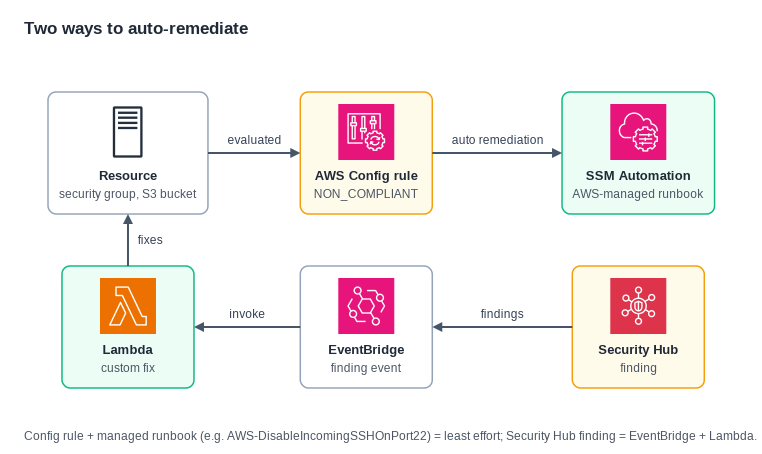
| Continuous compliance rule on resources | AWS Config managed rules | e.g. required-tags, s3-bucket-logging-enabled |
| Fix automatically | Config auto remediation → SSM Automation runbook | e.g. AWS-DisableIncomingSSHOnPort22, AWS-ConfigureS3BucketLogging |
| React to a Security Hub finding | EventBridge → Lambda | Custom remediation pattern |
| Multi-account inventory | Config aggregator | "Aggregators provide a read-only view into the source accounts and" Regions |
| CIS benchmark across accounts | Security Hub CSPM + Organizations auto-enable | Delegated admin adds new accounts automatically |
| Unusual API activity | CloudTrail Insights | Baselines management and data events |
| DNS threats (DGA, tunneling) | Route 53 Resolver DNS Firewall Advanced | Not WAF, not Shield |
| Out-of-band changes to stack resources | CloudFormation drift detection | Run on a schedule via EventBridge + Lambda + SNS |
| Root sign-in alert | EventBridge (CloudTrail ConsoleLogin) → SNS |
SQS does not send email |
| Compliance reports for AWS controls (PCI, SOC) | AWS Artifact | Hand them to auditors |
Trusted Advisor: "AWS Trusted Advisor checks are available to customers with an AWS Business Support+, AWS Enterprise Support, or AWS Unified Operations plan." Basic Support gets Service Limits and selected Security/Fault tolerance checks.
IAM, SCPs and cross-account access
- Customer managed policy + group: reusable, editable, versioned (up to five versions). AWS managed policies can't be edited by you; inline policies are per identity and not versioned.
- Wildcards:
service:*allows all actions of the service;Describe*/List*only read actions. - EC2 needs AWS access: use an instance role (temporary credentials), least-privilege actions, never embedded access keys.
- Cross-account assume role: the target role's trust policy names the other account AND the caller needs an identity policy allowing
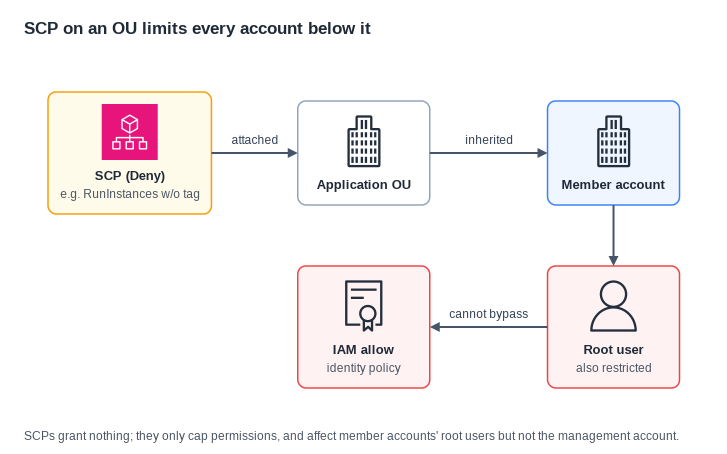
sts:AssumeRoleon the role ARN. - SCPs: guardrails only, grant nothing. "SCPs affect all users and roles in attached accounts, including the root user." They don't affect the management account. Attach to an OU to scope; a deny wins. Keep
FullAWSAccessor everything is denied.
Network access to instances
| Control | Stateful? | Trap |
|---|---|---|
| Security group | Yes | No outbound rule needed for responses |
| Network ACL | No | Custom NACL needs inbound AND outbound (ephemeral ports) rules |
- EC2 Instance Connect Endpoint: SSH to private instances without bastion or public IP; IAM controls who can use it; the instance security group must allow inbound SSH 22 from the endpoint. No key pair is needed.
- S3 from a VPC without internet: S3 gateway endpoint (route table entry, no charge); NAT, VPN and Transit Gateway don't fit.
- ALB: HTTP:80 listener redirects to HTTPS:443 listener holding the ACM certificate.
Encryption and data protection
- Encrypted RDS snapshot sharing: use a customer managed key whose policy allows the target account; the default key can't be shared. Aliases give no access.
- EBS only supports symmetric KMS keys; customer managed keys give custom key policy and automatic rotation (365 days by default). Imported key material is not auto-rotated.
- AMI backup to S3: store image task (
CreateStoreImageTask), restore withCreateRestoreImageTask.
Exam traps
- A Config rule alone only detects; remediation must be configured.
- IAM policies cannot restrict the root user of a member account; SCPs can.
- Removing the default
FullAWSAccessSCP denies everything. - Security group SSH rule on the instance, not the endpoint's inbound rules, is what breaks Instance Connect Endpoint.
- Trusted Advisor coverage depends on the Support plan, not on SCPs or running instances.
- Gateway endpoints are not PrivateLink (interface endpoints are), though questions sometimes blur this.
Docs
- https://docs.aws.amazon.com/elasticloadbalancing/latest/application/load-balancer-listeners.html
- https://docs.aws.amazon.com/Route53/latest/DeveloperGuide/firewall-advanced.html
- https://docs.aws.amazon.com/config/latest/developerguide/setup-autoremediation.html
- https://docs.aws.amazon.com/systems-manager-automation-runbooks/latest/userguide/disable-incoming-ssh.html
- https://docs.aws.amazon.com/AmazonRDS/latest/UserGuide/share-encrypted-snapshot.html
- https://docs.aws.amazon.com/awssupport/latest/user/trusted-advisor.html
- https://docs.aws.amazon.com/organizations/latest/userguide/orgs_manage_policies_scps.html
- https://docs.aws.amazon.com/config/latest/developerguide/aggregate-data.html
- https://docs.aws.amazon.com/securityhub/latest/userguide/accounts-orgs-auto-enable.html
- https://docs.aws.amazon.com/vpc/latest/privatelink/vpc-endpoints-s3.html
- https://docs.aws.amazon.com/AWSEC2/latest/UserGuide/connect-using-eice.html