Exams / SN-CIS-TPRM / D1 Assessment Configuration
D1.1
Assessment Configuration
- Exam domain: Assessment Configuration
You are reading a free preview. The rest of the SN-CIS-TPRM course unlocks with an Exam pass or All access.See plans
Building blocks and tables
| Concept | What it is | Table / detail |
|---|---|---|
| Question | An assessment metric: each non-scripted metric is a questionnaire question | asmt_metric |
| Questionnaire template | Reusable set of questions | asmt_metric_type |
| Assessment template | Groups questionnaire / document-request templates | sn_vdr_risk_asmt_template |
| External (third-party risk) assessment | What the third-party contact responds to | sn_vdr_risk_asmt_assessment |
| Internal assessment | Tiering / IRQ, completed by internal users to scope risk | sn_vdr_risk_asmt_internal_assessment |
| Issue | Follow-up on a finding | sn_vdr_risk_asmt_issue |
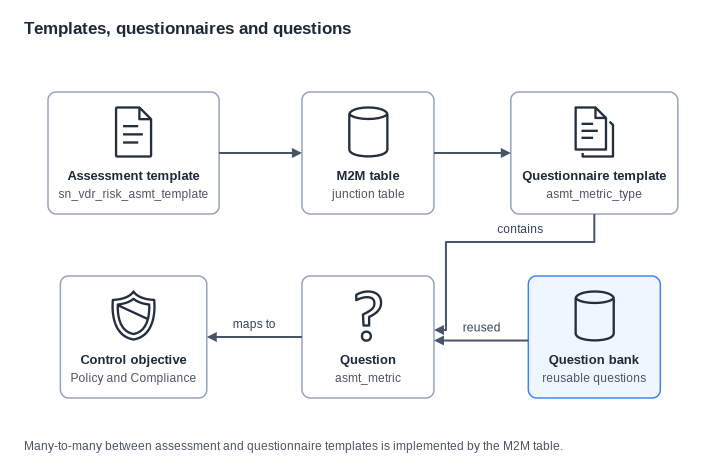
Assessment templates and questionnaire templates are linked many-to-many through a junction (M2M) table. A question bank lets you reuse questions across assessments (classic engine: add questions to an assessment category in the bank, then drop them into an assessment).
Scoring and rating
- Each external assessment uses the platform assessment score calculation engine.
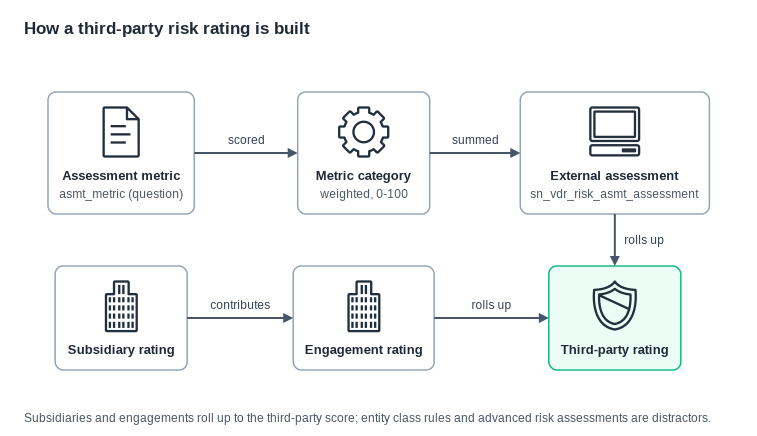
- Question → category (weighted, normalized) → questionnaire score; document requests get a qualitative score from the "Do you have document...?" question.
- A scored question contributes 0 when answered incorrectly and a weighted share of the maximum score (100) when correct. Category scores use a 0-100 convention.
- Ratings aggregate and roll up to engagements and third parties; subsidiary ratings contribute to the controlling third party's score.
Assignment, reminders and the portal
- Assessments can be created manually or generated by event-driven management rules (one-time or recurring, filtered by conditions).
- Scheduled reminder flows email the primary contact: due in 1 week, due in 3 days, overdue (per the Brazil docs; older exam keys quote 30 and 7 days).
- Third-party contacts reach the portal at
[instance URL]/svdp. They can import a completed SIG questionnaire (Import widget on the portal). - Assessors can answer on behalf of contacts if
sn_svdp.allow_assessor_editis enabled.
Risk intelligence, elements and control objectives
- A provider is available for report requests only when Order reports is selected; you also define a request type (the name of a report available for the provider).
- Third-party elements are external organizations that an engagement or third party relies on for goods, services or support (not the goods themselves, not component criteria).
- Control objectives come from Policy and Compliance Management; mapping them to questions lets controls be marked compliant / non-compliant from the response.
Issues and closing an assessment
- Internal-only issues have no third-party interaction, so the external states (Submitted to Third-party, Finalize with Third-party) can be skipped.
- Accepting an issue records the intention to create an exception for a known control failure or risk.
- Before closing, the assessor reviews comments and evaluates the risk; the manager or owner approves and closes.
Exam traps
sn_vdr_risk_asmt_assessmentis the assessment table, not_taskor_issue.- Questions are
asmt_metric, notasmt_assessment_instance,taskor GRC task. - Roll-up contributors: engagements and child third parties (subsidiaries), not entity class rules or advanced risk assessments.
- Portal URL suffix is
/svdp. - Third-party contacts answer external risk assessments, not tiering or IRQ (internal).
Docs
- https://raw.githubusercontent.com/ServiceNow/ServiceNowDocs/brazil/markdown/governance-risk-compliance/third-party-risk-management/tprm-data-model.md
- https://raw.githubusercontent.com/ServiceNow/ServiceNowDocs/brazil/markdown/governance-risk-compliance/third-party-risk-management/tprm-terminology.md
- https://raw.githubusercontent.com/ServiceNow/ServiceNowDocs/brazil/markdown/governance-risk-compliance/third-party-risk-management/vendor-ratings-scoring.md
- https://raw.githubusercontent.com/ServiceNow/ServiceNowDocs/brazil/markdown/governance-risk-compliance/third-party-risk-management/tprm_email_notification.md
- https://raw.githubusercontent.com/ServiceNow/ServiceNowDocs/brazil/markdown/governance-risk-compliance/third-party-risk-management/vendor-portal.md
- https://raw.githubusercontent.com/ServiceNow/ServiceNowDocs/brazil/markdown/governance-risk-compliance/third-party-risk-management/tprm-tpcontact-use-sig.md
- https://raw.githubusercontent.com/ServiceNow/ServiceNowDocs/brazil/markdown/governance-risk-compliance/third-party-risk-management/tprm-riskintelprvdr-register.md
- https://raw.githubusercontent.com/ServiceNow/ServiceNowDocs/brazil/markdown/governance-risk-compliance/third-party-risk-management/tprm-add-controls-q.md