Exams / SN-CIS-SM / D1 Customer Service Management System Setup and Configuration
Customer Service Management System Setup and Configuration (part 1 of 2)
- Exam domain: Customer Service Management System Setup and Configuration
The questions of this module are about the discovery and mapping foundation of the CMDB: Service Mapping, Discovery, patterns, MID Servers, and the Identification and Reconciliation Engine (IRE).
Service Mapping: top-down discovery
Service Mapping starts from an entry point and follows connections between applications using patterns. This is called top-down mapping. The MID Server talks to the hosts, and credentials give it access.
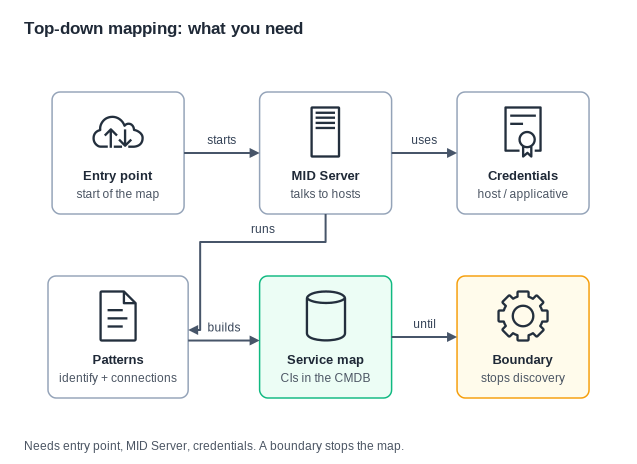
| Item | Role |
|---|---|
| Entry point | Where the map starts |
| MID Server | Facilitates communication between Service Mapping and the devices and applications |
| Credentials | Host credentials (SSH / Windows) are typically enough; some applications need applicative credentials |
| Pattern | Sequence of commands that detects the attributes of a CI and its outbound connections |
| Boundary | Makes Service Mapping stop and not follow outgoing connections (shown as a dotted-circle icon below a CI on the map) |
| Tag-based mapping | Uses tags (key-value pairs) discovered by Discovery / Cloud Provisioning and Governance |
- Generic applications are applications found with an open listening port and no pattern for them.
- A CI type (class) must exist before a pattern can be built for it; "Create CI types" is a step before "Create or customize patterns".
- The scheduled job "Generate entry point candidates from netflow and netstat data" supports mapping many application services in bulk.
Patterns
- A pattern has identification, connection and extension sections.
- Extension sections let you add steps and modify discovery logic of identification sections without changing them. The MID Server runs them after identification sections, only if at least one identification section completed successfully.
- To capture a connection from Host A to Host B in a Connection section, debug on the source host (Host A): connections are outbound.
Discovery: schedules and scanning
- Shazzam cluster support distributes Shazzam (port scan) processing among multiple MID Servers in a cluster; without it one MID Server runs the port scan.
- A
/16IP network = 65,536 addresses; Discovery does not scan the network or broadcast address, so about 65 thousand hosts. - IP ranges, unlike IP networks, scan everything in the range, including broadcast addresses.
- SSH Private Key credentials use the PEM format (key starts with
-----BEGIN). - SNMP community credentials have a community string only; the default read-only string is
public. SNMPv3 credentials add privacy protocol and key. - Classification of computers is driven by the operating system detected.
CMDB classes and relationships
| Class | Note |
|---|---|
| Application [cmdb_ci_appl] | Parent of application classes, including Application Server [cmdb_ci_app_server] (a child) |
| Key Value [cmdb_key_value] | Tags for tag-based mapping |
A relationship = two CIs + a relationship type (for example Runs on, Depends on, Contains).
CI Class Manager: view, create or edit class definitions (tables and columns), IRE class settings (identification rules, identifier entries, dependent relationship rules, reconciliation rules), CMDB Health settings, and some Service Mapping definitions.
Identification and Reconciliation Engine
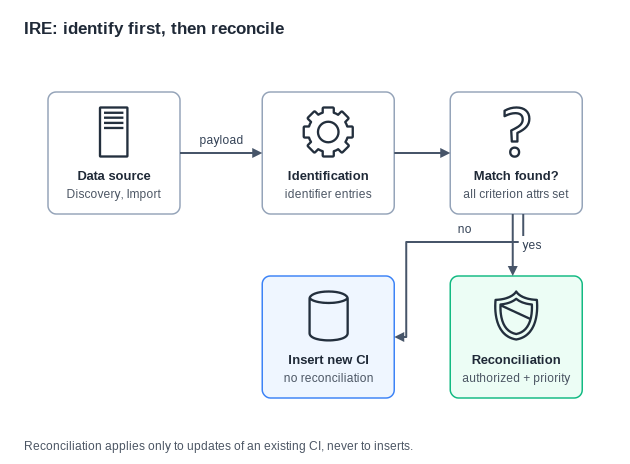
- Identification rules contain identifier entries with criterion attributes. If Allow null attribute is off, all criterion attributes must have values to attempt matching.
- Reconciliation rules: only authorized data sources may update attributes; if several are authorized, a priority decides. Lower-priority updates are rejected.
- Reconciliation is only for updates; inserts skip it.
- IRE always updates
last_discoveredanddiscovery_source.
Exam traps
- Reconciliation rules (authorized sources + priority) vs identification rules (find the matching CI).
- Boundary ≠ generic application (generic applications use a gear icon).
- Child vs parent: Application Server is a child of Application.
- Connection section debug host: the source (Host A).
- Network/broadcast addresses are skipped for IP networks, not for IP ranges.
- MID = Management, Instrumentation, and Discovery.
Docs
- https://raw.githubusercontent.com/ServiceNow/ServiceNowDocs/brazil/markdown/servicenow-platform/configuration-management-database-cmdb/create-reconciliation-rule-non-cmdb.md
- https://raw.githubusercontent.com/ServiceNow/ServiceNowDocs/brazil/markdown/servicenow-platform/configuration-management-database-cmdb/t_CreateCIIdentificationRule.md
- https://raw.githubusercontent.com/ServiceNow/ServiceNowDocs/brazil/markdown/servicenow-platform/configuration-management-database-cmdb/ci-class-manager-landing-page.md
- https://raw.githubusercontent.com/ServiceNow/ServiceNowDocs/brazil/markdown/it-operations-management/service-mapping/pattern-based-discovery.md
- https://raw.githubusercontent.com/ServiceNow/ServiceNowDocs/brazil/markdown/it-operations-management/discovery/discovery-schedule-form.md
- https://raw.githubusercontent.com/ServiceNow/ServiceNowDocs/brazil/markdown/it-operations-management/discovery/discovery-ip-address-configuration.md
- https://raw.githubusercontent.com/ServiceNow/ServiceNowDocs/brazil/markdown/it-operations-management/discovery-and-service-mapping-patterns/modify-pattern-using-extensions.md
- https://raw.githubusercontent.com/ServiceNow/ServiceNowDocs/brazil/markdown/it-operations-management/service-mapping/tag-based-mapping.md