Exams / SN-CIS-HAM / D1 HAM basics and process architecture
D1.1
HAM basics and process architecture (part 1 of 2)
- Exam domain: HAM basics and process architecture
You are reading a free preview. The rest of the SN-CIS-HAM course unlocks with an Exam pass or All access.See plans
Asset vs configuration item (CI)
| Asset | CI | |
|---|---|---|
| Lives in | Asset Management (alm_asset) |
CMDB |
| Focus | Financial: cost, contracts, procurement, maintenance, retirement | Operational data and relationships to other CIs |
| Typical question | "Who owns it, what does it cost, when is it retired?" | "What does it depend on?" |
Asset Management "focuses on the financial aspects of owning property"; when an asset has a CI, the two records are kept synchronized by business rules.
Model categories, asset classes and creation of assets
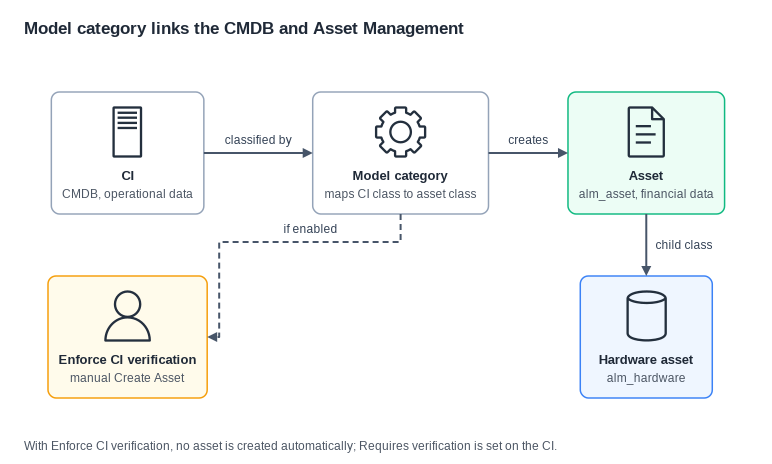
- A model category connects model, asset class and CI class: it is the link between configuration management and asset management.
- With Enforce CI verification enabled on the model category, a new or discovered CI does not create an asset; the CI gets Requires verification and an asset is created with the Create Asset action.
- Default asset classes: Hardware, Software License, Consumable, Bundle, Software Entitlement, Facility. Contracts are not an asset class.
alm_assetis the base table;alm_hardwareextends it.- Display name is set automatically from Asset tag and Model.
States and substates
| State | Notes |
|---|---|
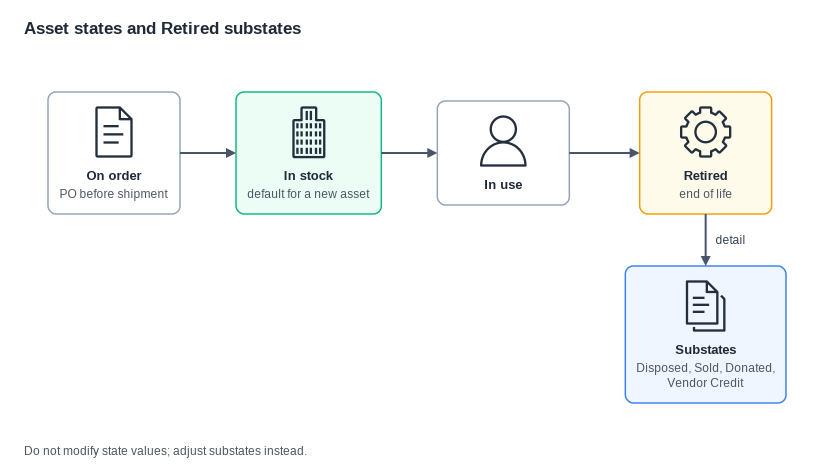
| On order | Asset created from a PO before shipment |
| In stock | Default for a new asset |
| Consumed | Consumable assets that were used |
| Retired | End of life; substates Disposed, Sold, Donated, Vendor Credit |
Do not modify state values; adjust substates. Retiring an asset also retires its related CIs.
Processes and artifacts
| Item | Key fact |
|---|---|
| Transfer order | Moves assets between company stockrooms |
| Service Catalog | Requests are sourced from existing stock first; otherwise a purchase order is triggered |
| HAM lifecycle flows | Asset order, bulk stock order, disposal order |
| HAM adds | Mobile Asset Receiving, Hardware Model Normalization, Hardware Asset Dashboard |
ham_admin |
Administrative role for the HAM application; flows and catalog need separate roles |
| Capability tiers | Trustworthy data, Practical management, Operational integration, Strategic conformance (exam material) |
Exam traps
- Financial, contractual and lifecycle information = asset; operational data and relationships = CI.
- Retired substates are exactly Disposed, Sold, Donated, Vendor Credit (not Destroyed).
- Contracts are not an asset class; Facility, Hardware and Software Entitlement are.
- Questions on personas, ham_admin scope, contract states and model lifecycle phases could not be checked against the docs: treat them with care.