Exams / SN-CIS-EM / D1 Event Management Overview
D1.1
Event Management Overview
- Exam domain: Event Management Overview
You are reading a free preview. The rest of the SN-CIS-EM course unlocks with an Exam pass or All access.See plans
Where Event Management fits
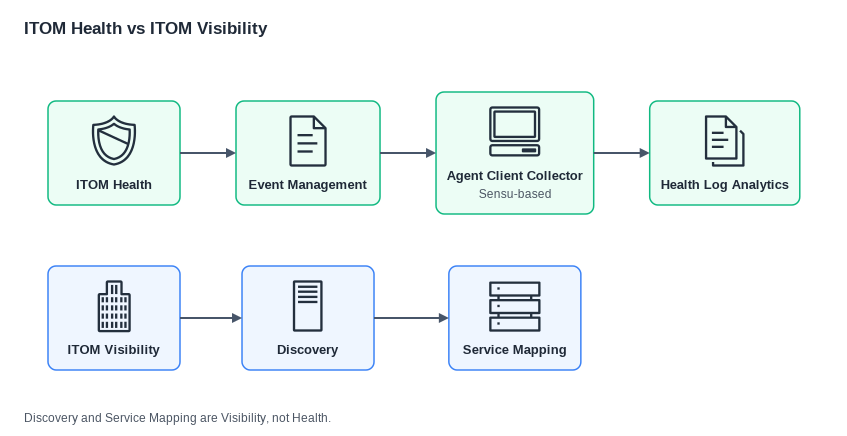
Event Management belongs to the ITOM Health family (called ITOM AIOps in current docs). Discovery and Service Mapping are ITOM Visibility; they feed the CMDB that Event Management uses to map alerts to CIs.
| Product family | Applications |
|---|---|
| ITOM Health | Event Management, Operational Intelligence (Metric Intelligence), Agent Client Collector, Health Log Analytics |
| ITOM Visibility | Discovery, Service Mapping |
| ITOM Optimization | Cloud Management / Cloud Provisioning and Governance |
- "Event Management gathers alerts from infrastructure events captured by third-party monitoring tools."
- Operational Intelligence (Metric Intelligence) analyses operational metrics to identify anomalies and prevent potential service outages.
- Agent Client Collector (ACC) is built on Sensu; community Sensu checks can be customised and installed as a plugin.
From event to alert
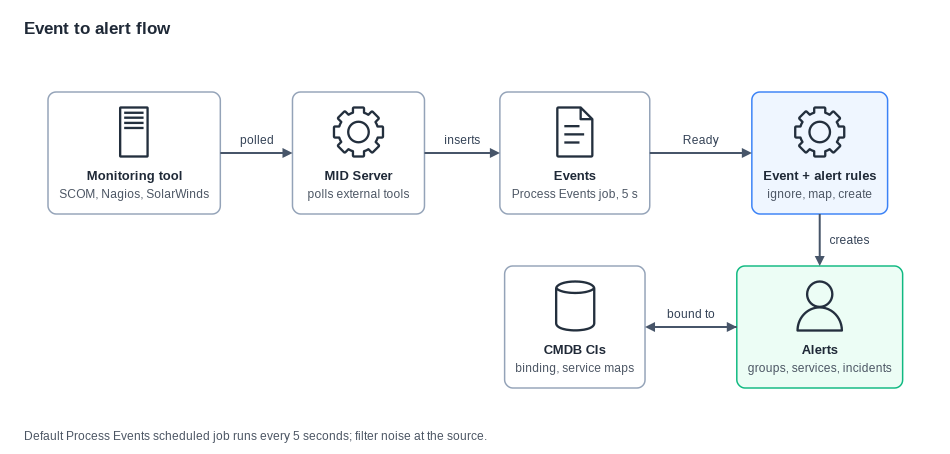
An event is a notable occurrence reported by a monitoring tool; an alert is what Event Management creates from events after applying rules.
| Item | Fact |
|---|---|
| Event sources | Email, script, SNMP trap, web service API, or MID Server polling an external tool |
| Processing | Scheduled job Event Management - Process Events, every 5 seconds, handles each Ready event (event rule, mapping rule, create/update alert) |
| Ignore rule | If the rule's Ignore box is selected, no alert is generated |
| Scaling | Enable multi-node processing and set the number of scheduled jobs (evt_mgmt.event_processor_job_count) to the deployment size |
| MID Server | Management, Instrumentation, and Discovery; polls external tools and sends data to the instance |
Operator experience
- Operators work with alert groups, application services (manual or discovered through Service Mapping) and technical services (dynamic CI groupings). "Correlation groups" is not an object type; correlation rules create alert groups.
- Express List (Service Operations Workspace) is a sortable, continually updated alert list that cuts clicks and refreshes.
- Link View shows how alerts in a group are linked; it was introduced for tag-based groups.
- Enrich automation standardises raw events (extract/compose fields, tags) to help grouping and response.
- Now Assist for ITOM writes human-readable alert analyses.
- Roles:
evt_mgmt_adminis for configuration and operational control, such as creating technical services.
Licensing and setup
- Licensing counts unique nodes that send events; where alerts are bound to CIs, the bound CIs are counted.
- Guided Setup is the feature for rapid implementation.
CMDB and service data
| Topic | Fact |
|---|---|
| CMDB Health Dashboard | KPIs: Completeness, Correctness, Compliance |
| Data quality over time | IRE: identification, reconciliation and relationship rules |
| CSDM | Common Service Data Model, the shared framework for service-level reporting |
Exam traps
- Discovery and Service Mapping are Visibility, not Health.
- Operational Intelligence detects anomalies, not alert correlations or missing CMDB data.
- CMDB Health = Completeness, Correctness, Compliance (not Conformity or Conciseness).
- Event processing is a 5-second scheduled job, not a business rule at insert.
- Filter noise at the source, do not promote every event to an alert.
- Licensing is not based on connectors or listeners.
Docs
- https://raw.githubusercontent.com/ServiceNow/ServiceNowDocs/brazil/markdown/it-operations-management/itom-health-use-case-product-view.md
- https://raw.githubusercontent.com/ServiceNow/ServiceNowDocs/brazil/markdown/it-operations-management/event-management/exploring-event-management.md
- https://raw.githubusercontent.com/ServiceNow/ServiceNowDocs/brazil/markdown/it-operations-management/event-management/r_InstalledWithEventManagement.md
- https://raw.githubusercontent.com/ServiceNow/ServiceNowDocs/brazil/markdown/it-operations-management/event-management/r_EMBestPractice.md
- https://raw.githubusercontent.com/ServiceNow/ServiceNowDocs/brazil/markdown/it-operations-management/event-management/license-usage.md
- https://raw.githubusercontent.com/ServiceNow/ServiceNowDocs/brazil/markdown/it-operations-management/event-management/operator-application-services.md
- https://raw.githubusercontent.com/ServiceNow/ServiceNowDocs/brazil/markdown/it-operations-management/event-management/express-list.md
- https://raw.githubusercontent.com/ServiceNow/ServiceNowDocs/brazil/markdown/it-operations-management/metric-intelligence/operational-metrics.md
- https://raw.githubusercontent.com/ServiceNow/ServiceNowDocs/brazil/markdown/it-operations-management/agent-client-collector/acc-custom-checks.md