Ingest
- Exam domain: Ingest
Ways to populate the CMDB
| Method | Nature | Uses IRE? | Exam cue |
|---|---|---|---|
| Discovery | Agentless, probes, sensors, patterns | Yes | Many relationships created automatically |
| Service Graph Connector (SGC) | Prebuilt Store integration | Yes | Fastest time to value, least technical debt (e.g. SCCM) |
| IntegrationHub ETL | Guided ETL transform maps for third-party data | Always (built in) | Custom third-party data; field mappings |
| Import Sets + transform maps | Organization-built | Only via CMDBTransformUtil in an onBefore script |
Most technical debt |
| Agent Client Collector (ACC) | Agent-based | Yes | Intermittent / isolated devices |
| Service Mapping | Application services and their infrastructure | Yes | Application service maps |
"You can populate the CMDB by using Discovery, by using the IntegrationHub ETL or Import Sets to import and integrate data from a third-party source, by integrating with an external CMDB, or by manually creating CIs."
IntegrationHub ETL, RTE and IRE
Data is imported into staging tables, the Robust Transform Engine (RTE) uses the ETL transform map to build IRE payloads, and IRE identifies/reconciles before writing to the CMDB (or supported non-CMDB tables).
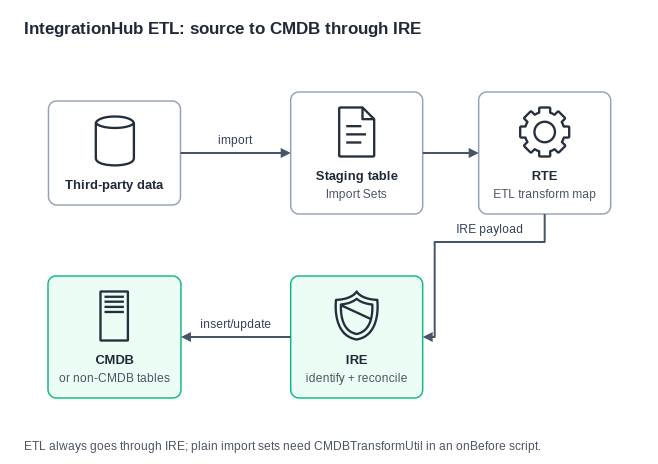
- IRE is incorporated into ETL, so everything is processed by IRE; Table API and plain import sets can bypass it.
- To use IRE from an import set, call
CMDBTransformUtilin the transform maponBeforescript. - The mappings of a Service Graph Connector are reviewed in IntegrationHub ETL; the CMDB Integrations Dashboard shows only status, results and errors.
IRE rules
- Identification rules: identifier entries (e.g. Hardware: serial number, then name, then Network Adapter mac+name) decide whether an incoming CI matches. An attribute that is in no entry (like IP address in the exam exhibit) cannot match, so the CI is inserted.
- Identification inclusion rules narrow the scope of CIs in identification (e.g. only operational CIs).
- Reconciliation rules decide which source may update an attribute.
- Duplicates: with
glide.identification_engine.skip_duplicatestrue (default) and fewer duplicates than the threshold (default 5), the oldest duplicate is updated and becomes the main CI.
CMDB 360 (multisource)
Retains raw values from every discovery source and CI, lets you modify reconciliation rules and recompute, and needs the ITOM Discovery License plugin.
Reclassification
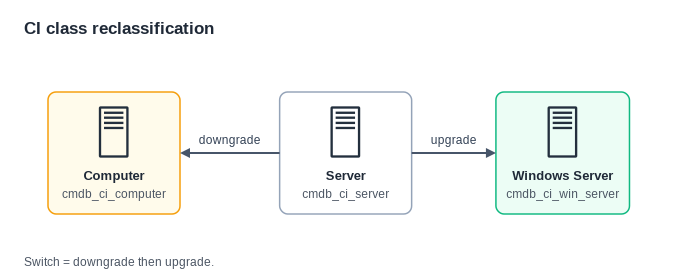
Upgrade = to a derived child class (more attributes). Downgrade = to a parent. Switch = downgrade then upgrade. Avoid downgrade and switch: data loss.
CMDB Data Manager
Policy-driven bulk CI life-cycle management: Attestation, Retire, Archive, Delete. Tasks are created per Managed By group and reviewed in CMDB Workspace.
Class design and CSDM
Reuse classes from the CMDB CI Class Models app, then extend the right CI class; never repurpose base classes. CSDM Design & Planning is the domain of enterprise architects and (digital product / application) owners.
Exam traps
- ETL always uses IRE; import sets do not unless scripted with
CMDBTransformUtil(onBefore). - "Verify CIs exist" = Attestation, not Certification (not a policy type in the docs).
- Upgrade = child class; do not confuse with downgrade/switch.
- CMDB 360 keeps all source values; it is not the CMDB quality score (CMDB Health).
- SCCM + fastest value = Service Graph Connector, not ETL/import sets.
- Customizing an out-of-box SGC record means upgrades skip it.