Exams / SF-IA / D1 Salesforce Integration Patterns
D1.1
Salesforce Integration Patterns (part 1 of 3)
- Exam domain: Salesforce Integration Patterns
You are reading a free preview. The rest of the SF-IA course unlocks with an Exam pass or All access.See plans
Choosing the pattern
The official pattern catalog sorts integrations by who calls whom, whether the caller waits, and whether the data is copied or only displayed.
| Need | Pattern | Typical mechanism |
|---|---|---|
| Salesforce needs the answer in the same interaction | Remote Process Invocation - Request and Reply | Apex callout (Named Credentials), External Services from Flow, Continuation for slow endpoints |
| Salesforce hands work off and moves on | Remote Process Invocation - Fire and Forget | Platform event with external subscriber, outbound messaging |
| Show remote data without copying it | Data Virtualization | Salesforce Connect external objects (OData adapter, cross-org adapter) |
| Large scheduled data movement | Batch Data Synchronization | ETL tool + Bulk API 2.0 |
| The remote system creates/reads Salesforce data | Remote Call-In | REST/SOAP/Bulk API, OAuth with a connected app or external client app |
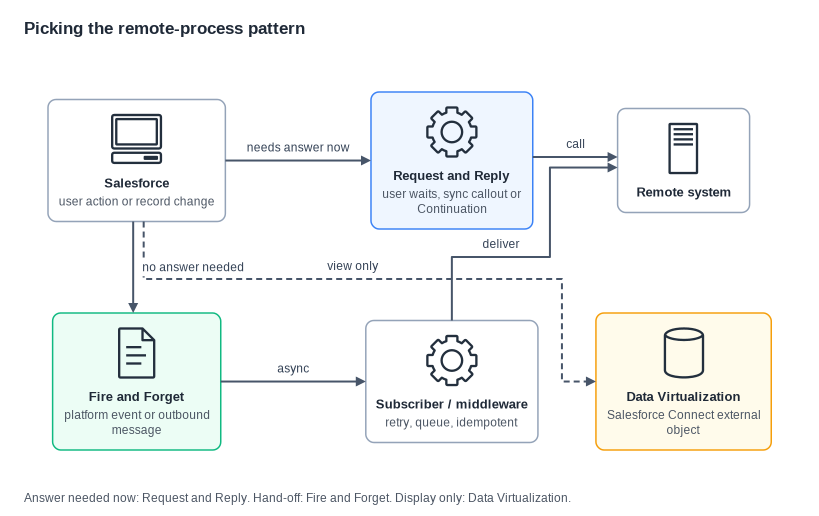
Request and Reply
- Synchronous: the caller blocks until the remote system answers.
- External Services invokes a REST API declaratively when its definition is available in OpenAPI 2.0 or 3.0 format. If no OpenAPI spec is available, use Named Credentials in Apex for the HTTP callout.
- A Named Credential defines the endpoint and the authentication in one definition; do not build your own authentication.
- For high-latency endpoints use an asynchronous callout (Continuation) to avoid synchronous Apex governor limits. The docs say continuations are the preferred way to manage callouts for user experience, although since Winter '20 callouts no longer count toward the long-running request limit.
- Error handling, retries and logging for critical flows (payments, credit checks) are best put in middleware.
Fire and Forget
- Salesforce publishes and does not wait. Platform events (event bus) are the modern mechanism; outbound messaging is the older SOAP-based one.
- Outbound messaging retries until the remote service gives a positive acknowledgment, a form of guaranteed delivery. That makes it at-least-once, so the receiver should be idempotent.
- Idempotent receivers track duplicates by a unique message identifier, which also solves lost acknowledgments.
- Asynchronous queues buffer surges (for example a registration peak) so the receiving system is not overloaded.
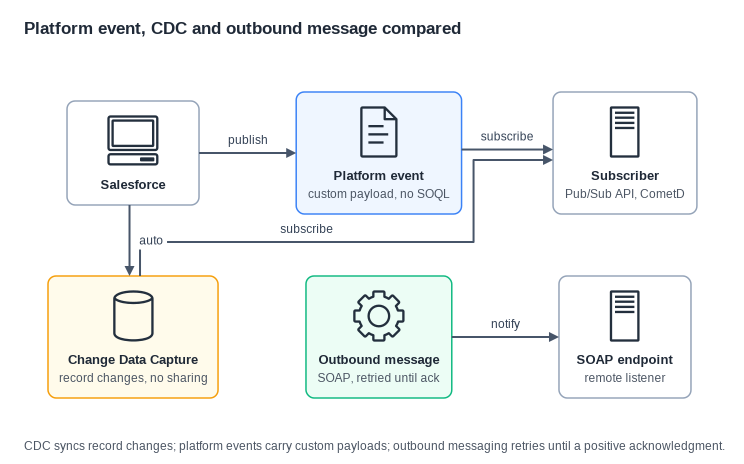
| Mechanism | Remember |
|---|---|
| Platform event | Custom payload, publishable from Apex/Flow/API; no SOQL, no Lightning record page, deleted definition is permanent |
| Publish Immediately vs Publish After Commit | Immediately = outside the DB transaction, may arrive before it commits |
| Change Data Capture | Auto-published for creates, updates, deletes and undeletes; used to sync an external store; no record-sharing support |
| Outbound messaging | SOAP message to an endpoint, retried until acknowledged |
Data Virtualization (Salesforce Connect)
- Maps external tables to external objects and fetches data in real time through a live connection.
- Relationships to standard or custom objects (for example Case) are supported.
- Fits very large or fast-growing data that stays in its system of record (core banking transactions, 20M+ archived records), minimal code.
- Adapters include OData and cross-org; middleware can expose the OData endpoint.
Middleware
- Complex cross-system orchestration, aggregation of several services, long-running processes and routing are recommended in the middleware layer.
- Middleware can create service facades that hide provider-specific endpoints, so the Salesforce side does not change when providers come and go.
- Real-time access to on-premise data needs APIs Salesforce can call (custom APIs or MuleSoft-exposed APIs), not batch jobs.
Remote Call-In and bulk
- Authentication of the calling system uses OAuth 2.0 through a connected app; new connected apps are restricted from Spring '26, so use an external client app.
- Bulk API 2.0 is the REST-based asynchronous option for large data volumes (more than about 2,000 records).
- A named credential plus the standard REST API is the cheapest push between two orgs.
- Enterprise WSDL: strongly typed, org-specific. Partner WSDL: loosely typed, any org.
Exam traps
- "Immediately visible but huge and external" is external objects, not ETL.
- Fire and Forget never returns a result to the user; use Request and Reply when the user must see an error or confirmation.
- Platform events cannot be queried with SOQL or shown on a record page.
- CDC ignores sharing; PushTopic events honor it.
- Retries cause duplicates: pair them with idempotent design.
- ConnectedApp is the legacy name; external client apps replace new connected apps.