Exams / SF-DCC / D1 Study Up on Identity Resolution
D1.1
Study Up on Identity Resolution
- Exam domain: Study Up on Identity Resolution
You are reading a free preview. The rest of the SF-DCC course unlocks with an Exam pass or All access.See plans
Identity resolution merges the records of the same person (or account) coming from several sources into one unified individual.
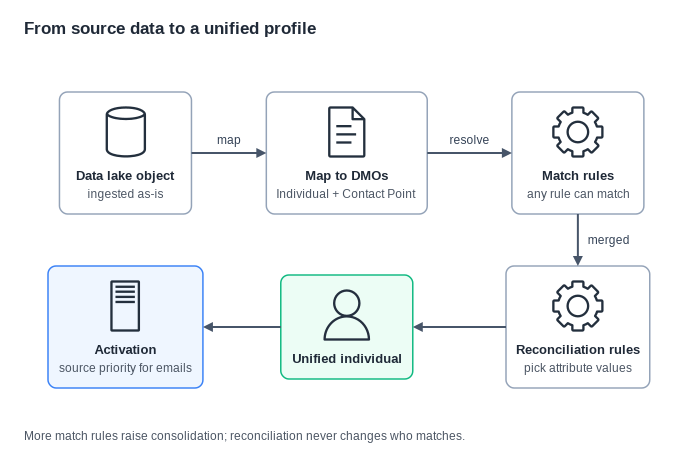
Pipeline and objects
| Step | What happens | Exam point |
|---|---|---|
| Ingest | Data lands in data lake objects (DLOs) as-is | One DLO per source |
| Map (harmonize) | DLO fields mapped to the standard data model | Required before segmenting |
| Match rules | Decide which records belong together | Any single active rule can match |
| Reconciliation rules | Decide which value wins in the unified profile | Last Updated, Most Frequent, Source Priority |
| Activation | Sends data out | Source priority picks the contact point |
- Person attributes (name) → Individual; email → Contact Point Email; alternate IDs (loyalty, patient, CRM ID) → Party Identification (same identification name across sources).
- No usable primary key → composite key built with a formula field.
- Docs example: the rule Fuzzy Name and Normalized Email merges duplicates from Salesforce CRM and Amazon S3 into one unified Individual.
Tuning
| Symptom | Action |
|---|---|
| Low consolidation rate | Add match rules (more ways to match) |
| False merges (shared email/phone, households) | New, stricter ruleset; compare, then migrate |
| Need exact precision (healthcare) | Party Identification on a unique ID |
| Latest email missing | Check mapping to Contact Point Email; reconciliation does not apply to contact points |
| Conflicting values | Reconciliation rules; Ignore Empty Value skips empties |
Consolidation rate rises when match rules are added or new overlapping sources arrive.
Validating and cleaning up
- Validate unified data with Data Explorer, Profile Explorer and the Query API (SQL over unified, data lake, profile and engagement objects).
- Deleting a ruleset removes its unified data; source data stays.
- Right to be forgotten: Consent API privacy request plus delete-file for ingested records.
Exam traps
- Reconciliation rules do not change which records match; match rules do.
- Harmonization maps schemas; identity resolution merges people.
- Fewer rules or stricter rules lower consolidation; more rules raise it.
- Email and phone contact points are not reconciled; choose them at activation by source priority.
- Data Cloud is not master data management.