Exams / GCP-PCNE / D1 Configuring, implementing and managing a cloud network security solution
D1.1
Configuring, implementing and managing a cloud network security solution (part 1 of 3)
- Exam domain: Configuring, implementing and managing a cloud network security solution
You are reading a free preview. The rest of the GCP-PCNE course unlocks with an Exam pass or All access.See plans
Firewall rules and policies
| Topic | Fact |
|---|---|
| Priority | Rules are evaluated from highest to lowest priority, where 0 is the highest priority. |
| Targets / sources | VPC firewall rules target instances by network tag or service account (never labels). Service accounts are the more precise identity. |
| Implied rules | Implied deny ingress and implied allow egress exist. They cannot be logged. |
| Logging | Enabled individually per rule. To see denied traffic, create an explicit deny rule with logging. |
| Hierarchical policies | Evaluated before VPC rules; lower-level rules cannot override a higher-level rule. goto_next hands the packet to the next level (folder, then VPC policies). |
Pattern for "block X everywhere except the corporate network, and let some VPCs decide": org-level ingress rule for the corporate range with goto_next (higher priority), then a deny from 0.0.0.0/0, then allow rules in the VPC policies.
Cloud Armor policy types
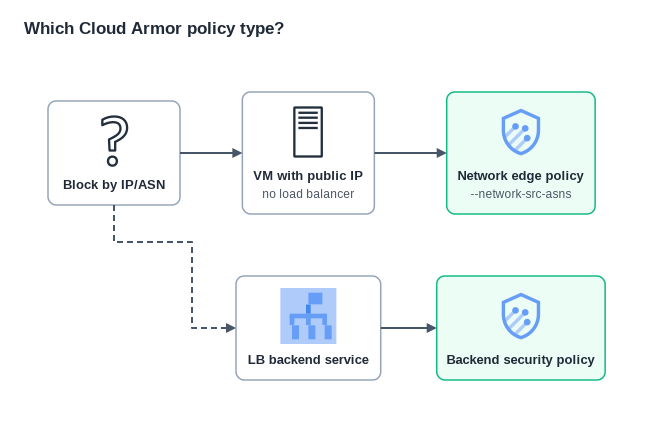
- Backend security policy: attached to backend services of external load balancers (also GKE through Ingress and BackendConfig).
- Edge security policy: filters before cache, for backend services and buckets.
- Network edge security policy: protects VMs with public IPs, regional external passthrough LBs and protocol forwarding; supports source ASN matching (
--network-src-asns). - Preview mode logs what a rule would match without enforcing it.
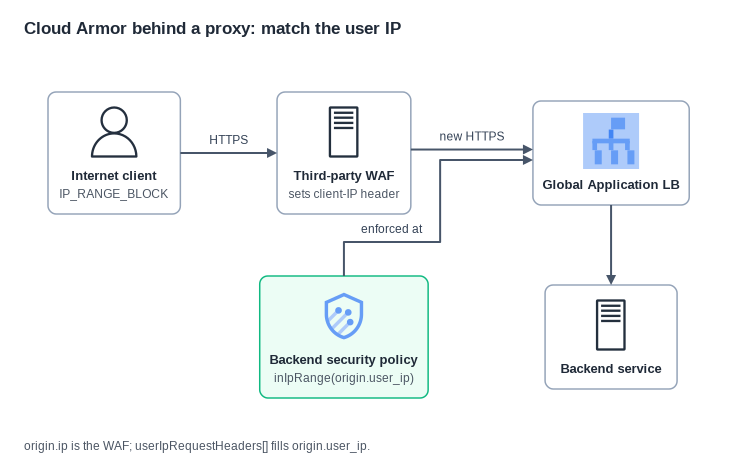
- Behind a third-party proxy,
origin.ipis the proxy. SetuserIpRequestHeaders[]and matchorigin.user_ip.
Cloud NGFW TLS inspection
- Create a CA pool and CA in Certificate Authority Service.
- Grant the service agent
roles/privateca.certificateRequester(it generates intermediate CAs signed by your pool). - Create a TLS inspection policy referencing the pool (trust config is optional).
- Add the policy to the firewall endpoint association.
- Enable TLS inspection in the firewall policy rules.
Secure Web Proxy is similar: for HTTPS, a rule is evaluated only if TLS inspection is enabled on it, so path/header matchers need it.
Packet Mirroring
- Sources: subnets, tags or instance names; filter by protocol/CIDR/direction.
- Collector: internal passthrough NLB in the same region as the sources; can be in a peered VPC.
- Mirrored traffic that crosses zones is charged as egress, so use a collector group per zone.
VPC Service Controls, Shared VPC, NCC, routing
| Need | Answer |
|---|---|
| Restrict Google APIs (Storage, BigQuery) to a project/corporate IPs | VPC-SC perimeter per project + access level with IP ranges |
| Shared VPC admin across folders | Compute Shared VPC Admin + Project IAM Admin at org level |
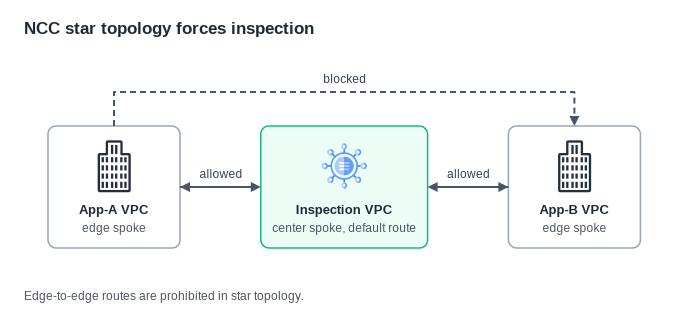
| Force VPC-to-VPC traffic through an inspection VPC | NCC star topology: inspection VPC center, others edge (no edge-to-edge) |
| Inspect subnet-to-subnet traffic with NVAs | Policy-based route: source, destination, next hop ILB, scoped by tag |
| Send tagged VMs through Secure Web Proxy | Static 0.0.0.0/0 route with network tag |
| Find overly broad allow rules | Firewall Insights, overly permissive rules |
Exam traps
- A deny-all at priority 0 overrides every allow; lower number wins.
- Implied rules do not log; make an explicit rule.
origin.ipvsorigin.user_ipbehind a proxy.- Network tags, not labels, in firewall rules.
- Packet Mirroring collectors must be in the sources' region.
- NCC star topology blocks edge-to-edge; mesh does not.
- VPC-SC protects Google APIs, not load balancer clients.
Docs
- https://docs.cloud.google.com/vpc/docs/packet-mirroring
- https://docs.cloud.google.com/armor/docs/user-ip-overview
- https://docs.cloud.google.com/armor/docs/security-policy-overview
- https://cloud.google.com/armor/docs/network-edge-policies
- https://cloud.google.com/firewall/docs/setup-tls-inspection
- https://docs.cloud.google.com/firewall/docs/firewall-policies-rule-eval-order
- https://cloud.google.com/firewall/docs/vpc-firewall-rules-logging-overview
- https://cloud.google.com/vpc/docs/provisioning-shared-vpc
- https://cloud.google.com/network-connectivity/docs/network-connectivity-center/concepts/connectivity-topologies
- https://docs.cloud.google.com/secure-web-proxy/docs/tls-rule-evaluation