Exams / GCP-PCA / D1 Designing for security and compliance
D1.1
Designing for security and compliance (part 1 of 3)
- Exam domain: Designing for security and compliance
You are reading a free preview. The rest of the GCP-PCA course unlocks with an Exam pass or All access.See plans
Protecting data: at rest, in use, before storage
| Need | Service | Notes |
|---|---|---|
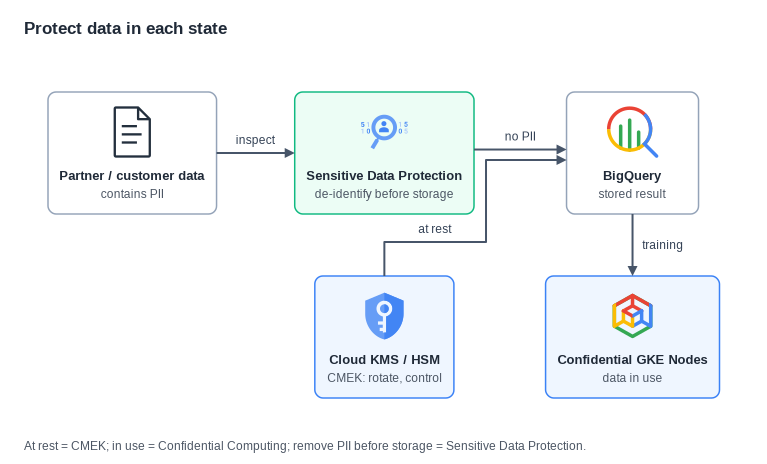
| Remove or mask PII before it is stored | Sensitive Data Protection (de-identification) | Masks, deletes or otherwise obscures sensitive values in text; apply it in the ingestion pipeline (for example Dataflow) before the first write |
| Rotatable key you control for a bucket | Cloud KMS key as CMEK | Cloud KMS supports automatic and manual rotation |
| Keys in a Google-managed HSM | Cloud KMS key with HSM protection level | Cloud HSM keys are stored in Google-owned HSMs (FIPS 140-2 Level 3) |
| Data in use | Confidential GKE Nodes / Confidential Computing | Hardware-based memory encryption |
| Shrink PCI scope | Tokenization | Systems that store, process or transmit cardholder data are in scope; tokens are not card numbers |
Access control and perimeters
- IAM inheritance: allow policies are inherited down the hierarchy and are additive. To remove access, remove the higher-level grant.
- BigQuery: Job User at project level lets users run queries; grant data access per dataset to scope each group.
- VPC Service Controls: perimeter around Google-managed services that protects against exfiltration by malicious insiders and compromised code, even with valid IAM. Access levels (IP, device...) allow requests from outside conditions you define.
- Signed URLs: time-limited access to Cloud Storage objects for users without Google accounts.
- Delegated authorization for third parties: OAuth 2.0.
- VM to Google APIs: use the attached service account (Application Default Credentials), not service account keys.
- GKE users and enterprise IdP: OIDC (or SAML) identity provider integration.
Firewall rules
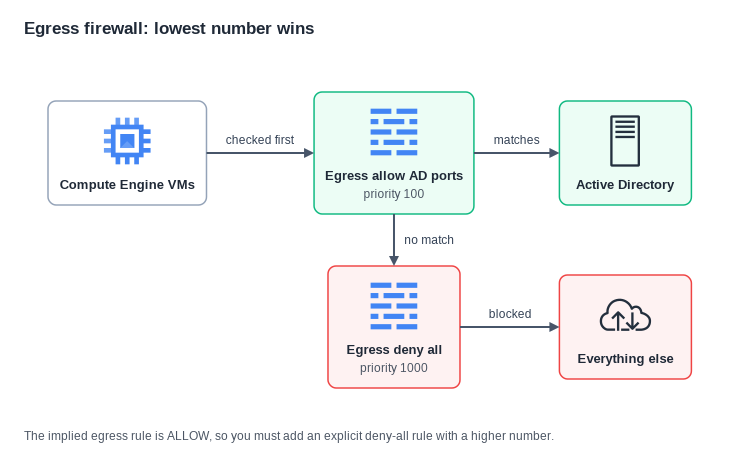
The lowest priority number wins. The implied egress rule is allow, the implied ingress rule is deny. To allow only specific egress, add an allow rule (low number) and an explicit deny-all rule (higher number).
Audit and detection
| Question | Answer |
|---|---|
| Who changed cluster configuration / ran kubectl | Cloud Audit Logs Admin Activity (always on) plus GKE Kubernetes API server audit logs |
| Who created a network or VM | Admin Activity audit log entry (for example v1.compute.networks.insert) in Cloud Logging |
| Per-user BigQuery query counts | INFORMATION_SCHEMA.JOBS (user_email) |
| React quickly to a log event | Logging sink to Pub/Sub, then a function |
Fleet configuration and policy
Config Sync syncs configuration from a central Git source of truth across clusters. Policy Controller (OPA Gatekeeper based) enforced policies, but it is deprecated as of November 12, 2026 (end of support December 31, 2027); migrate to ValidatingAdmissionPolicies, Pod Security Admission or self-managed Gatekeeper.
Compliance
- HIPAA: sign the Google Cloud BAA and use only covered products; disable or do not use services that are not covered.
- Cost for batch: Spot VMs for fault-tolerant jobs.
- Retention: Cloud Storage lifecycle rules (age condition, Delete action) automate deletion.
- Dedicated Interconnect cannot be upgraded in place to 100 Gbps: provision a new connection and migrate.
Exam traps
- Customer-managed keys (CMEK) protect data at rest, not data in use.
- Viewer on a child folder never overrides an Owner role inherited from above.
- The implied egress firewall rule allows traffic; do not rely on it to block.
- Private Google Access alone does not stop exfiltration; VPC Service Controls does.
- Anonymizing everything or hashing everything destroys analytical value.
- Policy Controller appears in older answers but is now deprecated.
Docs
- https://docs.cloud.google.com/storage/docs/lifecycle
- https://docs.cloud.google.com/kubernetes-engine/docs/how-to/confidential-gke-nodes
- https://docs.cloud.google.com/storage/docs/access-control/signed-urls
- https://cloud.google.com/kubernetes-engine/docs/how-to/audit-logging
- https://docs.cloud.google.com/sensitive-data-protection/docs/deidentify-sensitive-data
- https://docs.cloud.google.com/kubernetes-engine/enterprise/policy-controller/docs/overview
- https://docs.cloud.google.com/kms/docs/protection-levels
- https://docs.cloud.google.com/vpc-service-controls/docs/overview
- https://cloud.google.com/firewall/docs/firewalls
- https://docs.cloud.google.com/iam/docs/resource-hierarchy-access-control
- https://cloud.google.com/security/compliance/hipaa