Exams / GCP-GAIL / D4 Fundamentals of gen AI
Fundamentals of gen AI
- Exam domain: Fundamentals of gen AI
Generative AI basics
Generative AI "is a type of AI that can create new content and ideas, including conversations, stories, images, videos, and music." Diffusion models are one family: they "create new data by iteratively making controlled random changes to an initial data sample", then reverse the process, so generation turns noise into structured content such as an image.
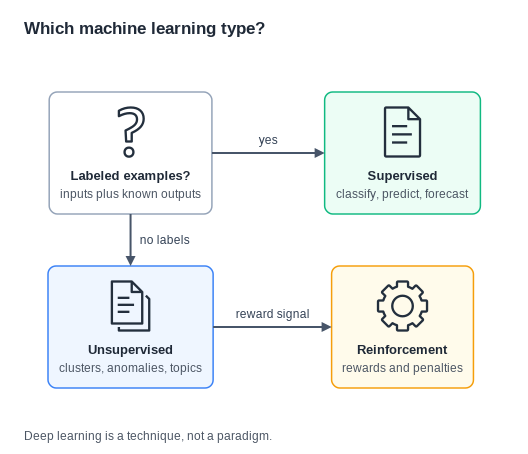
Machine learning types
| Type | Data | Typical task | Exam cue |
|---|---|---|---|
| Supervised | Labeled inputs and outputs | Classification, regression, forecasting | "labeled", "predict", "past tickets" |
| Unsupervised | Unlabeled | Clustering, anomalies, topics | "no labels", "natural groupings" |
| Reinforcement | Environment feedback | Games, control | "reward", "penalty", "trial and error" |
Deep learning "is a type of machine learning that uses artificial neural networks": it is a technique, not an answer to "labeled or not".
Data types
Open-ended survey answers, comments and reviews are unstructured data (no predefined schema). Structured data fits fixed fields.
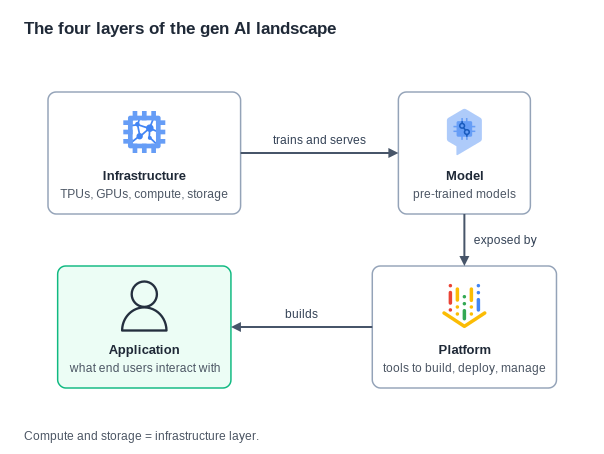
The gen AI landscape layers
| Layer | Role |
|---|---|
| Infrastructure | Compute (TPUs, GPUs) and storage for training and running models |
| Model | Pre-trained models |
| Platform | Tools to build, deploy and manage AI solutions |
| Application | What end users interact with |
AI agents
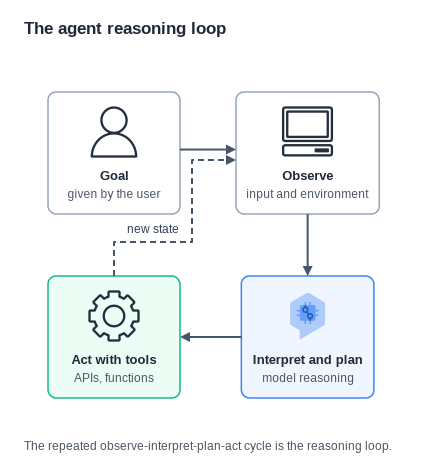
An AI agent is an application that achieves a goal by processing input, reasoning with available tools and acting. It works through a reasoning loop (observe, interpret, plan, act). Multi-agent systems coordinate specialized agents on complex workflows. Agent types include workflow agents (automating defined business-process steps).
Model limitations and safety
| Limitation | Meaning |
|---|---|
| Hallucination | Incorrect or fabricated output stated as fact |
| Data dependency / bias | Quality and representativeness of training data bound the output |
| Knowledge cutoff | No knowledge of recent events |
Safety settings configure content-filter blocking thresholds for harm categories. They do not control length (max tokens) or randomness (temperature).
Exam traps
- Deep learning is not a separate paradigm next to supervised/unsupervised.
- Safety settings are not temperature or max tokens.
- Compute and storage are infrastructure; build and deploy tools are platform; pre-trained models are the model layer.
- Deterministic, regulated rule decisions belong to rules logic, not a generative model.
- Skewed demographic training data points to bias; noisy or incomplete data is a quality issue.
Docs
- https://docs.cloud.google.com/docs/generative-ai/glossary
- https://cloud.google.com/discover/what-are-ai-agents
- https://docs.cloud.google.com/architecture/choose-agentic-ai-architecture-components
- https://cloud.google.com/discover/what-is-supervised-learning
- https://cloud.google.com/discover/what-is-unsupervised-learning
- https://cloud.google.com/discover/what-is-reinforcement-learning
- https://cloud.google.com/discover/what-are-ai-hallucinations
- https://docs.cloud.google.com/gemini-enterprise-agent-platform/models/capabilities/configure-safety-filters
- https://docs.aws.amazon.com/prescriptive-guidance/latest/strategy-enterprise-ready-gen-ai-platform/layered-approach.html
- https://aws.amazon.com/what-is/generative-ai/
- https://aws.amazon.com/what-is/structured-data/