Exams / DBX-GAEA / D1 Evaluation and Monitoring
Evaluation and Monitoring
- Exam domain: Evaluation and Monitoring
Evaluation vs monitoring
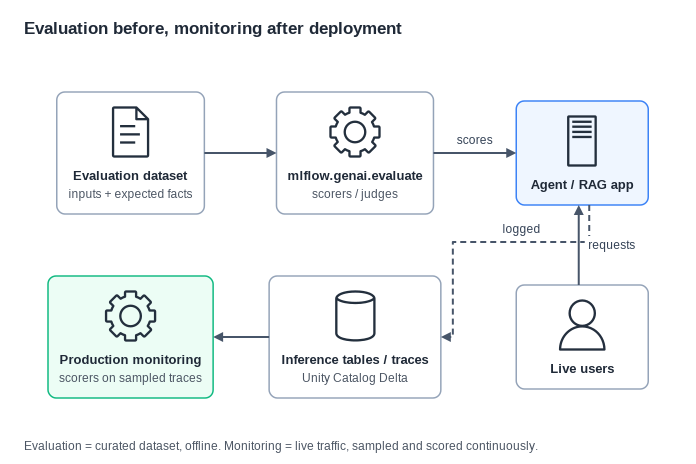
| Evaluation | Monitoring | |
|---|---|---|
| Data | Curated evaluation dataset | Live production requests |
| Tool | mlflow.genai.evaluate() with scorers / judges |
Scorers run on sampled traces; inference tables for endpoint payloads |
| Goal | Decide readiness, find what to improve | Track quality and health over time |
"Production monitoring lets you automatically run MLflow 3 scorers on traces from your agents to continuously assess quality."
Evaluating RAG
"Evaluating RAG applications requires assessing both the retrieval quality (are the right documents retrieved?) and the generation quality (is the response grounded in those documents?)." Build a dataset that tests the two parts separately.
| Judge | Needs expected_response? |
|---|---|
| correctness | Yes |
| context sufficiency (RetrievalSufficiency) | Yes (expected facts) |
| groundedness, relevance, chunk relevance, guidelines | No |
Metrics: BLEU for translation against references ("The BLEU score indicates how similar the candidate text is to the reference text."); ROUGE for summarization; MMLU is a model benchmark, not a production metric.
Custom scorers and guidelines
"After you define a custom scorer, you can use it with mlflow.genai.evaluate() just like a built-in LLM Judge." Use the @scorer decorator, return bool/number, pass via scorers=. Guidelines judges use pass/fail natural-language criteria; when SMEs disagree, write shared rubrics first.
Observability tools
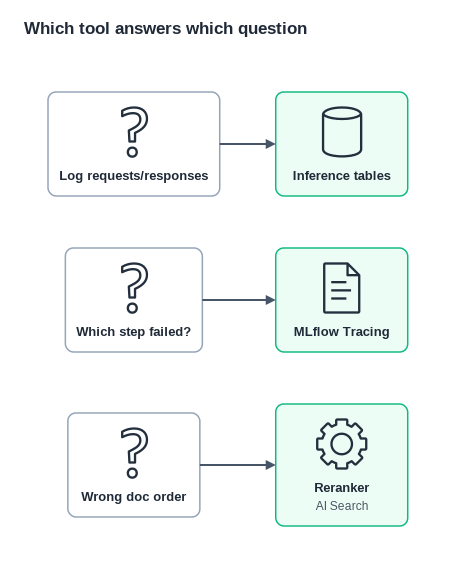
- Inference tables: "The inference table automatically captures incoming requests and outgoing responses for a model serving endpoint and logs them as a Unity Catalog Delta table."
- MLflow Tracing: step-level visibility to debug agents.
- Reranker: "Reranking is a technique that improves retrieval quality by evaluating the retrieved documents to identify the ones that are semantically most relevant."
- Production metrics: throughput, latency, factual accuracy.
Exam traps
- More compute = faster, not more relevant.
- Chunk size is not the model's context window.
mlflow.evaluate/make_genai_metricare legacy; usemlflow.genai.evaluateand@scorer.- Operational metrics are default; quality metrics need configured scorers.
- Declared prompt variables must appear as placeholders in the template.
Docs
- https://docs.databricks.com/en/machine-learning/model-serving/inference-tables.html
- https://docs.databricks.com/gcp/en/vector-search/query-vector-search
- https://docs.databricks.com/aws/en/generative-ai/agent-evaluation/monitoring-agent-framework
- https://mlflow.org/docs/latest/genai/eval-monitor/scorers/llm-judge/rag/
- https://mlflow.org/docs/latest/genai/eval-monitor/scorers/custom/
- https://mlflow.org/docs/latest/genai/tracing
- https://docs.cloud.google.com/vertex-ai/generative-ai/docs/models/eval-python-sdk/determine-eval