Exams / CSCO-350-801 / D1 Infrastructure and Design
D1.1
Infrastructure and Design (part 1)
- Exam domain: Infrastructure and Design
You are reading a free preview. The rest of the CSCO-350-801 course unlocks with an Exam pass or All access.See plans
Cluster sizing and node roles
| Topic | Fact |
|---|---|
| Sizing inputs | Number of users, traffic mix, traffic load, features |
| BHCA | Busy hour call attempts; system BHCA <= user BHCA x number of users |
| OVA templates | Small, Medium, Large; Medium supports up to 10,000 endpoints |
| TFTP | Two dedicated TFTP nodes plus a dedicated publisher once endpoints exceed 1,250 |
| Cluster limit | At most 21 server nodes in a cluster |
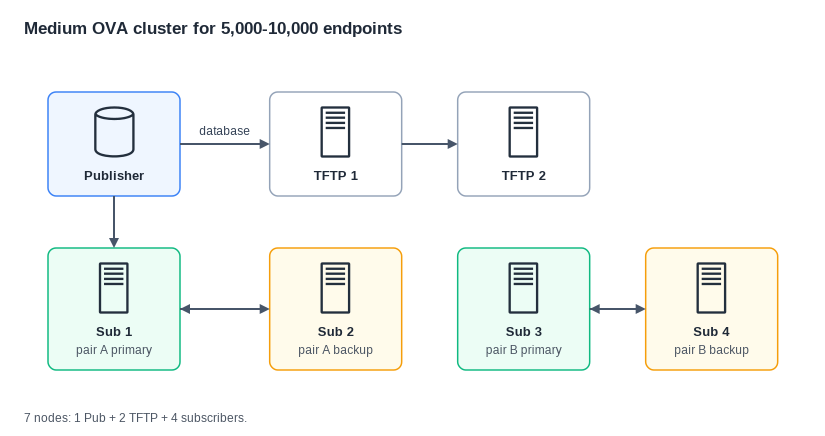
| Medium, 5,000-10,000 endpoints | 1 publisher + 2 TFTP + 4 call-processing subscribers (2 pairs) |
| Clustering over the WAN | Max 80 ms round trip (40 ms one way) between nodes |
Registration and redundancy
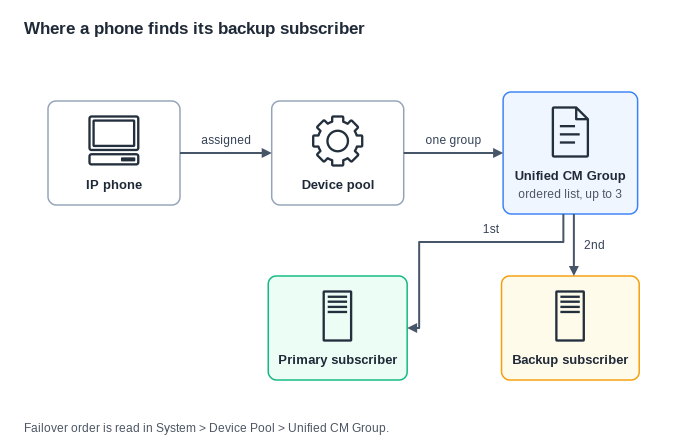
A phone gets its Cisco Unified CM Group from its device pool. The group is a prioritized list of up to three servers: primary and backups. To see where a phone fails over: System > Device Pool > Unified CM Group.
Call admission control
| Method | Use |
|---|---|
| Locations / Enhanced Locations CAC | Hub-and-spoke (tree) WAN; bandwidth counted per call at Layer 3 (codec plus IP headers) |
| RSVP-enabled locations | Full-mesh or complex topology; reserves bandwidth along the real path |
Core network services for UCM
| Service | Facts |
|---|---|
| NTP | UDP 123; NTPv4 required as preferred source from CUCM 9.x; Linux or IOS source, Windows unsupported. Replace a server: utils ntp server delete, then utils ntp server add |
| DHCP | Option 150 = TFTP server address (UCM DHCP page has an Option 150 field); Option 66 = TFTP name |
| DNS | Resolves FQDN / SRV for trunk destinations. SIP trunk destination: up to 16 IP/FQDN, or a single DNS SRV. DNS server IP change requires a reboot (utils system restart) |
| IOS DHCP | ip dhcp database ftp://user:pass@host/file timeout 80; ip dhcp excluded-address <low> <high> |
Switch access layer
| Item | Fact |
|---|---|
| Trust the phone's PC port traffic | platform qos trust extend (CDP tells the phone to trust tagged frames) |
| Re-mark the PC port traffic | platform qos trust extend cos <value> |
| Voice access switch needs | Multiple egress queues, classify/reclassify and trust boundary, 802.1Q trunking and 802.1p CoS |
| CDP vs LLDP | CDP is Cisco only; LLDP (IEEE 802.1AB) discovers non-Cisco devices |
| Disable LLDP on one interface | no lldp transmit and no lldp receive (no lldp run is global) |
Management and security
| Topic | Fact |
|---|---|
| SNMP | Only SNMPv3 authPriv encrypts; polling and traps give faults and alerts |
| Diagnostic signatures | Call Home feature on IOS XE that detects known problems and collects data; can notify by email |
| BAT | Phones (all models), CTI ports, H.323 clients |
| Toll fraud | Restrict call forward CSS and the logged-out Extension Mobility CSS to internal and emergency destinations |
| SX80 | xStatus Video Output reads connector state (xConfiguration = settings, xCommand = actions) |
Exam traps
- Locations CAC counts packet bandwidth including IP headers, not payload only.
- Port 53 is DNS; NTP is port 123 and needs NTPv4.
platform qos trust extendhas nocoskeyword for trust;cosre-marks.no lldp runis global; interface disable needs both transmit and receive.- An excluded-address range lists the low address first.
- Only one DNS SRV entry per SIP trunk destination.
- Changing the DNS server IP needs a reboot per current docs; the old key expects "restart the network service".