Exams / CSCO-350-701 / D1 Security Concepts
D1.1
Security Concepts (part 1 of 3)
- Exam domain: Security Concepts
You are reading a free preview. The rest of the CSCO-350-701 course unlocks with an Exam pass or All access.See plans
Cryptography basics
| Type | Keys | Examples | Notes |
|---|---|---|---|
| Symmetric (secret key) | One shared key encrypts and decrypts | 3DES, AES, RC4 | Efficient; no integer factorization |
| Asymmetric (public key) | Key pair: one encrypts, the other decrypts | RSA | Limited in how much data it can encrypt |
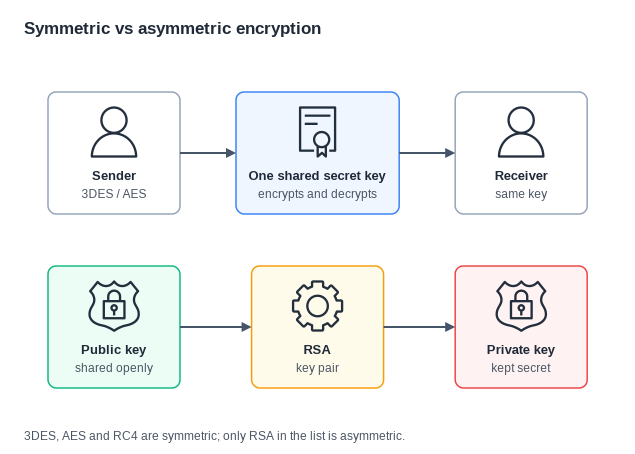
- 3DES implements Triple DES (168-bit) encryption; AES is designed to be more secure than DES and supports 128-, 192- and 256-bit keys (block size 128 bits).
- TLS provides authentication, message privacy and integrity, which defeats man-in-the-middle attacks.
Authentication
- MFA requires two or more factors: something you know, something you have, something you are (biometrics).
- MFA reduces the value of stolen usernames and passwords.
- Password reuse across systems is a user-behaviour risk: security awareness training.
Threats
| Threat | Definition |
|---|---|
| Worm | Replicates itself and spreads across devices without human action |
| Spam | Unsolicited bulk junk email |
| Botnet | Compromised computers controlled by an attacker |
| Phishing | Fraudulent messages targeting users at endpoints; mitigated by email filtering and browser alerts |
| Virus | Malware attached to a file that spreads host to host |
| SQL injection | Unvalidated input concatenated into SQL commands |
| Rootkit | User-mode, kernel-mode and bootloader (bootkit) types |
STIX is the format for threat intelligence; TAXII is the transport that exchanges it.
Cisco products and features
| Item | Function |
|---|---|
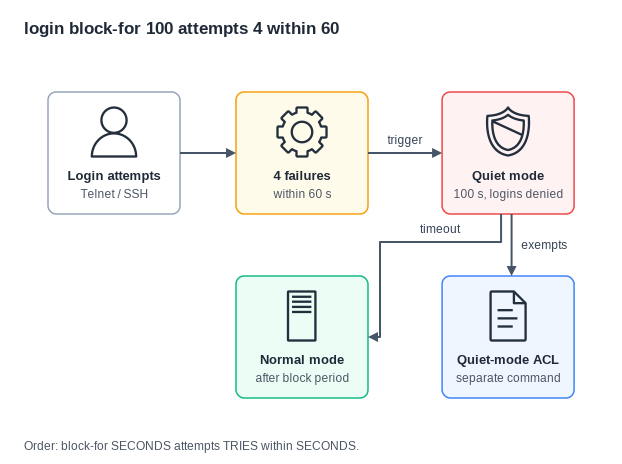
login block-for 100 attempts 4 within 60 |
4 failures in 60 s trigger a 100 s quiet period |
| Context Directory Agent | Reads AD domain controller events and maps IP to user |
| ISE profiling | Probes collect endpoint attributes |
| ISE CoA | Issued on first-time profiling and endpoint deletion; reply CoA-ACK on success |
| PKI enrollment profile | Separate authentication and enrollment, HTTP/TFTP options |
| ESA SCP push | Log retrieval over SSH with username and SSH key |
| Umbrella policy | Logging level is set per policy |
| Umbrella Investigate | Relationships among domains, IPs and files |
| NGIPS / AMP | Threat prevention / malware detection to remediation |
Exam traps
- In
login block-for, the first number is the quiet period, not the window. - AES is never 168-bit (that is 3DES); AES block size is always 128 bits.
- STIX (format) is not TAXII (exchange protocol).
- Quiet-mode ACL exemptions need
login quiet-mode access-class. - CoA-ACK is success, CoA-NAK failure.
Docs
- https://www.cisco.com/c/en/us/td/docs/ios-xml/ios/security/d1/sec-d1-cr-book/sec-cr-k1.html
- https://www.cisco.com/c/en/us/td/docs/ios-xml/ios/sec_conn_vpnips/configuration/xe-3s/sec-sec-for-vpns-w-ipsec-xe-3s-book/sec-cfg-vpn-ipsec.html
- https://www.cisco.com/c/en/us/td/docs/security/ibf/cda_10/Install_Config_guide/cda10/cda_oveviw.html
- https://www.cisco.com/c/en/us/td/docs/security/ise/3-1/admin_guide/b_ise_admin_3_1/b_ISE_admin_31_asset_visibility.html
- https://learn.microsoft.com/en-us/dotnet/standard/security/cryptographic-services
- https://learn.microsoft.com/en-us/entra/identity/authentication/concept-mfa-howitworks