Exams / CSCO-350-601 / D1 Security
D1.1
Security (part 1 of 3)
- Exam domain: Security (AAA, RBAC, port security and CoPP on Nexus/MDS, UCS and IMC hardening, ACI microsegmentation)
You are reading a free preview. The rest of the CSCO-350-601 course unlocks with an Exam pass or All access.See plans
AAA on MDS / Nexus
| Need | Command / fact |
|---|---|
| MD5 challenge-response login | aaa authentication login chap enable (CHAP uses MD5 hashing) |
| Share RADIUS/TACACS+ config across switches | CFS: radius distribute, then radius commit |
| Console falls back to local | aaa authentication login console fallback error local |
| Telnet/SSH (default method) falls back | aaa authentication login default fallback error local |
| FC-SP (DHCHAP) via AAA | aaa group server tacacs+ X + aaa authentication dhchap default group X |
| TACACS+ shared key | key 7 = encrypted text; deadtime is in minutes, host timeout in seconds |
- The console and the default (telnet/SSH) methods are configured and fall back independently.
- TACACS+ encrypts the whole payload, which is why it is preferred when "all communication must be encrypted".
MDS RBAC and VSAN policy
- A role has numbered rules (permit/deny, command type, feature).
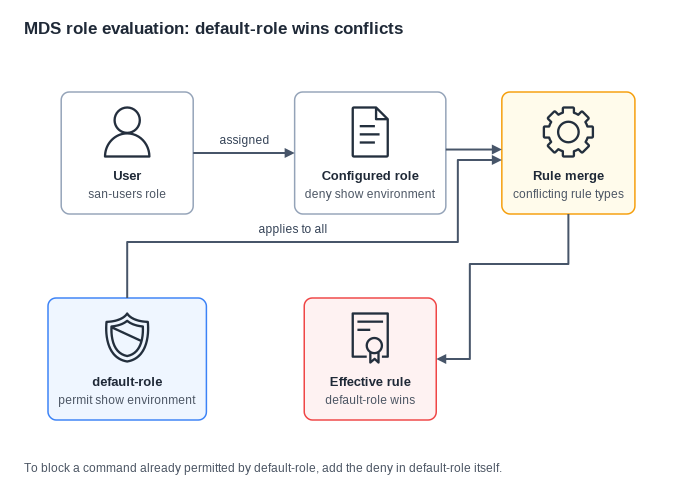
default-roleapplies to every user. - If
default-roleand the user's role have different rule types for the same feature, the default role overrides (a deny in a custom role cannot hide a command thatdefault-rolepermits). - VSAN policy
deny+ a permit list restricts a role to the listed VSANs;no permit vsan 15-20removes a sub-range.
Fabric binding and port security (SAN)
| Feature | Controls | Config idea |
|---|---|---|
| Fabric binding | Which switches (sWWN + domain ID) may join a VSAN | feature fabric-binding, fabric-binding database vsan N, swwn <wwn> domain <id>, fabric-binding activate vsan N |
| Port security | Which devices (pWWN/nWWN) may log in on which ports | port-security enable, activate vsan N no-auto-learn, port-security database vsan N, then port-security commit vsan N |
- Each VSAN has its own sWWN: copy the one shown for that VSAN, and the decimal domain ID (0x20 = 32).
Nexus 9000 port security and CoPP
| Violation action | Effect |
|---|---|
| protect | Drops traffic from new (unlearned) MACs; learned MACs unaffected |
| restrict | Drops and logs the violation |
| shutdown | Error-disables the port |
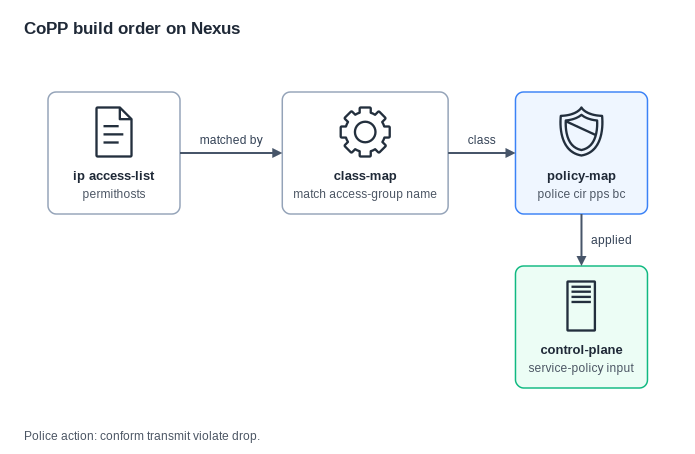
CoPP protects the supervisor: ACL -> class-map (match access-group name) -> policy-map (class, police cir ... pps bc ... packets conform transmit violate drop) -> control-plane service policy.
NX-API on Nexus 9000 uses HTTP Basic authentication (Postman: Authorization > Basic Auth).
Cisco UCS Manager
| Topic | Fact |
|---|---|
| HTTPS | set https keyring <k>, set https cipher-suite-mode high, set https ssl-protocol tls1-2, commit-buffer |
| Key ring | scope security > create keyring kr2016 > set modulus mod1024 > commit-buffer (from the primary FI, UCS-A) |
| Backups | all configuration, system configuration (users, roles), logical configuration (VLANs, VSANs, policies; XML), full state (binary); TFTP is the UDP protocol, SCP/SFTP are secure |
| Auth realms | local, LDAP, RADIUS, TACACS+ (not Kerberos, 802.1X) |
| Users | Disabling a local user keeps its configuration; local roles override remote roles; password minimum 8 characters with strength check |
| Roles | server-profile (vNIC/vHBA via service profiles), facility-manager (power management: fan speed, power redundancy) |
Cisco IMC (C-Series) hardening
- KVM scope:
set encrypted yes,set kvm-port <non-2068>,set max-sessions 1,set local-video no(private session, no local monitor). - Communication services: enable Redirect HTTP to HTTPS, set Session Timeout to 900 s (15 min; default 1,800), move SSH off port 22.
ACI microsegmentation
- uSeg EPGs classify endpoints by attribute: VM Name, VM Identifier, Datacenter, Hypervisor, MAC, IP...
- To split prod/dev VMs in the same subnet use VM Name; IP-based uSeg cannot classify addresses in the same subnet.
- VMware DVS is supported (not only AVS/AVE); the base EPG's port group uses a PVLAN on the DVS.
Exam traps
default-rolebeats a conflicting rule in a custom MDS role: put the deny indefault-role.protectis silent;restrictalso logs;shutdownkills the port.key 7is encrypted (not type 6);deadtime 10is 10 minutes.- Fabric binding = switches (sWWN + domain); port security = devices (pWWN/nWWN).
- Logical backup has VLANs/VSANs but not users; system backup has users/roles; full state is binary.
cipher-suite-modeaccepts high/medium/low/custom, not "secure".