Exams / CSCO-350-501 / D1 Networking
D1.1
Networking (part 1 of 6)
- Exam domain: Networking
You are reading a free preview. The rest of the CSCO-350-501 course unlocks with an Exam pass or All access.See plans
This chapter covers BGP policy and path selection, IGP details (OSPF, IS-IS), L2/L3 VPN building blocks, multicast, EVPN VXLAN and a few platform topics.
BGP path selection and policy
| Topic | Fact |
|---|---|
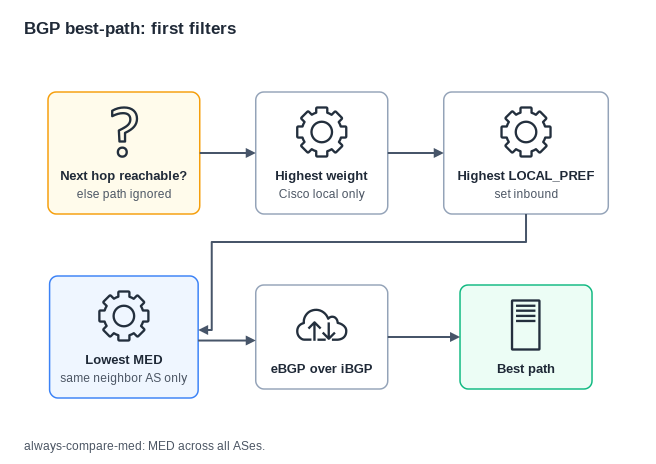
| Unreachable next hop | "Paths for which the NEXT_HOP is inaccessible." are not eligible for best-path selection |
| Local preference | "Prefer the path with the highest LOCAL_PREF." Set it inbound on routes from the preferred speakers |
| MED | "Prefer the path with the lowest multi-exit discriminator (MED)." Compared only for the same neighbor AS by default |
| deterministic-med | Compares MED between paths from different peers in the same AS |
| always-compare-med | Compares MED for paths from neighbors in different ASes |
| local-as | neighbor x local-as N makes the router peer with that eBGP neighbor using AS N (AS migrations) |
| Conditional advertisement | neighbor x advertise-map A non-exist-map B: A is announced only if B's prefix is absent |
| Format migration | bgp upgrade-cli converts NLRI-format configuration to AFI format |
| Neighbor hardening | neighbor x password <pwd> (MD5, same on both sides) and neighbor x maximum-prefix N |
| Loopback peering | neighbor = the peer's loopback and update-source Loopback0 on both routers |
| no bgp default ipv4-unicast | Each neighbor must be activated under its address family |
| Graceful restart | NSF-capable router and NSF-aware peers; peers keep the routes as stale for a set time |
To demote a link toward a neighbor AS, advertise a higher MED on it (outbound route-map set metric).
IOS XR Routing Policy Language
- All route policies end with an implicit drop unless the route is explicitly passed.
if destination in SET then drop else set med 400 set community (4:400) additive endiflimits the actions to non-matching routes.additivekeeps existing communities; without it other communities are removed.- IOS XR eBGP neighbors need inbound and outbound policies (unless the unsafe override is configured).
OSPF, IS-IS, BFD
| Topic | Fact |
|---|---|
| Prefer a link | Give the other link a higher ip ospf cost on both ends |
| Multi-area adjacency | ip ospf multi-area only works on point-to-point network types |
| OSPFv3 (classic) | ipv6 ospf <pid> area <id> on each interface |
| IS-IS NET | area . system ID (unique, e.g. from MAC) . NSEL 00; same area on all L2 routers |
| BFD for IS-IS | Baseline BFD timers on the interface first; CEF and IP routing enabled on all routers |
| LACP bundle | With max active links 1, the standby member with the lowest port priority/ID takes over |
| TI-LFA | Repair path = post-convergence path, built from P/Q/PQ nodes with segment routing |
L2VPN and L3VPN
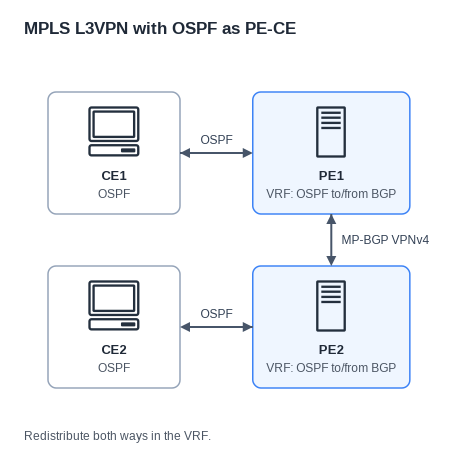
- L3VPN with OSPF PE-CE: each PE redistributes OSPF into MP-BGP and MP-BGP back into the VRF's OSPF, in both directions.
- L2VPN (AToM):
pseudowire-classwithencapsulation mpls, attached withxconnect <peer> <vc-id> pw-class <name>; the core never sees customer routes.
Multicast
- PIM-SSM: derived from PIM sparse mode, needs IGMPv3 on receivers; "SSM does not require an RP", so no Auto-RP, MSDP or BSR.
- BSR: the elected BSR distributes RP-set information (from candidate RPs) to all PIM routers.
EVPN VXLAN IRB
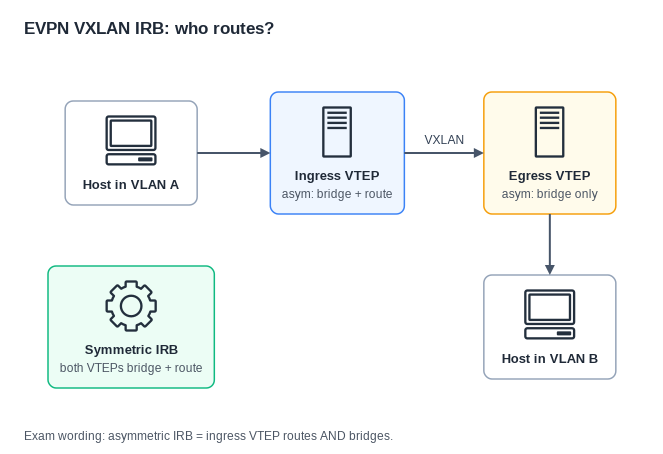
- Asymmetric IRB: ingress VTEP bridges and routes; egress only bridges; both VNIs needed on both VTEPs.
- Symmetric IRB: both ingress and egress VTEPs bridge and route; better scalability.
Platforms, programmability, QoS
- IOS XE: Linux-based kernel, IOS as one process, other modules in their own protected memory; classic IOS is monolithic.
- ACI L3Out:
bgpPeerP addr=is the neighbor, nestedbgpAsP asn=its AS. - XML:
<tag/>is an empty element. - DSCP 36 = AF42 (AF43 = 38). SCCP signaling: TCP 2000 (2443 secure).
- IOS XR SNMPv3: authPriv user needs
auth shaandpriv aes 128;show snmp viewshows view family, storage type, status.
Exam traps
- AF42 is DSCP 36, not AF43.
- SCCP is TCP, not UDP; RTP ranges (16384-32767) are media, not signaling.
- Asymmetric IRB: the ingress VTEP does routing AND bridging.
non-exist-mapadvertises when the watched route is missing.local-asdoes not enable address families.- Raising cost on the preferred link or changing reference bandwidth for both links does not create a backup.
- IOS XR eBGP without route-policy in/out: no routes exchanged.
Docs
- https://www.cisco.com/c/en/us/td/docs/routers/ios/config/17-x/ip-routing/b-ip-routing/m_irb-bi-fwd-det-0-1.html
- https://www.cisco.com/c/en/us/td/docs/routers/ios/config/17-x/mpls/b-mpls/m_mp-any-transport-xe.html
- https://www.cisco.com/c/en/us/td/docs/iosxr/cisco8000/segment-routing/25xx/configuration/guide/b-segment-routing-cg-cisco8000-25xx/configuring-topology-independent-loop-free-alternate.html
- https://www.cisco.com/c/en/us/support/docs/ip/border-gateway-protocol-bgp/16137-cond-adv.html
- https://www.cisco.com/c/en/us/support/docs/ip/border-gateway-protocol-bgp/13753-25.html
- https://www.cisco.com/c/en/us/support/docs/ip/border-gateway-protocol-bgp/16046-bgp-med.html
- https://www.cisco.com/c/en/us/support/docs/ip/open-shortest-path-first-ospf/118800-configure-ospf-00.html
- https://www.cisco.com/c/en/us/support/docs/ip/open-shortest-path-first-ospf/118879-configure-ospf-00.html
- https://www.cisco.com/c/en/us/td/docs/iosxr/cisco8000/routing/configuration-guide/routing-config-cisco8000/routing-policy-language-wrapper/policy-execution-and-semantics.html
- https://www.cisco.com/c/en/us/td/docs/switches/lan/catalyst9300/software/release/17-9/configuration_guide/vxlan/b_179_bgp_evpn_vxlan_9300_cg/configuring_evpn_vxlan_integrated_routing_and_bridging.html
- https://www.cisco.com/c/en/us/td/docs/ios-xml/ios/ipmulti_pim/configuration/xe-16/imc-pim-xe-16-book/imc-ssm.html
- https://www.cisco.com/c/en/us/td/docs/routers/asr1000/operations/guide/asr1000ops/monitoring_control_plane.html