Exams / CSCO-350-401 / D1 Network Assurance
D1.1
Network Assurance (part 1)
- Exam domain: Network Assurance
You are reading a free preview. The rest of the CSCO-350-401 course unlocks with an Exam pass or All access.See plans
This chapter groups the first block of ENCOR questions: switching and FHRP troubleshooting, overlays (VXLAN, SD-WAN, SD-Access), monitoring tools (SPAN, ERSPAN, IP SLA, logging) and model-driven programmability.
Layer 2 trunks: DTP, VTP domain, native VLAN
| DTP mode | Behaviour |
|---|---|
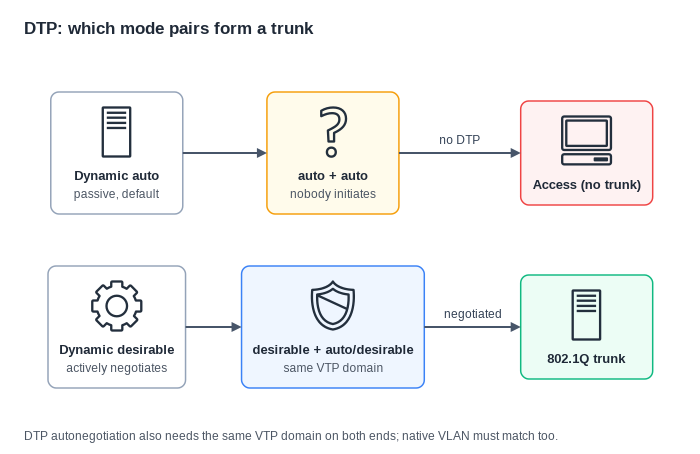
| dynamic auto | Becomes a trunk only if the neighbour is trunk or desirable (default on Ethernet interfaces) |
| dynamic desirable | Becomes a trunk if the neighbour is trunk, desirable or auto |
- Two
dynamic autoports never form a trunk. To autonegotiate trunking, the interfaces must be in the same VTP domain. - The native VLAN must be the same on both ends of an 802.1Q trunk. A mismatch is logged as
%CDP-4-NATIVE_VLAN_MISMATCHand can cause STP loops. Fix it withswitchport trunk native vlan <id>on the remote end; do not disable STP on the native VLAN. - Rapid PVST+ (802.1w) can revert to 802.1D per port to interoperate with a legacy PVST+ neighbour; each switch keeps its configured mode.
First-hop redundancy: HSRP and VRRP
- HSRP v1 virtual MAC is
0000.0C07.ACxx(xx = group in hex); v2 uses0000.0C9F.Fxxxand multicast 224.0.0.102 (v1: 224.0.0.2). Changing the version re-initializes every group because the virtual MAC changes. %IP-4-DUPADDR ... sourced by 0000.0c07.acNNwith a different group number than the local one means the same virtual IP is configured on two groups.- VRRP object tracking lowers the priority by the decrement when the tracked object fails (110 - 20 = 90 < 100), so the backup takes over.
- HSRP is not supported with NSF/SSO.
High availability: NSF/SSO, CEF
- NSF must run on a device configured for SSO; no IP multicast, IPv4 unicast only, no HSRP.
- CEF has two modes: central (FIB on the route processor) and distributed (dCEF, copies on line cards).
Routing details
| Topic | Fact |
|---|---|
| GRE tunnel up/up | Needs a valid source (up/up interface with IP) and a routable destination |
| OSPF passive-interface default | Opt interfaces back in with no passive-interface <int> under router ospf |
| OSPF summarization | area <source-area> range <addr> <mask> on the ABR creates one type 3 LSA |
| LSA types | Type 3 network summary, type 4 ASBR summary, type 5 external |
| BGP Idle (Admin) | Neighbour was shut down: no neighbor <ip> shutdown |
| PBR route-map deny | Matching traffic is forwarded normally (destination-based), not dropped |
| VRF-lite | ip vrf <name>, then ip vrf forwarding <name> on the interface before the IP address; verify with show ip vrf |
| PIM | RP only in sparse mode (and bidir); default SPT switchover means the RP is only needed to set up new flows |
Overlays and architecture
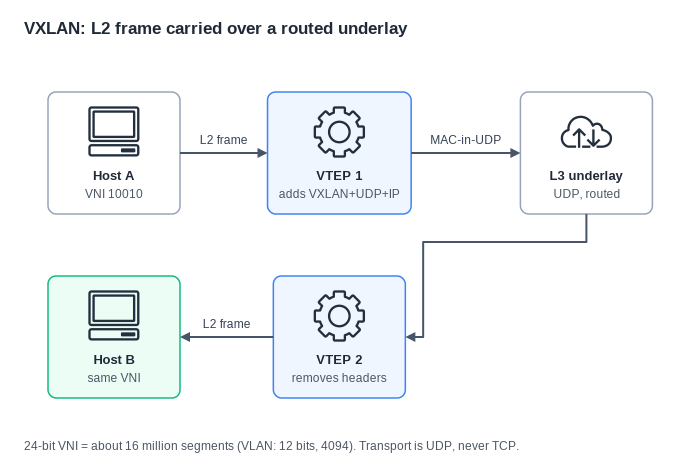
- VXLAN = MAC-in-UDP, 24-bit VNI, multi-tenant, over an L3 underlay.
- Three-tier campus model: access, distribution, core. Leaf and spine are the data center fabric.
- SD-WAN: transport-agnostic overlay; vManage (SD-WAN Manager) = management, vSmart = control, vBond = orchestration. BFD on data plane tunnels measures latency, loss and jitter used by application-aware routing.
- SD-Access: the border node is the gateway between the fabric and external networks; edge nodes attach clients; control plane node holds endpoint locations.
- Northbound APIs are used by applications; southbound APIs talk to devices.
Monitoring and operations
| Tool | Notes |
|---|---|
terminal monitor |
Shows logs on Telnet/SSH sessions |
| SPAN | Source = port to monitor, destination = analyzer; a port cannot be both; verify with show monitor |
| ERSPAN | Session is shut by default: no shutdown |
| IP SLA | icmp-echo <dst> source-ip <src>, ip sla schedule N life forever start-time now, show ip sla statistics N |
| CoPP | service-policy output applies to packets transmitted by the router's control plane |
| QoS | Classification identifies, marking tags, trust keeps received markings, shaping buffers excess traffic |
Programmability
- YANG models data; NETCONF and RESTCONF are the protocols. TLS, SSH and HTTPS are only transports.
- A NETCONF reply with an empty
<data/>and no<rpc-error>is a successful reply with nothing to return. - HTTP
Content-Typeis a header field.
Exam traps
- auto + auto does not trunk; DTP also needs the same VTP domain.
- A VXLAN VNI has 24 bits (not 12) and uses UDP, never TCP.
ip vrf forwardingremoves an existing IP address: apply it first.passive-interface defaultblocks adjacencies on every interface until opted back in.- Output CoPP polices traffic the router generates, not transit traffic.
- PBR deny does not drop traffic.
- NSF/SSO: no multicast, no IPv6, no HSRP.