Exams / CSCO-350-201 / D1 Techniques
D1.1
Techniques (part 1 of 2)
- Exam domain: Techniques
You are reading a free preview. The rest of the CSCO-350-201 course unlocks with an Exam pass or All access.See plans
Automation vs orchestration
| Term | What it does |
|---|---|
| Automation | Executes defined tasks and removes repetitive manual work. "Azure Automation is a cloud-based automation service that helps you automate processes." |
| Orchestration | Coordinates components and automated tasks into larger, ordered workflows. Step Functions "workflows that orchestrate a series of tasks, or steps, in a specific order." |
Prevention controls
| Threat | Control |
|---|---|
| One client floods an API | Per-client rate limiting: "The rate-limit-by-key policy prevents API usage spikes on a per key basis by limiting the call rate to a specified number per a specified time period." |
| Man-in-the-middle / HTTP downgrade | HTTP Strict Transport Security (HSTS): HTTPS only |
| Compromised workstation reaching sensitive data over insecure protocols | VLAN segmentation + firewall allowing only required, secure services |
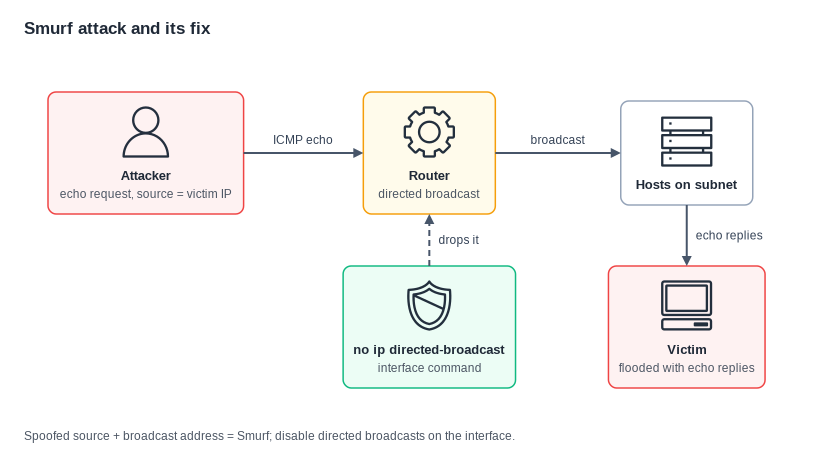
| Smurf (ICMP broadcast reflection) | no ip directed-broadcast on the interface |
| Weak or single-factor login | MFA |
| Copy/paste or USB exfiltration at the endpoint | DLP for data in use |
| Unapproved executables | Application control |
| Legacy app needing an IPS exception | Narrowest allow list: authorized hosts, app IP, specific port |
Triage and analytics
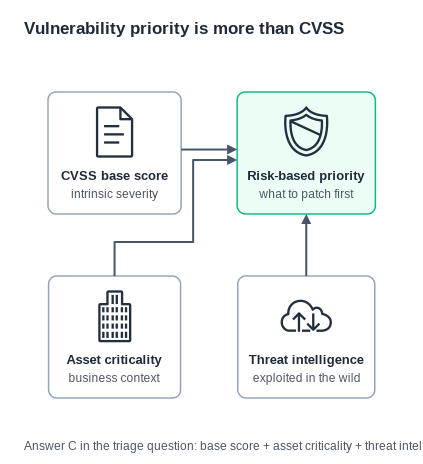
- Advanced analytics on large data sets: SIEM + UEBA + XDR. "Microsoft Sentinel UEBA uses machine learning to build dynamic behavioral profiles for users, hosts, IP addresses, applications, and other entities."
- Fileless / living-off-the-land attacks: hunt PowerShell logs ("When you enable Script Block Logging, PowerShell records the content of all script blocks"), network egress and privileged-account behavior.
- Static analysis shows no IOCs: run the sample in a sandbox and observe behavior (dynamic analysis).
- Mapping: outbound HTTP to an external server = MITRE tactic Command and Control, technique Application Layer Protocol.
- Cisco Secure Network Analytics: Top Conversations ranks the biggest host-to-host transfers for a host group.
Tools and commands
| Need | Use |
|---|---|
| Source IP of suspicious traffic | Packet sniffer (e.g. Wireshark) |
| List classic event logs (Max(K), Retain, OverflowAction, Entries, Log) | Get-EventLog -List |
| Move files / list / persist variables | mv, ls, ~/.bashrc |
| Case-insensitive content search | grep -i "yellow" colors.txt (locate searches names) |
| rwx for everyone | chmod 777 |
| Compact Snort alerts | alert_fast output module |
| Snort brute-force false positives | detection_filter: track by_src instead of by_dst |
| Python port scan | connect_ex() returns 0 when the port is open |
Exam traps
- Several answers are plausible; pick the most specific preventive control (e.g. segmentation, not SOAR/IDS/syslog).
- Orchestration is not automation: workflows vs single tasks.
locatefinds file names, not text;exportalone is not persistent.track by_dstaggregates all clients; brute force needs per-source counting.- Sources for several items (Snort, GNU, MITRE, OWASP) are outside the allowed documentation sites, so those facts are less strongly sourced.
Docs
- https://learn.microsoft.com/en-us/azure/automation/automation-intro
- https://docs.aws.amazon.com/step-functions/latest/dg/welcome.html
- https://learn.microsoft.com/en-us/azure/api-management/rate-limit-by-key-policy
- https://learn.microsoft.com/en-us/aspnet/core/security/enforcing-ssl?view=aspnetcore-8.0
- https://learn.microsoft.com/en-us/azure/sentinel/identify-threats-with-entity-behavior-analytics
- https://learn.microsoft.com/en-us/powershell/module/microsoft.powershell.core/about/about_logging?view=powershell-5.1
- https://learn.microsoft.com/en-us/powershell/module/microsoft.powershell.management/get-eventlog?view=powershell-5.1
- https://www.cisco.com/c/en/us/td/docs/routers/ios/config/17-x/ip-addressing/b-ip-addressing/m_iap-bph-0.html
- https://learn.microsoft.com/en-us/purview/dlp-learn-about-dlp