Exams / CSCO-300-715 / D1 Architecture and Deployment
D1.1
Architecture and Deployment (part 1 of 2)
- Exam domain: Architecture and Deployment
You are reading a free preview. The rest of the CSCO-300-715 course unlocks with an Exam pass or All access.See plans
Personas and services
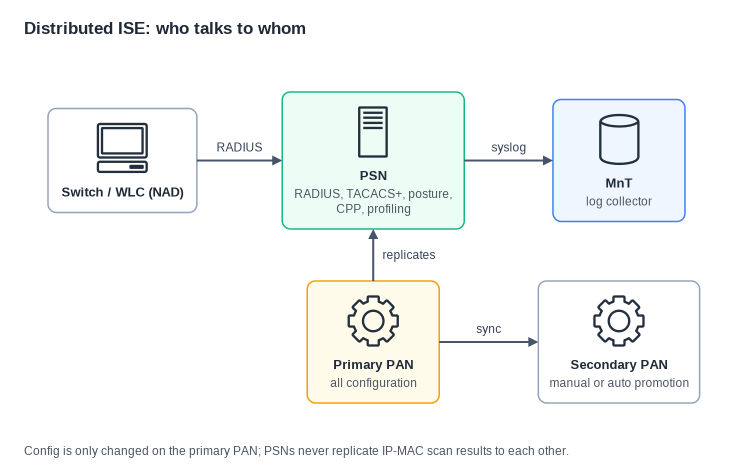
A Cisco ISE node can assume the Administration, Policy Service, or Monitoring personas. Gatekeeping is not a persona.
| Persona | Role |
|---|---|
| Administration (PAN) | All configuration; primary and secondary PAN for high availability |
| Policy Service (PSN) | Network access, posture, guest, client provisioning, profiling (RADIUS, TACACS+ with Device Admin service) |
| Monitoring (MnT) | Log collector; stores log messages from the PANs and PSNs |
| pxGrid | Shares session context with ecosystem partners |
- Enable Session Services = network access, posture, guest and client-provisioning services. Client provisioning (supplicant profiles) traffic therefore originates from the PSN.
- Cisco recommends not enabling Monitoring and Policy Service on the same node.
- A standalone node runs all default personas and you cannot edit its personas or services.
Deployment models
| Model | Content |
|---|---|
| Standalone / small | All personas (PAN, MnT, PSN, pxGrid) on one node, or a pair for redundancy. Small: up to 50,000 concurrent sessions |
| Split | Admin + Monitoring on one node, Policy Service on others; the AAA load is split between primary and secondary, each able to take the full AAA load |
| Medium | PAN/MnT/pxGrid on redundant pair, PSNs dedicated; up to 150,000 sessions; today up to six PSNs (five in older releases) |
| Large / fully distributed | PAN, MnT, PSN and pxGrid each on dedicated nodes (up to 50 PSNs) |
- PSN redundancy = node group (PSNs in the same LAN or behind a load balancer); if one member fails, the others detect it and reset URL-redirected sessions (CoA).
- The RADIUS server list on the NAD provides NAD-side failover, not PSN redundancy within ISE.
Building and changing a deployment
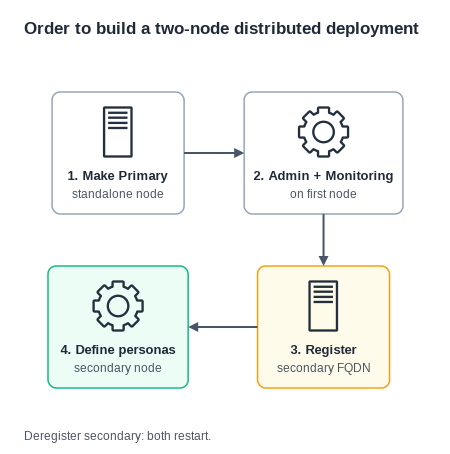
- Make the first node primary PAN, enabling Administration and Monitoring.
- Register the second node (DNS-resolvable FQDN), then define its personas.
- Nodes registered must trust each other's admin certificates; the node status can show "unreachable on port 443".
- When registering a secondary PAN with the internal CA, back up the ISE CA certificates and keys from the primary PAN and restore them on the secondary (
application configure ise→ export/import internal CA store). - Deregister: only secondary nodes; they become standalone; with two nodes both restart. You cannot deregister a primary PAN (button greyed out).
- When the primary PAN is down and the secondary is not yet promoted: AD RADIUS authentication and posture continue; flows for device registration (Hotspot, BYOD with internal CA, CWA with auto device registration) and new guest are unavailable.
Certificates and misc.
- Replace self-signed certs: generate a CSR, submit it to the CA, bind the signed cert.
- Certificate Provisioning Portal, single certificate without CSR: enter the Common Name and choose a certificate template.
- Switch:
ip http serveris needed for web authentication redirection (HTTPS interception is separate). - TrustSec: ingress tagging, egress enforcement (SGACL matrix).
- Profiling in a distributed deployment: IP-MAC bindings and scans are local to a PSN; the Endpoint Attribute Filter reduces replication load.
Sizing and drag-drop recap
- Small ≤ 50,000 concurrent sessions; medium ≤ 150,000; large > 150,000.
- Dedicated PSN for RADIUS + TACACS+: Policy Service persona only, with Session Services and Device Admin Service enabled.
- Order: make primary (Administration + Monitoring) → register secondary → define its personas.
Exam traps
- "Split" deployment = AAA workload split between nodes; "dispersed" distractors.
- Medium deployment PSN max: five in the older answer key, six in current docs.
- The MnT, not the PAN or PSN, collects syslog from PSNs.
- Secondary PAN is not promoted automatically unless auto-failover is configured with health check nodes.