Exams / CSCO-300-710 / D1 Configuration
D1.1
Configuration (part 1 of 6)
- Exam domain: Configuration
You are reading a free preview. The rest of the CSCO-300-710 course unlocks with an Exam pass or All access.See plans
Interfaces and firewall modes
| Type | Key facts |
|---|---|
| Routed mode | "In routed mode, the Firewall Threat Defense device is considered to be a router hop in the network." |
| Transparent mode | Bridge groups with a BVI; the BVI needs an IP address on the member subnet. |
| IRB | Bridge groups inside routed mode; the device routes between BVIs and regular routed interfaces. |
| Inline set | IPS-only interface; firewall mode does not affect it. |
| Tap mode | FTD inline, traffic flow undisturbed. |
| Passive / ERSPAN | SPAN or mirror port; ERSPAN needs a Flow ID (1-1023) and a Source IP, and routed firewall mode. |
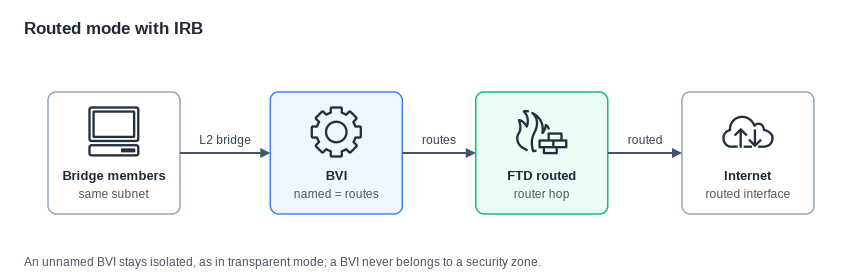
BVI rules: IPv4 address required to pass traffic; cannot be added to a security zone; in routed mode a named BVI participates in routing, an unnamed one stays isolated as in transparent mode.
Where things are configured
| Need | Where |
|---|---|
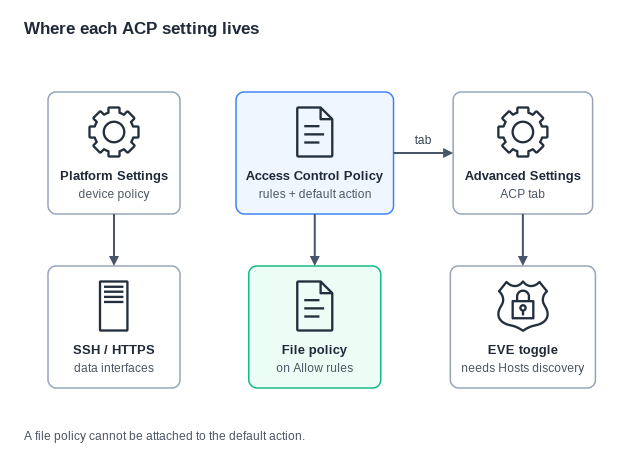
| SSH / HTTPS on data interfaces | Platform Settings policy |
| Disable response pages and interactive blocking | ACP HTTP Responses = None |
| Warn but allow | Interactive Block rule + Interactive Block Response Page |
| EVE | ACP Advanced Settings > Encrypted Visibility Engine toggle |
| Malware blocking | File policy attached to an access control rule |
| Rate limiting | QoS rule: Apply QoS On interfaces, download/upload limit in Mbits/s |
| Time-limit then bypass detection | Automatic Application Bypass |
| Inline overload fail-open | Snort Fail Open (Busy/Down) |
Policies and high availability
- Intrusion policies: Balanced Security and Connectivity (default, speed + detection), Connectivity Over Security, Security Over Connectivity, Maximum Detection.
- FTD HA peers: same number and types of interfaces, same NTP configuration, no DHCP or PPPoE on interfaces.
- Port objects represent TCP/UDP, ICMP/ICMPv6 and other protocols that do not use ports.
- Native dynamic routing: OSPF and BGP (EIGRP/IS-IS need FlexConfig).
- Correlation rules use a connection tracker to follow connections after the initial criteria match.
- AMP for Endpoints: a Simple Custom Detection list blocks files by SHA-256; Spero Analysis applies to MSEXE files.
Exam traps
- BVI is never in a security zone, and unnamed means isolated.
- DHCP/PPPoE on an interface prevents HA.
- A file policy cannot be attached to the default action.
- Interactive Block (click-through) differs from Block Response Page.
- "Tap" vs "passive": tap is inline copy; passive uses SPAN/ERSPAN.
- Speed/duplex default to auto-negotiate; the bank still treats them as the routed-interface settings.
Docs
- https://docs.manage.security.cisco.com/cdfmc/t_configure_the_bvi.html
- https://docs.manage.security.cisco.com/cdfmc/t_choosing_http_response_pages.html
- https://docs.manage.security.cisco.com/cdfmc/c_port_objects.html
- https://docs.manage.security.cisco.com/cdfmc/c_system-provided_network_analysis_and_intrusion_policies_snort3.html
- https://www.cisco.com/c/en/us/td/docs/security/secure-firewall/management-center/device-config/770/management-center-device-config-77/get-started-tfw.html
- https://www.cisco.com/c/en/us/td/docs/security/secure-firewall/management-center/device-config/760/management-center-device-config-76/interfaces-settings-ifcs-ips.html
- https://www.cisco.com/c/en/us/td/docs/security/secure-firewall/management-center/device-config/100/management-center-device-config-10-0/ha-scale-high-availability.html
- https://www.cisco.com/c/en/us/td/docs/security/secure-firewall/management-center/device-config/770/management-center-device-config-77/advanced-access-file.html