Exams / CSCO-300-620 / D1 ACI Management
D1.1
ACI Management (part 1)
- Exam domain: ACI Management
You are reading a free preview. The rest of the CSCO-300-620 course unlocks with an Exam pass or All access.See plans
Backup, export and import
| Item | What to remember |
|---|---|
| Export policy | Creates the backup (XML or JSON), as a one-time or recurring snapshot; remote protocols include SCP (encrypted over SSH) and FTP |
| Snapshot | Stored on the APIC; recurring snapshots are saved under Admin > Import/Export > Export Policies > Configuration > defaultAuto |
| Global AES encryption | Without it, no secure properties (passwords, keys) are exported; with it, they are encrypted with AES-256 from a passphrase |
| Import modes | Merge or Replace; importMode=atomic + importType=replace = Atomic Replace (overwrites the whole configuration) |
| Local snapshot | Can be restored with no external connectivity |
"As of release 1.1(2), the secure properties of APIC configuration files can be encrypted by enabling AES-256 encryption." "The option for that is called an Atomic Replace."
Contracts, scope and VRF enforcement
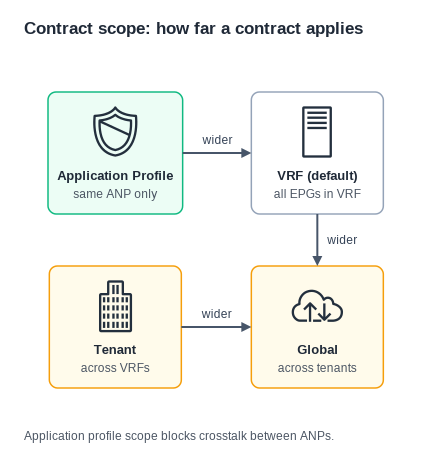
- Application Profile scope: rules only between EPGs of the same application profile; reuse across profiles gives no crosstalk.
- VRF (default): crosstalk allowed between profiles in the same VRF. Different profiles/VRFs need tenant or global scope.
- Unenforced VRF (Policy Control Enforcement = Unenforced): all EPGs in the VRF talk freely, no contracts.
- A service graph is attached to a contract (subject); L4-L7 function type: GoThrough = transparent, GoTo = routed.
- Filter entry: Name and EtherType are the base; ARP flag, IP protocol, ports are optional matches.
Faults, events, audit
| Need | Where |
|---|---|
| Who changed configuration | Audit log (user actions) |
| Hide a fault code | Right-click fault > Ignore Fault (creates a squelch / fault severity assignment policy) |
| Hide an event | Event Severity Assignment Policy, severity squelched |
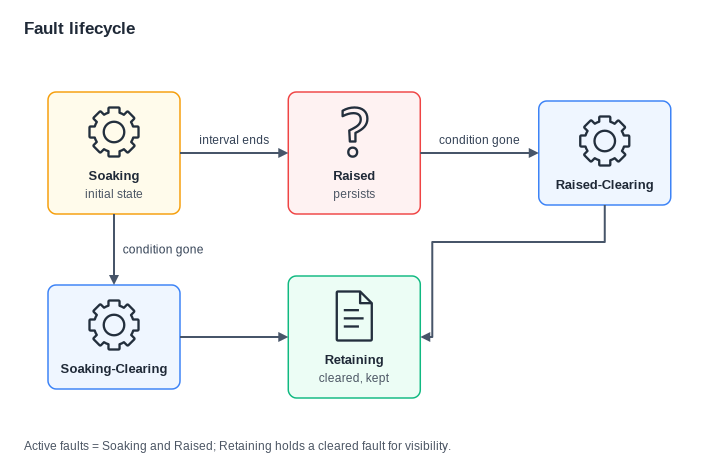
| Active faults | Soaking + Raised |
| Stats thresholds | Rising: Reset value cannot be greater than Set value |
| Tenant quota | Fabric > Fabric Policies; Exceed Action Fail Transaction (error 400) vs Raise Fault |
| Hardware syslog | Default fabric monitoring policy uni/fabric/monfab-default (monFabricPol) |
Management access
- OOB management: out-of-band EPG + OOB contract; the contract must permit the traffic (SNMP traps use UDP 162).
- Leaf/spine mgmt0 addresses come from a node management addresses policy (mgmt tenant).
- VMM domain uses a dynamic VLAN pool;
resource-pool-consumedfault F3222 means the pool is nearly used: expand it. - AAEP ties interface policy groups to domains and VLAN pools.
Exam traps
- Exports without global AES silently lose passwords.
- Fail Transaction rejects creation; Raise Fault creates the object and shows a fault.
- Event squelching is under Event policies, not Fault ones.
- VRF scope is wider than application profile scope.
- Audit log = user actions; event log = system events.
Docs
- https://www.cisco.com/c/en/us/td/docs/switches/datacenter/aci/apic/sw/kb/b_KB_Using_Import_Export_to_Recover_Config_States.html
- https://www.cisco.com/c/en/us/td/docs/switches/datacenter/aci/apic/sw/2-x/KB/b_Cisco_APIC_Quota_Management_Configuration.html
- https://www.cisco.com/c/en/us/td/docs/switches/datacenter/aci/apic/sw/all/faults/guide/b_APIC_Faults_Errors/b_IFC_Faults_Errors_chapter_01.html
- https://www.cisco.com/c/en/us/td/docs/switches/datacenter/aci/apic/sw/all/faults/guide/b_APIC_Faults_Errors/b_IFC_Faults_Errors_chapter_010.html
- https://www.cisco.com/c/en/us/products/collateral/networking/cloud-networking/application-centric-infrastructure/contract-guide.html
- https://www.cisco.com/c/en/us/td/docs/dcn/aci/apic/6x/system-management-configuration/cisco-apic-system-management-configuration-guide-60x/process-statistics-60x.html