Exams / CSCO-300-435 / D1 Controller-Based Network Automation
Controller-Based Network Automation (part 1 of 3)
- Exam domain: Controller-Based Network Automation
Controller REST APIs: common pattern
All controllers in this chapter (Cisco Catalyst Center, Catalyst SD-WAN Manager/vManage, Meraki Dashboard) are driven by HTTPS REST calls with JSON bodies. The exam asks you to complete scripts, so know the authentication header and the verb for each controller.
| Controller | Authentication | Header carrying the credential |
|---|---|---|
| Catalyst Center (DNA Center) | POST /dna/system/api/v1/auth/token with Basic auth, returns Token |
x-auth-token |
| SD-WAN Manager (vManage) | POST /j_security_check (form fields j_username, j_password), then GET /dataservice/client/token |
Cookie (session) + X-XSRF-TOKEN |
| Meraki Dashboard | static API key | X-Cisco-Meraki-API-Key |
Python requests: requests.request('DELETE', url, headers=headers, data=payload) is the generic form; requests.post(..., json=dict) serialises a dict (curly braces, quoted keys) to a JSON body.
Cisco Catalyst Center
- Assurance: the data sheet says it will "Enable every point on the network to become a sensor, sending continuous streaming telemetry on application performance and user connectivity in real time."
- Intent API base path:
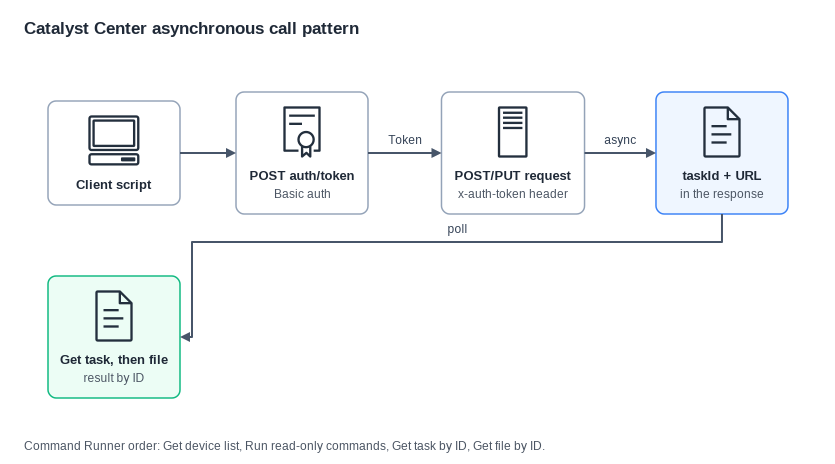
/dna/intent/api/v1/...; token path is under/dna/system/.... - Operations are asynchronous: the POST/PUT response carries a task ID and a status URL; you query the task, and for Command Runner you then fetch the file.
- Command Runner order: Get device list → Run read-only commands on devices → Get task by ID → Get file by ID.
- Device sync:
PUT /dna/intent/api/v1/network-device/sync(Sync Devices, optionalforceSync); the exam also acceptsPUT /dna/intent/api/v1/network-device. - Site health:
GET /dna/intent/api/v1/site-health?timestamp=<epoch ms>. - PnP import:
POST /dna/intent/api/v1/onboarding/pnp-device/import. - SD-Access fabric creation takes a JSON object such as
{"fabricName": "..."}. - Events: you can subscribe an event to a REST API endpoint (webhook), e-mail or SNMP trap. The ITSM bundles (CMDB sync, Network Issue Monitor and Enrichment, SWIM Events) are ServiceNow workflows; the exam answer for forwarding events to a REST endpoint is "Network Events for REST API Endpoint".
SD-WAN Manager (vManage)
- Session:
/j_security_check→/dataservice/client/token→ sendCookieandX-XSRF-TOKENon every call. - Responses wrap results in
{"data": [...]}; in Python index lists with integers and keys with quoted strings:d["data"][0]["host-name"]. - Template attach:
POST /dataservice/template/device/config/attachfeature, device entry hascsv-status: complete,Content-Type: application/json. - Certificate Management API: generates a CSR (certificate signing request).
- Debug cues: a typo in the path (
/dataservice/even) returns a non-JSON error andresponse.json()raisesJSONDecodeError; a wrong query string (port_stats?deviceId=deviceId=...) makes the call fail with "Failed to get error statistics".
Meraki Dashboard API
| Task | Call |
|---|---|
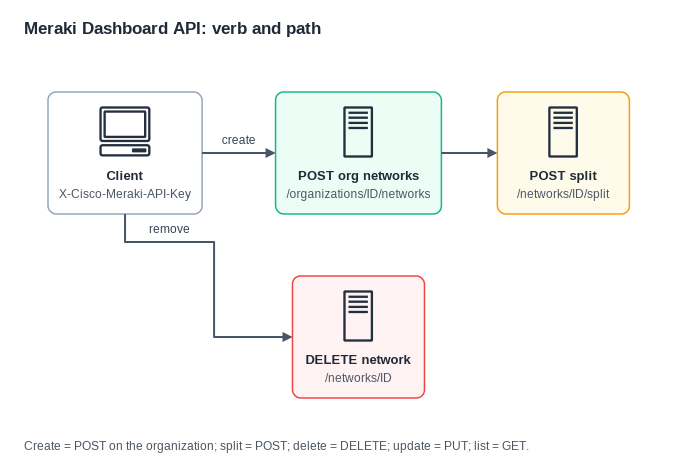
| List networks | GET /organizations/{organizationId}/networks |
| Create network | POST /organizations/{organizationId}/networks (body: name, productTypes, tags, timeZone) |
| Split network | POST /networks/{networkId}/split |
| Delete network | DELETE /networks/{networkId} |
| Alert settings | PUT /networks/{networkId}/alertsSettings |
| VLAN settings / VLAN | PUT /networks/{id}/appliance/vlans/settings, PUT .../appliance/vlans/20 |
| Firmware | SDK dashboard.networks.updateNetworkFirmwareUpgrades(network_id, products={switch: {nextUpgrade: {time, toVersion}}}) |
Webhooks deliver alert events (for example settings changed) to a receiver you configure. In Ansible use the uri module with url, method, body_format: json.
Model-driven telemetry
For an on-change subscription, "the dampening period must be set to 0 to indicate that there is no dampening period". The IOS XE guide documents this for yang-push; on-change updates are sent only when the monitored data changes.
YANG tree reading: a path is the chain of containers/lists down to the leaf, e.g. vlans/vlan/interfaces/interface/name.
Synchronous vs asynchronous calls
Synchronous calls block until the server replies and can add perceived latency; asynchronous calls do not block.
Exam traps
- Create a Meraki network on the organization path with POST;
/networks/{id}is for update (PUT) and delete. x-auth-token(Catalyst Center) is notAuthorizationand notX-Auth-Tokenin the expected answers.- A Catalyst Center POST answers with a task ID and URL, not the final data.
- vManage needs both the session cookie and
X-XSRF-TOKEN. - On-change subscriptions require dampening period
0. - Several bank questions have flawed options (invalid Python in 050, odd wording in 001/039/052); pick the closest official answer.