Exams / CSCO-300-420 / D1 Network Services
D1.1
Network Services (part 1)
- Exam domain: Network Services
You are reading a free preview. The rest of the CSCO-300-420 course unlocks with an Exam pass or All access.See plans
Management network design
| Model | Idea | Exam hint |
|---|---|---|
| Out-of-band (OOB) | Dedicated management path, logically/physically isolated from managed devices | Stays reachable during a production outage; restrict with VTY ACLs, isolated VRF |
| In-band | Management shares the production network | Cheaper, but lost with the production network |
- Best practices: isolation and access control (authorized users only, restrictive VTY ACL).
- OOB is not a backup data path and is not for data backups.
QoS: shaping, policing, WRED, classification
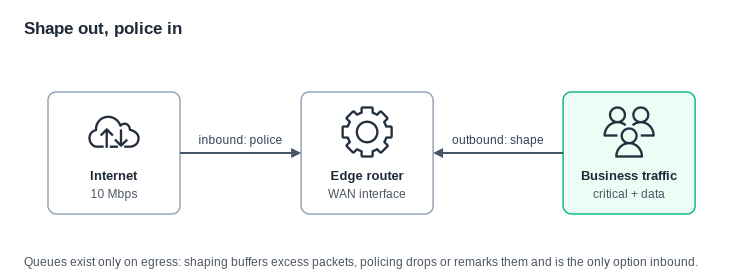
| Mechanism | Behavior | Direction |
|---|---|---|
| Shaping | Delays excess traffic using a buffer/queue | Outbound only (queues are egress) |
| Policing | Drops or remarks excess traffic | Inbound or outbound |
| WRED | Drops selectively by IP precedence/DSCP as the queue fills | Output interface |
| Class selector (CS) | DSCP xxx000, backward compatible with IP Precedence |
Marking |
| NBAR / NBAR2 | Classifies by application or protocol, not just ports | Classify at the access edge |
- QoS cannot create bandwidth: with persistent congestion add EtherChannel members or faster uplinks.
- Trust DSCP on inter-switch links; use conditional trust only for phones.
Spanning tree
- PortFast brings an access port connected to a single workstation or server straight to forwarding. Use it on host ports only (also for WoL clients), never on switch uplinks.
Multicast
| PIM mode | Key fact |
|---|---|
| BIDIR-PIM | Shared tree only, no RPF check, Designated Forwarder election, no source trees |
| MSDP (RFC 3618) | Connects RPs of different PIM-SM domains (inter-AS source discovery) |
SD-Access fabric
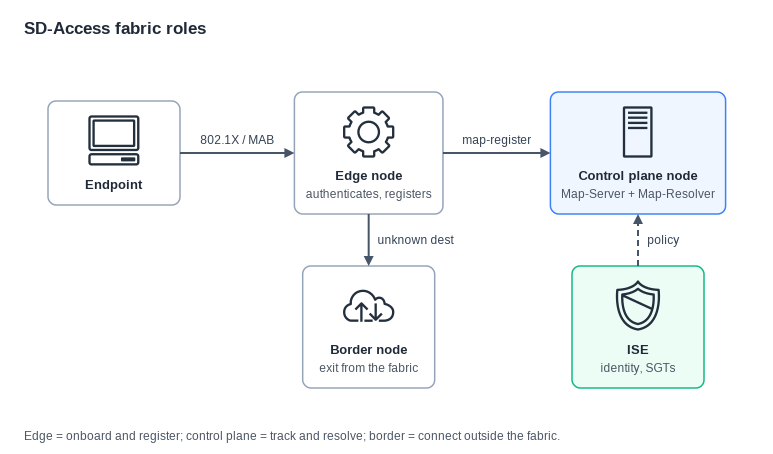
| Element | Role |
|---|---|
| Edge node | Onboards endpoints (802.1X/MAB) and registers them with the control plane via LISP map-register |
| Control plane node | LISP Map-Server (registrations) + Map-Resolver (lookups) |
| Border node | Gateway between the fabric and outside networks |
| VN | Macro-segmentation |
| Scalable group (SGT) | Micro-segmentation inside a VN |
| ISE | Core SD-Access component for identity and SGTs; mandatory for identity-based micro-segmentation |
Addressing and routing topics
| Topic | Rule |
|---|---|
| IS-IS IPv6 | Identical topology and levels -> single topology (no transition); transition only to migrate |
| Stateful NAT64 | Many-to-one PAT; use when IPv6 hosts outnumber IPv4 addresses |
| Stateless NAT64 | One-to-one mapping |
| NAT-PT | Deprecated; dynamic mode: pool size caps concurrent sessions |
| HSRPv2 | IPv6 support and MD5 authentication |
| Seamless MPLS | BGP labeled unicast between PEs and ABRs + MP-BGP VPNv4 on PEs |
| SD-WAN OMP service routes | Advertise services (firewall, IDS) for service insertion |
Exam traps
- Inbound traffic cannot be shaped, only policed.
- PortFast speeds convergence; BPDU guard only protects.
- BIDIR-PIM is the only mode with shared tree only.
- Control plane node = Map-Server + Map-Resolver, not ETR/ITR.
- Edge authenticates/registers; the control plane tracks and resolves; the border exits.
- NAT-PT is deprecated, but older items still expect dynamic NAT-PT.
Docs
- https://www.cisco.com/c/en/us/solutions/collateral/service-provider/out-of-band-best-practices-wp.html
- https://www.cisco.com/c/en/us/support/docs/quality-of-service-qos/qos-policing/19645-policevsshape.html
- https://www.cisco.com/c/en/us/td/docs/routers/ios-xe/quality-of-service/quality-of-service/m_qos-plcshp-oview-0.html
- https://www.cisco.com/c/en/us/td/docs/switches/lan/catalyst9600/software/release/17-14/configuration_guide/lyr2/b_1714_lyr2_9600_cg/configuring_optional_spanning_tree_features.html
- https://www.cisco.com/c/en/us/td/docs/solutions/CVD/Campus/cisco-sda-design-guide.html
- https://www.cisco.com/c/en/us/td/docs/ios-xml/ios/ipmulti_pim/configuration/xe-3s/asr903/17-1-1/b-imc-pim-xe-17-1-asr900/m-bidirectional-pim.html
- https://www.cisco.com/c/en/us/td/docs/ios/ios_xe/ipv6/configuration/guide/ip6-nat_trnsln_xe.html