Exams / CSCO-300-415 / D1 Security and Quality of Service
D1.1
Security and Quality of Service (part 1)
- Exam domain: Security and Quality of Service
You are reading a free preview. The rest of the CSCO-300-415 course unlocks with an Exam pass or All access.See plans
Control plane and monitoring basics
| Item | Fact |
|---|---|
| vdaemon | Daemon on each vSmart controller and router that creates and maintains the secure DTLS/TLS connections; OMP runs inside them |
| BFD | Detects link failures and measures latency, loss and jitter used by application-aware routing |
| Underlay reachability | A WAN Edge needs IP reachability (IGP/static) to controllers before control connections can form |
| Control connection errors | LISFD = listener socket error, most common cause a duplicate transport IP; CRTREJSER = serial number not on controllers, or wrong Product ID (model) in the PnP portal |
| UDP port offset | Source ports 12346+n, 12366+n, ... where n is 0-19 (0 = default) |
| Syslog severity | Alert = action must be taken immediately (severity 1); Critical is lower |
| SNMP user | Name 1-32 characters |
show bfd tloc-summary-list |
BFD session summary per TLOC (vEdge only) |
| OMP graceful restart | IPsec rekey time must be at least twice the OMP graceful-restart timer (24 h -> 48 h minimum) |
Enterprise Firewall with application awareness
- Zone-based model; a firewall policy allows stateful inspection of TCP, UDP and ICMP.
- A zone pair associates a source zone with a destination zone and applies the policy to traffic between them.
- Actions:
inspect(stateful, sessions tracked, return traffic allowed),pass(no inspection),drop. - Benefit highlighted by Cisco: application visibility and granular control.
- vEdge advanced security: Enterprise Firewall and Umbrella DNS security. AMP/Threat Grid, Snort IPS and URL filtering are IOS XE (UTD) features.
| Need | Solution |
|---|---|
| Malware file reputation + sandbox | AMP and Threat Grid |
| DNS-layer security in cloud | Umbrella DNS security |
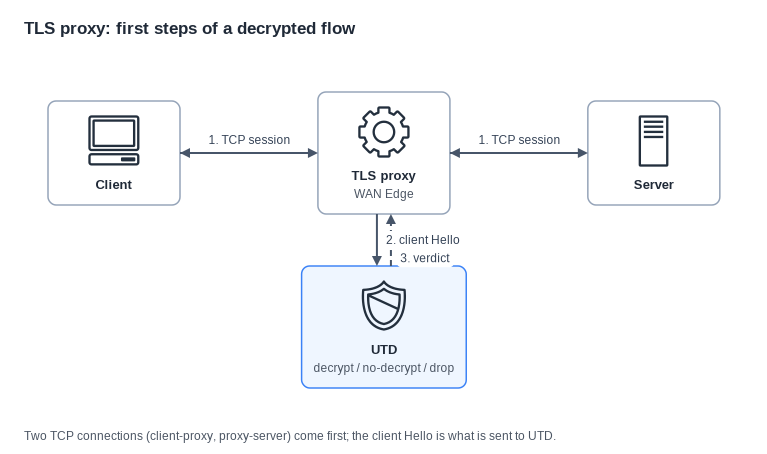
| Decrypt TLS for UTD inspection | TLS/SSL proxy |
QoS and policing
- Queue 0 is reserved for control traffic and low-latency queuing (LLQ).
policy cloud-qosenables QoS scheduling for traffic received from transport side;cloud-qos-service-sideis separate.- Shaping (egress, queues excess) matches a contracted rate, e.g.
shape average 80000000outbound on the ISP-facing interface; policing drops or remarks. - Policer
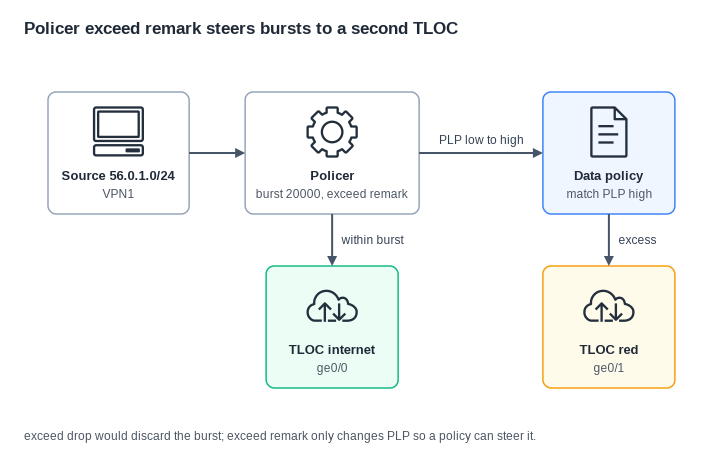
exceed remarkchanges PLP low to high so a data policy can redirect the burst.
Other points
- VRRP prefix-list tracking: tracks OMP plus remote prefixes; loss of the prefixes causes immediate failover.
- Multicast: IGMP on the service side lets hosts join groups; PIM is configured on participating interfaces.
- Data policy:
protocol 1= ICMP (58 is ICMPv6, 2 is IGMP).
Exam traps
- TLS proxy: the TCP connections (client-proxy, proxy-server) come before the client Hello is sent to UTD.
- BFD, not OMP, measures loss/latency/jitter.
- Alert vs critical: "immediate action" = alert.
exceed dropvsexceed remark: only remark allows redirection.- Port offset range is 0-19.
- Rekey must be at least 2x the graceful restart value.