Exams / CSCO-300-410 / D1 VPN Technologies
D1.1
VPN Technologies (part 1 of 3)
- Exam domain: VPN Technologies
You are reading a free preview. The rest of the CSCO-300-410 course unlocks with an Exam pass or All access.See plans
VRF-lite and MPLS Layer 3 VPN
VRF-lite gives a router several isolated routing tables so that "IP addresses can be overlapped among" customers. In a full MPLS L3 VPN the PE router adds BGP signalling on top of the VRFs.
| Element | Role | Configured with |
|---|---|---|
| VRF | Separate routing/forwarding table per customer | ip vrf / ip vrf forwarding |
| RD (route distinguisher) | 8-byte value prepended to the IPv4 prefix → unique VPNv4 prefix; makes overlapping customer space unique | rd 1:1 |
| RT (route target) | BGP extended community that controls which VRFs import a route | route-target import/export/both |
| MP-BGP (VPNv4 family) | Carries VPNv4 routes between PEs | address-family vpnv4 |
| LDP / LSP | Label path between PEs; must exist for VPN traffic to cross the core | mpls ldp |
| RSVP | Label distribution for MPLS traffic engineering | MPLS-TE |
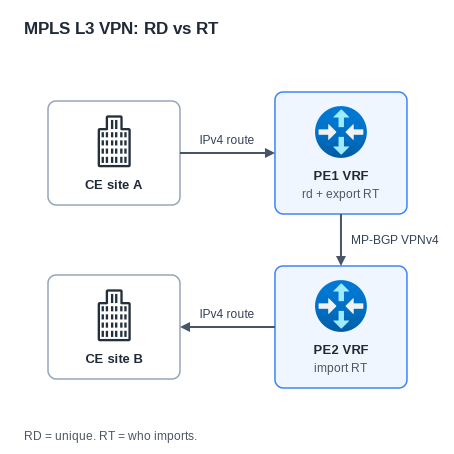
- A route is imported into a VRF only if it carries one of that VRF's import RTs.
- Full-mesh single-customer VPN: the same RT is used (export and import) on all VRFs, so the RT is identical for the whole VPN. A hub-and-spoke design would use different RTs.
- RDs may differ per PE (e.g.
rd 1:1andrd 1:2) while the RTs match (route-target both 1:1) — RT, not RD, links the sites (question 001). - CE devices only run an ordinary routing protocol with the PE; they know nothing of RD or VPNv4.
DMVPN
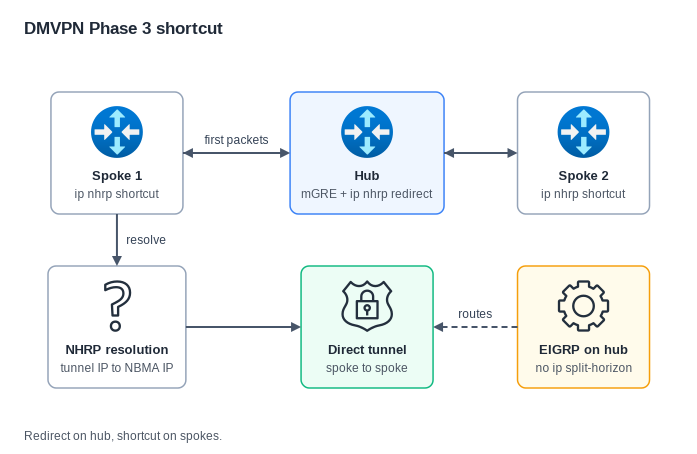
DMVPN = mGRE tunnel + NHRP + IPsec (+ a routing protocol). The hub uses tunnel mode gre multipoint so new spokes can be added without touching the hub; spokes register with ip nhrp nhs and a static ip nhrp map of the hub's tunnel IP to its NBMA (public) IP.
| Phase | Behaviour | Key commands |
|---|---|---|
| 1 | Hub-and-spoke only | spokes may use point-to-point GRE |
| 2 | Spoke-to-spoke, spokes keep the real next hop | mGRE on spokes; hub: no ip next-hop-self eigrp, no ip split-horizon eigrp |
| 3 | Hub sends NHRP redirect; spokes install shortcut routes | hub: ip nhrp redirect; spokes: ip nhrp shortcut |
- Reading
show dmvpn: the Peer NBMA Addr column is the WAN/underlay address; Peer Tunnel Add is the overlay address; attributeS= static,D= dynamic (question 007). - EIGRP on the hub: split horizon on the mGRE interface stops routes learned from one spoke being advertised to the others, so use
no ip split-horizon eigrp <as>on the tunnel interface (not the physical one). - OSPF (broadcast network type): hub priority > 1 (e.g. 2), spokes priority 0 so the hub is DR. OSPF has no split-horizon problem.
- MTU:
ip mtu 1400andip tcp adjust-mss 1360cover common GRE + IPsec overhead. - IPv6 over DMVPN: dual-stack spokes; transport can be IPv4 or IPv6.
- 2547oDMVPN segments VPN traffic inside a DMVPN tunnel using MPLS (VRF-integrated DMVPN).
Plain GRE tunnels
A GRE tunnel's tunnel source / tunnel destination are the provider-reachable (outer) addresses; the inner addresses on the tunnel interface are the overlay. Lower ip mtu (1400) to leave room for GRE (and IPsec) overhead.
Exam traps
- RD ≠ RT: RD = uniqueness of the prefix; RT = distribution/import-export policy (question 222 wants RT communities).
- RT must be identical (not "unique") across a single-customer full mesh.
- Overlapping prefixes: RD; VPN membership → RT; transport of VPNv4 → MP-BGP.
- DMVPN Phase 3 needs both
redirect(hub) andshortcut(spokes). no ip split-horizon eigrpgoes on the hub's tunnel interface.- An mGRE hub uses
tunnel mode gre multipoint, nottunnel destination. - BGP synchronization (enabled by default on old IOS) blocks iBGP routes not present in the IGP:
no synchronization. - SNMP: informs = reliable (acknowledged);
priv= encryption;authonly authenticates.
Docs
- Cisco: Dynamic Multipoint VPN Configuration Guide (15M&T)
- Cisco: Dynamic Multipoint IPsec VPNs (DMVPN)
- Cisco: Shortcut Switching Enhancements for NHRP in DMVPN Networks
- Cisco: Troubleshoot DMVPN Phase 3 NHRP Redirect Issues
- Cisco: Configuring VRF-lite
- Cisco: Multiprotocol BGP MPLS VPN
- Cisco: Implementing MPLS Layer 3 VPNs
- Cisco: MPLS Layer 3 VPN (Catalyst 9000)
- Cisco: Resolve IPv4 Fragmentation, MTU, MSS, and PMTUD Issues with GRE and IPsec
- Cisco: Troubleshoot BGP Routes That Do Not Advertise
- Cisco: SNMP configuration (Catalyst 9000)
- Cisco: IPv6 over DMVPN