Exams / CSCO-300-120 / D1 QoS on a Wireless Network
D1.1
QoS on a Wireless Network (part 1 of 2)
- Exam domain: QoS on a Wireless Network
You are reading a free preview. The rest of the CSCO-300-120 course unlocks with an Exam pass or All access.See plans
Why wireless QoS is different
Wi-Fi is a shared half-duplex medium: stations contend with CSMA/CA (collision avoidance, because WLANs use "collision avoidance (CA)" instead of collision detection). Only one station can transmit on a channel at a time, and unicast frames are acknowledged (an ACK; no ACK = retransmit). Without WMM every packet gets the same priority in DCF; WMM (the Wi-Fi Alliance subset of 802.11e) adds EDCA.
| Concept | What to remember |
|---|---|
| EDCA access categories | 4: AC_VO (voice), AC_VI (video), AC_BE (best effort), AC_BK (background) |
| AIFSN / CWmin / CWmax | How long a station waits and how large its random backoff is (smaller = higher priority) |
| TXOP | How long a station may keep transmitting after winning the medium |
| TSpec | Client signals its traffic needs to the AP: the basis of Call Admission Control (CAC) |
| 802.11e UP 6 | Voice (AC_VO). UP 5 = video. Over-the-air Cisco now recommends trusting DSCP end to end |
| DIFS | SIFS + 2 slots = 16 + 2×9 = 34 µs (OFDM, 9 µs slot) |
AireOS QoS profiles
Four profiles: Platinum/Voice, Gold/Video, Silver/Best Effort (default), Bronze/Background. Each is a ceiling for the WLAN.
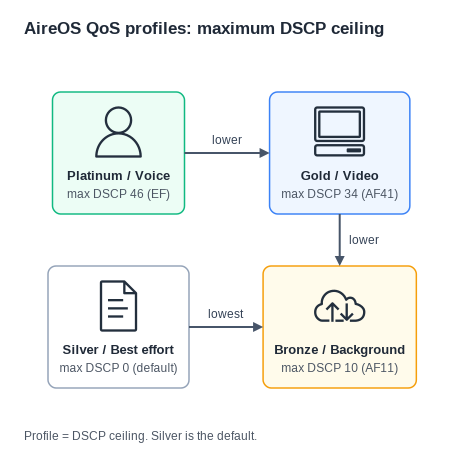
- Bandwidth contracts (average/burst, TCP data and UDP real-time) are set per user (client) and per SSID, upstream and downstream. Not per VLAN.
- Fastlane QoS: Apple clients running iOS 10 or higher.
- AVC (Application Visibility and Control) = DPI/NBAR2 classification; actions are drop, mark, police/rate-limit. The WLAN Application Visibility setting recognizes traffic; the AVC Profile holds the rules (mark = prioritize). Weighted Tail Drop is a queue mechanism, not an AVC action.
- Catalyst 9800 AutoQoS matches traffic and assigns each packet to qos-groups; the output policy maps qos-groups to queues (incl. priority queue). Its predefined profiles can be modified. Guest template = best effort.
WMM policy on a WLAN
| Setting | Effect |
|---|---|
| Disabled | WMM not used; max usable rate 54 Mbps (no 802.11n/ac rates) |
| Allowed | WMM clients may use it; non-WMM clients can connect but do not get 802.11n rates |
| Required | Clients must support WMM or cannot join |
(On 802.11ax APs, WMM cannot be disabled.)
Switch trust model
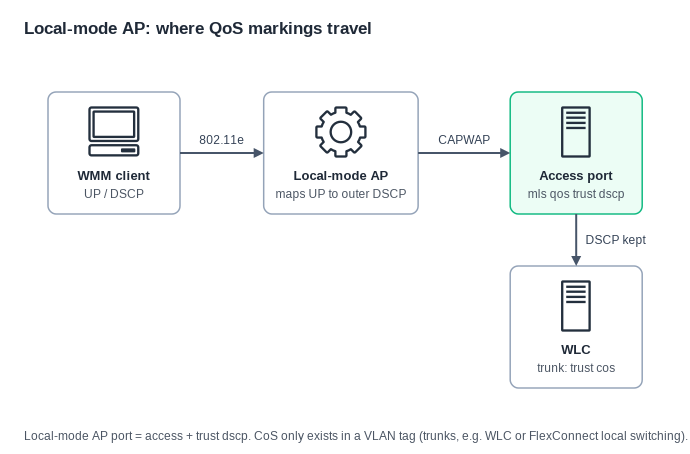
| Port connects to | Configuration |
|---|---|
| Local-mode AP, FlexConnect AP with no locally switched WLAN | access port, mls qos trust dscp |
| WLC | trunk, mls qos trust cos (if relying on CoS) |
| FlexConnect AP with a locally switched WLAN | trunk, mls qos trust cos |
CoS (802.1p) sits in the 802.1Q tag, so it exists only on tagged links.
RF design for voice
- Cell edge about -67 dBm, SNR at least 25 dB; design for call capacity per AP.
- Raise the minimum mandatory data rate (e.g. 12 Mbps) to shrink cells and save airtime.
- DFS channels can disrupt calls (radar forces a channel change).
- SNR = RSSI - noise floor (dB). DCA fixes interference by changing channel; TPC adjusts power.
- Frequency-hopping DECT phones (SI-FHSS) cannot be fenced into a fixed channel.
Exam traps
- CSMA/CA is "Carrier Sense Multiple Access / Collision Avoidance".
- TXOP = duration; AIFSN = wait before contention.
- DSCP 34 = AF41 = video; DSCP 46 = EF = voice; Gold max 34, Bronze max 10.
- Local-mode AP port = trust dscp, not cos.
- WMM disabled to remove 802.11n rates; "allowed" still lets WMM clients use them.
- Per-client and per-SSID contracts, not per-VLAN.
- Application Visibility recognizes; AVC Profile enforces.
Docs
- https://www.cisco.com/c/en/us/support/docs/wireless-mobility/voice-over-wireless-lan-vowlan/217942-cisco-unified-wireless-qos-tech-note.html
- https://www.cisco.com/c/en/us/td/docs/wireless/controller/8-10/config-guide/b_cg810/quality_of_service.html
- https://www.cisco.com/c/en/us/td/docs/wireless/controller/8-10/config-guide/b_cg810/wireless_quality_of_service.html
- https://www.cisco.com/c/en/us/td/docs/wireless/controller/9800/26-1/configuration-guide/wl-26-1-cg/wireless-auto-qos/info-auto-qos.html
- https://www.cisco.com/c/en/us/td/docs/wireless/controller/9800/26-1/configuration-guide/wl-26-1-cg/wlans/info-abt-wlans.html
- https://www.cisco.com/en/US/docs/solutions/Enterprise/Mobility/emob30dg/Voice.html